

4.2 Soil Profile Genesis
An essential character of Brown Soils, and indeed all orders
other than Raw Soils, is the topsoil, developed from what
would have originally been a Raw Soil, by the process of
melanisation (or topsoil darkening).
Another important characteristic of Brown Soils is the
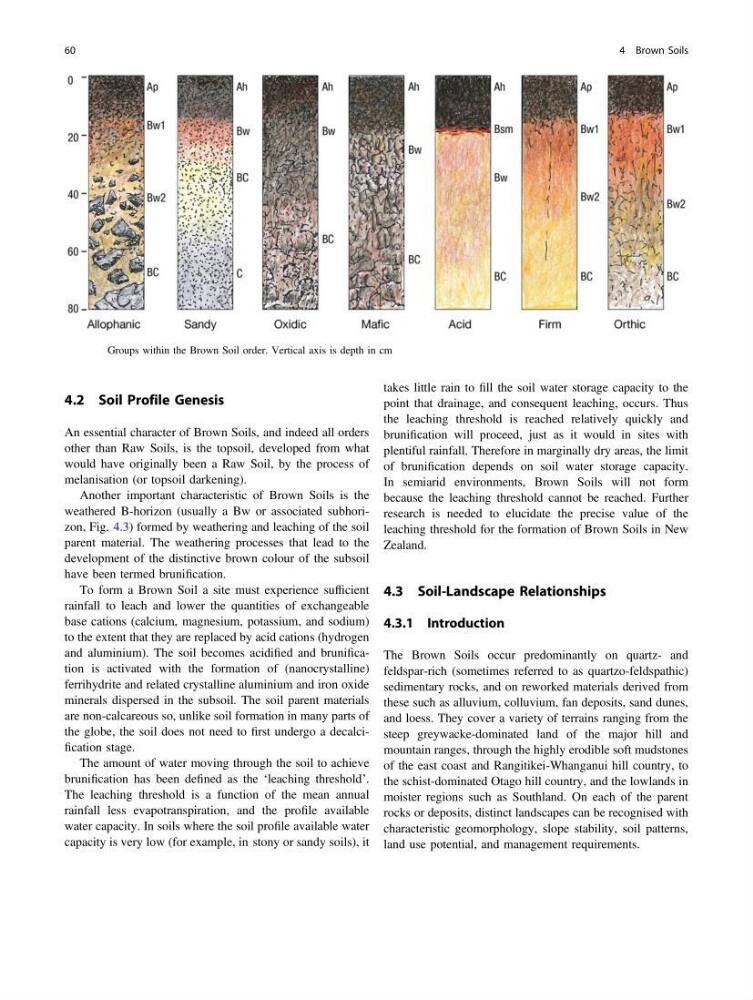
weathered B-horizon (usually a Bw or associated subhorizon, Fig. 4.3) formed by weathering and leaching of the soil
parent material. The weathering processes that lead to the
development of the distinctive brown colour of the subsoil
have been termed brunification.
To form a Brown Soil a site must experience sufficient
rainfall to leach and lower the quantities of exchangeable
base cations (calcium, magnesium, potassium, and sodium)
to the extent that they are replaced by acid cations (hydrogen
and aluminium). The soil becomes acidified and brunification is activated with the formation of (nanocrystalline)
ferrihydrite and related crystalline aluminium and iron oxide
minerals dispersed in the subsoil. The soil parent materials
are non-calcareous so, unlike soil formation in many parts of
the globe, the soil does not need to first undergo a decalcification stage.
The amount of water moving through the soil to achieve
brunification has been defined as the ‘leaching threshold’.
The leaching threshold is a function of the mean annual
rainfall less evapotranspiration, and the profile available
water capacity. In soils where the soil profile available water
capacity is very low (for example, in stony or sandy soils), it
takes little rain to fill the soil water storage capacity to the
point that drainage, and consequent leaching, occurs. Thus
the leaching threshold is reached relatively quickly and
brunification will proceed, just as it would in sites with
plentiful rainfall. Therefore in marginally dry areas, the limit
of brunification depends on soil water storage capacity.
In semiarid environments, Brown Soils will not form
because the leaching threshold cannot be reached. Further
research is needed to elucidate the precise value of the
leaching threshold for the formation of Brown Soils in New
Zealand.
4.3 Soil-Landscape Relationships
4.3.1 Introduction
The Brown Soils occur predominantly on quartz- and
feldspar-rich (sometimes referred to as quartzo-feldspathic)
sedimentary rocks, and on reworked materials derived from
these such as alluvium, colluvium, fan deposits, sand dunes,
and loess. They cover a variety of terrains ranging from the
steep greywacke-dominated land of the major hill and
mountain ranges, through the highly erodible soft mudstones
of the east coast and Rangitikei-Whanganui hill country, to
the schist-dominated Otago hill country, and the lowlands in
moister regions such as Southland. On each of the parent
rocks or deposits, distinct landscapes can be recognised with
characteristic geomorphology, slope stability, soil patterns,
land use potential, and management requirements.
Fig. 4.3 Groups within the Brown Soil order. Vertical axis is depth in cm
60
4 Brown Soils
An essential character of Brown Soils, and indeed all orders
other than Raw Soils, is the topsoil, developed from what
would have originally been a Raw Soil, by the process of
melanisation (or topsoil darkening).
Another important characteristic of Brown Soils is the
weathered B-horizon (usually a Bw or associated subhorizon, Fig. 4.3) formed by weathering and leaching of the soil
parent material. The weathering processes that lead to the
development of the distinctive brown colour of the subsoil
have been termed brunification.
To form a Brown Soil a site must experience sufficient
rainfall to leach and lower the quantities of exchangeable
base cations (calcium, magnesium, potassium, and sodium)
to the extent that they are replaced by acid cations (hydrogen
and aluminium). The soil becomes acidified and brunification is activated with the formation of (nanocrystalline)
ferrihydrite and related crystalline aluminium and iron oxide
minerals dispersed in the subsoil. The soil parent materials
are non-calcareous so, unlike soil formation in many parts of
the globe, the soil does not need to first undergo a decalcification stage.
The amount of water moving through the soil to achieve
brunification has been defined as the ‘leaching threshold’.
The leaching threshold is a function of the mean annual
rainfall less evapotranspiration, and the profile available
water capacity. In soils where the soil profile available water
capacity is very low (for example, in stony or sandy soils), it
takes little rain to fill the soil water storage capacity to the
point that drainage, and consequent leaching, occurs. Thus
the leaching threshold is reached relatively quickly and
brunification will proceed, just as it would in sites with
plentiful rainfall. Therefore in marginally dry areas, the limit
of brunification depends on soil water storage capacity.
In semiarid environments, Brown Soils will not form
because the leaching threshold cannot be reached. Further
research is needed to elucidate the precise value of the
leaching threshold for the formation of Brown Soils in New
Zealand.
4.3 Soil-Landscape Relationships
4.3.1 Introduction
The Brown Soils occur predominantly on quartz- and
feldspar-rich (sometimes referred to as quartzo-feldspathic)
sedimentary rocks, and on reworked materials derived from
these such as alluvium, colluvium, fan deposits, sand dunes,
and loess. They cover a variety of terrains ranging from the
steep greywacke-dominated land of the major hill and
mountain ranges, through the highly erodible soft mudstones
of the east coast and Rangitikei-Whanganui hill country, to
the schist-dominated Otago hill country, and the lowlands in
moister regions such as Southland. On each of the parent
rocks or deposits, distinct landscapes can be recognised with
characteristic geomorphology, slope stability, soil patterns,
land use potential, and management requirements.
Fig. 4.3 Groups within the Brown Soil order. Vertical axis is depth in cm
60
4 Brown Soils