

frost damage by absorbing heat during the day and
re-radiating it at night and the mounds themselves would
have helped to prevent frost damage through cold air flow.
Some plant nutritional benefits (e.g. K
+ ) likely arose from
the addition of burnt materials (although studies in central
New Zealand and elsewhere have shown the kumara to be
well adapted to low-nutrient sandy soil). The additions of
fresh sandy materials helped reduce disease and may have
also been part of a purification ritual. Certainly planting and
harvesting were accompanied by essential rituals and chants.
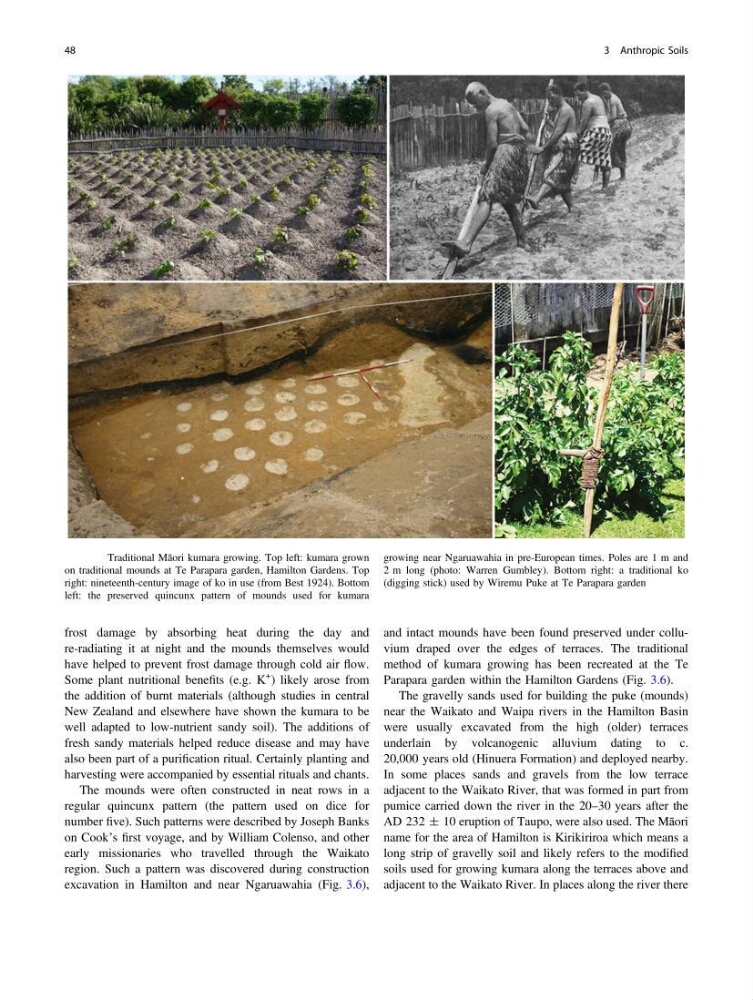
The mounds were often constructed in neat rows in a
regular quincunx pattern (the pattern used on dice for
number five). Such patterns were described by Joseph Banks
on Cook’s first voyage, and by William Colenso, and other
early missionaries who travelled through the Waikato
region. Such a pattern was discovered during construction
excavation in Hamilton and near Ngaruawahia (Fig. 3.6),
and intact mounds have been found preserved under colluvium draped over the edges of terraces. The traditional
method of kumara growing has been recreated at the Te
Parapara garden within the Hamilton Gardens (Fig. 3.6).
The gravelly sands used for building the puke (mounds)
near the Waikato and Waipa rivers in the Hamilton Basin
were usually excavated from the high (older) terraces
underlain by volcanogenic alluvium dating to c.
20,000 years old (Hinuera Formation) and deployed nearby.
In some places sands and gravels from the low terrace
adjacent to the Waikato River, that was formed in part from
pumice carried down the river in the 20–30 years after the
AD 232 ± 10 eruption of Taupo, were also used. The Māori
name for the area of Hamilton is Kirikiriroa which means a
long strip of gravelly soil and likely refers to the modified
soils used for growing kumara along the terraces above and
adjacent to the Waikato River. In places along the river there
Fig. 3.6 Traditional Māori kumara growing. Top left: kumara grown
on traditional mounds at Te Parapara garden, Hamilton Gardens. Top
right: nineteenth-century image of ko in use (from Best 1924). Bottom
left: the preserved quincunx pattern of mounds used for kumara
growing near Ngaruawahia in pre-European times. Poles are 1 m and
2 m long (photo: Warren Gumbley). Bottom right: a traditional ko
(digging stick) used by Wiremu Puke at Te Parapara garden
48
3 Anthropic Soils
re-radiating it at night and the mounds themselves would
have helped to prevent frost damage through cold air flow.
Some plant nutritional benefits (e.g. K
+ ) likely arose from
the addition of burnt materials (although studies in central
New Zealand and elsewhere have shown the kumara to be
well adapted to low-nutrient sandy soil). The additions of
fresh sandy materials helped reduce disease and may have
also been part of a purification ritual. Certainly planting and
harvesting were accompanied by essential rituals and chants.
The mounds were often constructed in neat rows in a
regular quincunx pattern (the pattern used on dice for
number five). Such patterns were described by Joseph Banks
on Cook’s first voyage, and by William Colenso, and other
early missionaries who travelled through the Waikato
region. Such a pattern was discovered during construction
excavation in Hamilton and near Ngaruawahia (Fig. 3.6),
and intact mounds have been found preserved under colluvium draped over the edges of terraces. The traditional
method of kumara growing has been recreated at the Te
Parapara garden within the Hamilton Gardens (Fig. 3.6).
The gravelly sands used for building the puke (mounds)
near the Waikato and Waipa rivers in the Hamilton Basin
were usually excavated from the high (older) terraces
underlain by volcanogenic alluvium dating to c.
20,000 years old (Hinuera Formation) and deployed nearby.
In some places sands and gravels from the low terrace
adjacent to the Waikato River, that was formed in part from
pumice carried down the river in the 20–30 years after the
AD 232 ± 10 eruption of Taupo, were also used. The Māori
name for the area of Hamilton is Kirikiriroa which means a
long strip of gravelly soil and likely refers to the modified
soils used for growing kumara along the terraces above and
adjacent to the Waikato River. In places along the river there
Fig. 3.6 Traditional Māori kumara growing. Top left: kumara grown
on traditional mounds at Te Parapara garden, Hamilton Gardens. Top
right: nineteenth-century image of ko in use (from Best 1924). Bottom
left: the preserved quincunx pattern of mounds used for kumara
growing near Ngaruawahia in pre-European times. Poles are 1 m and
2 m long (photo: Warren Gumbley). Bottom right: a traditional ko
(digging stick) used by Wiremu Puke at Te Parapara garden
48
3 Anthropic Soils