

Increasingly in New Zealand, urban subdivision and road
development are undertaken with major recontouring of land
surfaces. Topsoils are generally removed and stockpiled, the
land is recontoured to provide raised sections for building
construction and the lower lying streets thus become a
conduit for removing storm-water to prevent flooding of
buildings. Topsoil is then re-spread on the new land surface.
As land use becomes more intensive it is harder to find
good matches between land use requirements and available
soil. Techniques of soil design and construction are likely to
become increasingly valued. Costs include the preparation,
blending, and processing of soil materials, and the energy
costs of soil movement and emplacement.
3.3.7 Māori Impacts on Soils: Middens, Gardens,
Excavations, and Fortified Pā Sites
Even prior to the advent of large-scale earthmoving equipment, humans have impacted soils in New Zealand in a
number of ways. Small pockets of Anthropic Soils occur at
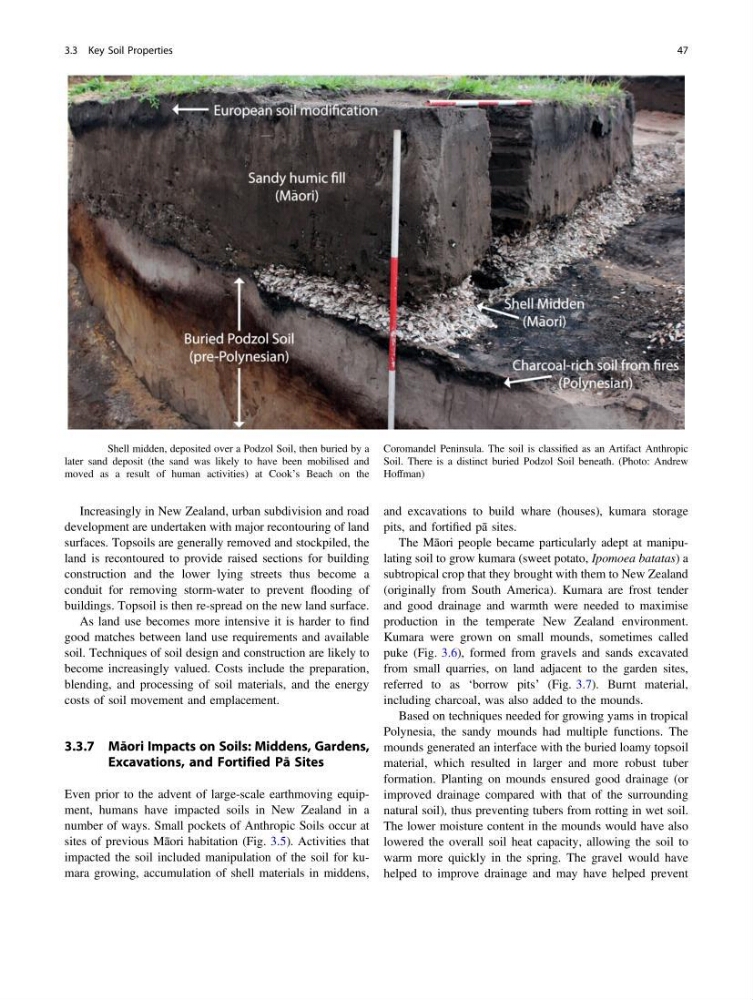
sites of previous Māori habitation (Fig. 3.5). Activities that
impacted the soil included manipulation of the soil for kumara growing, accumulation of shell materials in middens,
and excavations to build whare (houses), kumara storage
pits, and fortified pā sites.
The Māori people became particularly adept at manipulating soil to grow kumara (sweet potato, Ipomoea batatas) a
subtropical crop that they brought with them to New Zealand
(originally from South America). Kumara are frost tender
and good drainage and warmth were needed to maximise
production in the temperate New Zealand environment.
Kumara were grown on small mounds, sometimes called
puke (Fig. 3.6), formed from gravels and sands excavated
from small quarries, on land adjacent to the garden sites,
referred to as ‘borrow pits’ (Fig. 3.7). Burnt material,
including charcoal, was also added to the mounds.
Based on techniques needed for growing yams in tropical
Polynesia, the sandy mounds had multiple functions. The
mounds generated an interface with the buried loamy topsoil
material, which resulted in larger and more robust tuber
formation. Planting on mounds ensured good drainage (or
improved drainage compared with that of the surrounding
natural soil), thus preventing tubers from rotting in wet soil.
The lower moisture content in the mounds would have also
lowered the overall soil heat capacity, allowing the soil to
warm more quickly in the spring. The gravel would have
helped to improve drainage and may have helped prevent
Fig. 3.5 Shell midden, deposited over a Podzol Soil, then buried by a
later sand deposit (the sand was likely to have been mobilised and
moved as a result of human activities) at Cook’s Beach on the
Coromandel Peninsula. The soil is classified as an Artifact Anthropic
Soil. There is a distinct buried Podzol Soil beneath. (Photo: Andrew
Hoffman)
3.3 Key Soil Properties
47
development are undertaken with major recontouring of land
surfaces. Topsoils are generally removed and stockpiled, the
land is recontoured to provide raised sections for building
construction and the lower lying streets thus become a
conduit for removing storm-water to prevent flooding of
buildings. Topsoil is then re-spread on the new land surface.
As land use becomes more intensive it is harder to find
good matches between land use requirements and available
soil. Techniques of soil design and construction are likely to
become increasingly valued. Costs include the preparation,
blending, and processing of soil materials, and the energy
costs of soil movement and emplacement.
3.3.7 Māori Impacts on Soils: Middens, Gardens,
Excavations, and Fortified Pā Sites
Even prior to the advent of large-scale earthmoving equipment, humans have impacted soils in New Zealand in a
number of ways. Small pockets of Anthropic Soils occur at
sites of previous Māori habitation (Fig. 3.5). Activities that
impacted the soil included manipulation of the soil for kumara growing, accumulation of shell materials in middens,
and excavations to build whare (houses), kumara storage
pits, and fortified pā sites.
The Māori people became particularly adept at manipulating soil to grow kumara (sweet potato, Ipomoea batatas) a
subtropical crop that they brought with them to New Zealand
(originally from South America). Kumara are frost tender
and good drainage and warmth were needed to maximise
production in the temperate New Zealand environment.
Kumara were grown on small mounds, sometimes called
puke (Fig. 3.6), formed from gravels and sands excavated
from small quarries, on land adjacent to the garden sites,
referred to as ‘borrow pits’ (Fig. 3.7). Burnt material,
including charcoal, was also added to the mounds.
Based on techniques needed for growing yams in tropical
Polynesia, the sandy mounds had multiple functions. The
mounds generated an interface with the buried loamy topsoil
material, which resulted in larger and more robust tuber
formation. Planting on mounds ensured good drainage (or
improved drainage compared with that of the surrounding
natural soil), thus preventing tubers from rotting in wet soil.
The lower moisture content in the mounds would have also
lowered the overall soil heat capacity, allowing the soil to
warm more quickly in the spring. The gravel would have
helped to improve drainage and may have helped prevent
Fig. 3.5 Shell midden, deposited over a Podzol Soil, then buried by a
later sand deposit (the sand was likely to have been mobilised and
moved as a result of human activities) at Cook’s Beach on the
Coromandel Peninsula. The soil is classified as an Artifact Anthropic
Soil. There is a distinct buried Podzol Soil beneath. (Photo: Andrew
Hoffman)
3.3 Key Soil Properties
47