

caution needs to be exercised in using such arbitrary
models which all have limitations due to the assumptions
made in their development, the accuracy of input data,
and their ability to account for the inherent variability in
soils and landscapes. Unforeseen inequities can arise
with a blind reliance on such models.
18.5 Concluding Comments: Aotearoa New
Zealand Soils—A National Taonga
and Our Role in Kaitiakitanga
Les Molloy, in 1988, concluded that ‘…only rarely have we
stood back and celebrated our [New Zealand] soils as
something beautiful, and perhaps even mysterious. For what
other natural body, worldwide in its distribution, has so
many interesting secrets to reveal to the patient observer?’.
But how good are New Zealand soils? Given the diversity of
soils, and their uses, there is no one answer to the question.
European explorers initially thought that New Zealand soils
were particularly fertile because of the large size of many
native forest trees. However, their hopes were dashed as
pioneer farmers discovered the limitations inherent in the
soils of many areas. The early misconception arose from the
ability of many New Zealand plants to be highly nutrient
conservative. On acidic, low fertility, soils the trees utilise
what small nutrient resources are available and very efficiently recycle nutrients to support their growth. For example, the kauri, among the largest trees in the world, often
grows on low nutrient sites. However, we do have
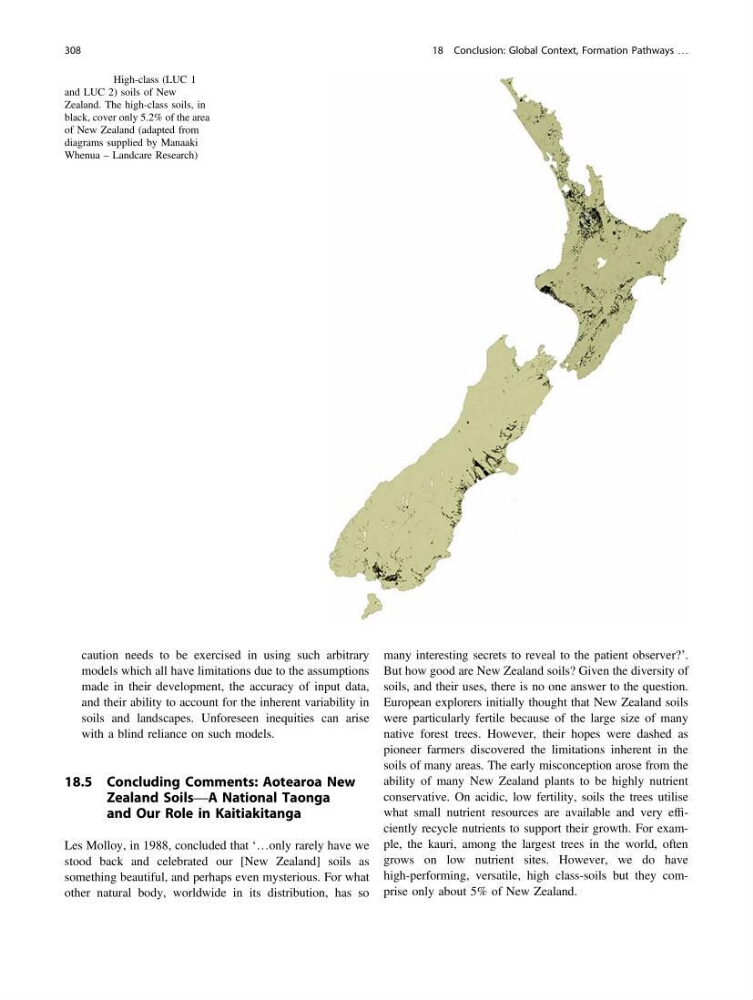
high-performing, versatile, high class-soils but they comprise only about 5% of New Zealand.
Fig. 18.8 High-class (LUC 1
and LUC 2) soils of New
Zealand. The high-class soils, in
black, cover only 5.2% of the area
of New Zealand (adapted from
diagrams supplied by Manaaki
Whenua – Landcare Research)
308
18 Conclusion: Global Context, Formation Pathways …
models which all have limitations due to the assumptions
made in their development, the accuracy of input data,
and their ability to account for the inherent variability in
soils and landscapes. Unforeseen inequities can arise
with a blind reliance on such models.
18.5 Concluding Comments: Aotearoa New
Zealand Soils—A National Taonga
and Our Role in Kaitiakitanga
Les Molloy, in 1988, concluded that ‘…only rarely have we
stood back and celebrated our [New Zealand] soils as
something beautiful, and perhaps even mysterious. For what
other natural body, worldwide in its distribution, has so
many interesting secrets to reveal to the patient observer?’.
But how good are New Zealand soils? Given the diversity of
soils, and their uses, there is no one answer to the question.
European explorers initially thought that New Zealand soils
were particularly fertile because of the large size of many
native forest trees. However, their hopes were dashed as
pioneer farmers discovered the limitations inherent in the
soils of many areas. The early misconception arose from the
ability of many New Zealand plants to be highly nutrient
conservative. On acidic, low fertility, soils the trees utilise
what small nutrient resources are available and very efficiently recycle nutrients to support their growth. For example, the kauri, among the largest trees in the world, often
grows on low nutrient sites. However, we do have
high-performing, versatile, high class-soils but they comprise only about 5% of New Zealand.
Fig. 18.8 High-class (LUC 1
and LUC 2) soils of New
Zealand. The high-class soils, in
black, cover only 5.2% of the area
of New Zealand (adapted from
diagrams supplied by Manaaki
Whenua – Landcare Research)
308
18 Conclusion: Global Context, Formation Pathways …