

suitability. Where good fits are identified there is the best
likelihood of good production and environmental performance. The goodness of fit is, therefore, a non-monetary
value that is expressed in terms of the efficient utilisation of a
landscape.
b. Soil functions
Soil functions are soil processes that provide something
directly useful for people and/or ecosystems. For example,
removal of nitrate from soil water is achieved by two
important soil functions: soil water storage, and denitrification. Soil water storage depends on the soil pore network (a
soil stock). When nitrate-charged water drains through the
soil, some is stored in the soil pores. The greater the soil
water storage capacity, the more water will remain in storage
until both the water and nutrients, including nitrate, are taken
up by plants, thus minimising nitrate loss to groundwater
while maximising nutrient and water availability to the plant.
Denitrification (conversion of nitrate-N to N 2 gas which is
released to the atmosphere) occurs in soil horizons saturated
by water in a state of biochemical reduction (gleying). Both
water storage and denitrification are functions that decrease
the amount of nitrate that may escape through the soil into
groundwater or streams.
c. Ecosystem services
Ecosystem services are the useful things generated by
ecosystems to support life on Earth. Originally understood in
reference to biological systems, the concept has been
broadened to incorporate the processes involved in land, air,
water, soil, and topography as well as ecology. The value in
providing environmental services and protecting the environment was estimated, by US researchers Collins and Larry
(in 2007) to be approximately 40–70 times greater than the
value of agricultural production (although if a food shortage
was to ensue then undoubtedly food production would be
valued more highly). Ecosystem services are divided into
four main categories (Table 18.6).
Soil science has a role to understand soil ecosystem services in the context of; the wider earth systems, natural and
agro-ecosystems, and to bridge the gaps between soil science
and related sciences that are working in the ecosystem services field. Estelle Dominati, Alec Mackay, and Murry
Patterson have defined ecosystem services, and the related
concepts, in the context of New Zealand’s soils, as well as
exploring soil natural capital valuation. In 2016, Dominati
and others developed a ‘more holistic, integrative modelling
approach’ which they called ‘an ecosystem approach to
quantify soil performance for multiple outcomes’. As an
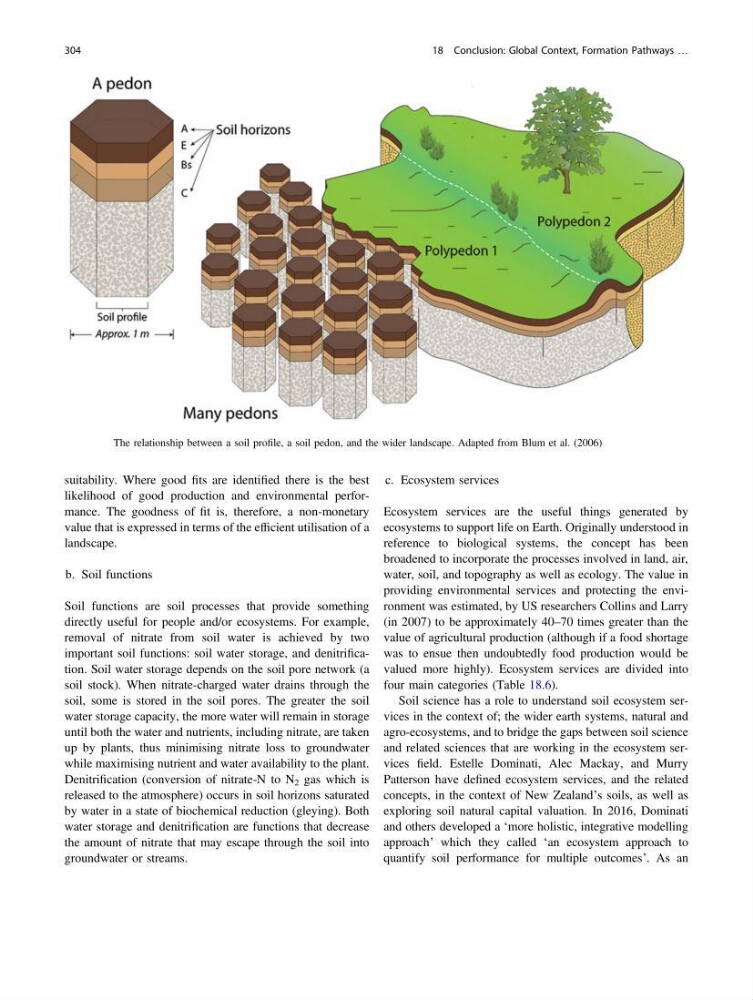
Fig. 18.5 The relationship between a soil profile, a soil pedon, and the wider landscape. Adapted from Blum et al. (2006)
304
18 Conclusion: Global Context, Formation Pathways …
likelihood of good production and environmental performance. The goodness of fit is, therefore, a non-monetary
value that is expressed in terms of the efficient utilisation of a
landscape.
b. Soil functions
Soil functions are soil processes that provide something
directly useful for people and/or ecosystems. For example,
removal of nitrate from soil water is achieved by two
important soil functions: soil water storage, and denitrification. Soil water storage depends on the soil pore network (a
soil stock). When nitrate-charged water drains through the
soil, some is stored in the soil pores. The greater the soil
water storage capacity, the more water will remain in storage
until both the water and nutrients, including nitrate, are taken
up by plants, thus minimising nitrate loss to groundwater
while maximising nutrient and water availability to the plant.
Denitrification (conversion of nitrate-N to N 2 gas which is
released to the atmosphere) occurs in soil horizons saturated
by water in a state of biochemical reduction (gleying). Both
water storage and denitrification are functions that decrease
the amount of nitrate that may escape through the soil into
groundwater or streams.
c. Ecosystem services
Ecosystem services are the useful things generated by
ecosystems to support life on Earth. Originally understood in
reference to biological systems, the concept has been
broadened to incorporate the processes involved in land, air,
water, soil, and topography as well as ecology. The value in
providing environmental services and protecting the environment was estimated, by US researchers Collins and Larry
(in 2007) to be approximately 40–70 times greater than the
value of agricultural production (although if a food shortage
was to ensue then undoubtedly food production would be
valued more highly). Ecosystem services are divided into
four main categories (Table 18.6).
Soil science has a role to understand soil ecosystem services in the context of; the wider earth systems, natural and
agro-ecosystems, and to bridge the gaps between soil science
and related sciences that are working in the ecosystem services field. Estelle Dominati, Alec Mackay, and Murry
Patterson have defined ecosystem services, and the related
concepts, in the context of New Zealand’s soils, as well as
exploring soil natural capital valuation. In 2016, Dominati
and others developed a ‘more holistic, integrative modelling
approach’ which they called ‘an ecosystem approach to
quantify soil performance for multiple outcomes’. As an
Fig. 18.5 The relationship between a soil profile, a soil pedon, and the wider landscape. Adapted from Blum et al. (2006)
304
18 Conclusion: Global Context, Formation Pathways …