

regularly, can be used to monitor changes over time. Globally, there are a number of visual soil assessment methods
developed for particular situations. In New Zealand Graham
Shepherd led the development of a VSA system that is
published in four volumes, comprising field guides and soil
management guidelines for both flat to rolling land and for
hill country. The guides are available at https://www.
landcareresearch.co.nz/publications/books/visual-soilassessment-field-guide/download-field-guide.
In the New Zealand VSA system, a number of soil and
plant indicators are rated on a defined three-point scale as
either poor, moderate, or good. Each indicator is then multiplied by a weighting factor and the total of all the indicator
rankings gives an overall ranking score for the site as good,
moderate, or poor. Undertaking the exercise provides the
operator with an increased awareness of the state of their soil
and an incentive to work to improve the land management to
improve the scores if they are low.
In Antarctica, Iain Campbell, Megan Balks, and Graeme
Claridge developed a VSA system to assess impacts of
human activities on the relatively pristine Antarctic soil
environment.
18.4.10 Soil Stocks, Soil Natural Capital, Soil
Functions, and Ecosystem Services
Four linked concepts—soil stocks, soil natural capital, soil
functions, and soil ecosystem services—are useful for
developing an understanding of the relationships between
soil and land evaluation, soil processes, and sustainable land
management. Such understanding starts with the soil profile,
and moves through the links between soils, land, and soil
processes, to the larger focus of processes of the atmosphere,
hydrosphere, geosphere, and biosphere, together with human
society. The four concepts together help form technical
linkages and enable multidisciplinary understanding.
a. Soil stocks and soil natural capital
Soil stocks are defined as the soil attributes that materially
influence ecosystems. Generally, people are familiar with the
idea of soils having carbon stocks which support carbon
sequestration. The concept has been extended to include a
range of other soil stocks, for example, the stock of soil
pores that supports soil water storage capacity, or the stock
of available soil phosphorus that supports plant growth. The
basic unit is the soil profile or its three-dimensional counterpart, the pedon. The pedon then becomes the fundamental
(spatial) soil individual which comprises a ‘bundle’ of soil
stocks. A soil-landscape or soil map unit is an aggregate of
similar, contiguous, pedons (referred to as a polypedon,
Fig. 18.5).
Most businesses use some form of capital resource to
support their enterprise, be it labour, finance, or land, to
create goods or services for profit. The term ‘natural capital’
identifies the natural resources used by businesses and
ecosystems. The term ‘soil natural capital’ identifies soil as
one of the natural capital stocks to be valued for the services
they provide, for example, filtering of contaminants, supplying nutrients to plants, storing and releasing water, and
drainage.
An objective of introducing the concept of ‘soil natural
capital’ is for soils to be ascribed value that can be factored
into economic analyses. Thus the soil may be better appreciated for its roles in supporting the major earth systems
including productive agroecosystems and the health of natural ecosystems. Therefore, soils may be considered by the
business community, with investment in soils being ‘an
opportunity to enhance services and mitigate risks’.
A soil natural capital approach may be integrated into
most techniques of land evaluation, for example, land capability or land use suitability, by analysing the goodness of
fit between land use needs and available soil stocks. The
goodness of fit becomes the estimate of capability or
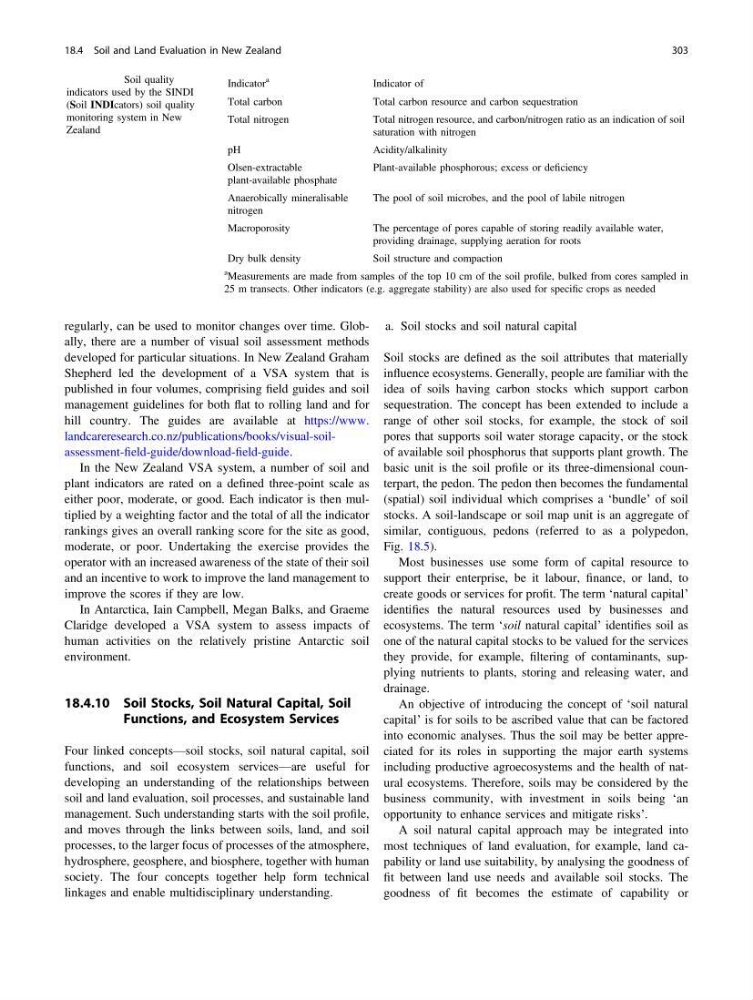
Table 18.5 Soil quality
indicators used by the SINDI
(Soil INDIcators) soil quality
monitoring system in New
Zealand
Indicator
a
Indicator of
Total carbon
Total carbon resource and carbon sequestration
Total nitrogen
Total nitrogen resource, and carbon/nitrogen ratio as an indication of soil
saturation with nitrogen
pH
Acidity/alkalinity
Olsen-extractable
plant-available phosphate
Plant-available phosphorous; excess or deficiency
Anaerobically mineralisable
nitrogen
The pool of soil microbes, and the pool of labile nitrogen
Macroporosity
The percentage of pores capable of storing readily available water,
providing drainage, supplying aeration for roots
Dry bulk density
Soil structure and compaction
a Measurements are made from samples of the top 10 cm of the soil profile, bulked from cores sampled in
25 m transects. Other indicators (e.g. aggregate stability) are also used for specific crops as needed
18.4 Soil and Land Evaluation in New Zealand
303
developed for particular situations. In New Zealand Graham
Shepherd led the development of a VSA system that is
published in four volumes, comprising field guides and soil
management guidelines for both flat to rolling land and for
hill country. The guides are available at https://www.
landcareresearch.co.nz/publications/books/visual-soilassessment-field-guide/download-field-guide.
In the New Zealand VSA system, a number of soil and
plant indicators are rated on a defined three-point scale as
either poor, moderate, or good. Each indicator is then multiplied by a weighting factor and the total of all the indicator
rankings gives an overall ranking score for the site as good,
moderate, or poor. Undertaking the exercise provides the
operator with an increased awareness of the state of their soil
and an incentive to work to improve the land management to
improve the scores if they are low.
In Antarctica, Iain Campbell, Megan Balks, and Graeme
Claridge developed a VSA system to assess impacts of
human activities on the relatively pristine Antarctic soil
environment.
18.4.10 Soil Stocks, Soil Natural Capital, Soil
Functions, and Ecosystem Services
Four linked concepts—soil stocks, soil natural capital, soil
functions, and soil ecosystem services—are useful for
developing an understanding of the relationships between
soil and land evaluation, soil processes, and sustainable land
management. Such understanding starts with the soil profile,
and moves through the links between soils, land, and soil
processes, to the larger focus of processes of the atmosphere,
hydrosphere, geosphere, and biosphere, together with human
society. The four concepts together help form technical
linkages and enable multidisciplinary understanding.
a. Soil stocks and soil natural capital
Soil stocks are defined as the soil attributes that materially
influence ecosystems. Generally, people are familiar with the
idea of soils having carbon stocks which support carbon
sequestration. The concept has been extended to include a
range of other soil stocks, for example, the stock of soil
pores that supports soil water storage capacity, or the stock
of available soil phosphorus that supports plant growth. The
basic unit is the soil profile or its three-dimensional counterpart, the pedon. The pedon then becomes the fundamental
(spatial) soil individual which comprises a ‘bundle’ of soil
stocks. A soil-landscape or soil map unit is an aggregate of
similar, contiguous, pedons (referred to as a polypedon,
Fig. 18.5).
Most businesses use some form of capital resource to
support their enterprise, be it labour, finance, or land, to
create goods or services for profit. The term ‘natural capital’
identifies the natural resources used by businesses and
ecosystems. The term ‘soil natural capital’ identifies soil as
one of the natural capital stocks to be valued for the services
they provide, for example, filtering of contaminants, supplying nutrients to plants, storing and releasing water, and
drainage.
An objective of introducing the concept of ‘soil natural
capital’ is for soils to be ascribed value that can be factored
into economic analyses. Thus the soil may be better appreciated for its roles in supporting the major earth systems
including productive agroecosystems and the health of natural ecosystems. Therefore, soils may be considered by the
business community, with investment in soils being ‘an
opportunity to enhance services and mitigate risks’.
A soil natural capital approach may be integrated into
most techniques of land evaluation, for example, land capability or land use suitability, by analysing the goodness of
fit between land use needs and available soil stocks. The
goodness of fit becomes the estimate of capability or
Table 18.5 Soil quality
indicators used by the SINDI
(Soil INDIcators) soil quality
monitoring system in New
Zealand
Indicator
a
Indicator of
Total carbon
Total carbon resource and carbon sequestration
Total nitrogen
Total nitrogen resource, and carbon/nitrogen ratio as an indication of soil
saturation with nitrogen
pH
Acidity/alkalinity
Olsen-extractable
plant-available phosphate
Plant-available phosphorous; excess or deficiency
Anaerobically mineralisable
nitrogen
The pool of soil microbes, and the pool of labile nitrogen
Macroporosity
The percentage of pores capable of storing readily available water,
providing drainage, supplying aeration for roots
Dry bulk density
Soil structure and compaction
a Measurements are made from samples of the top 10 cm of the soil profile, bulked from cores sampled in
25 m transects. Other indicators (e.g. aggregate stability) are also used for specific crops as needed
18.4 Soil and Land Evaluation in New Zealand
303