

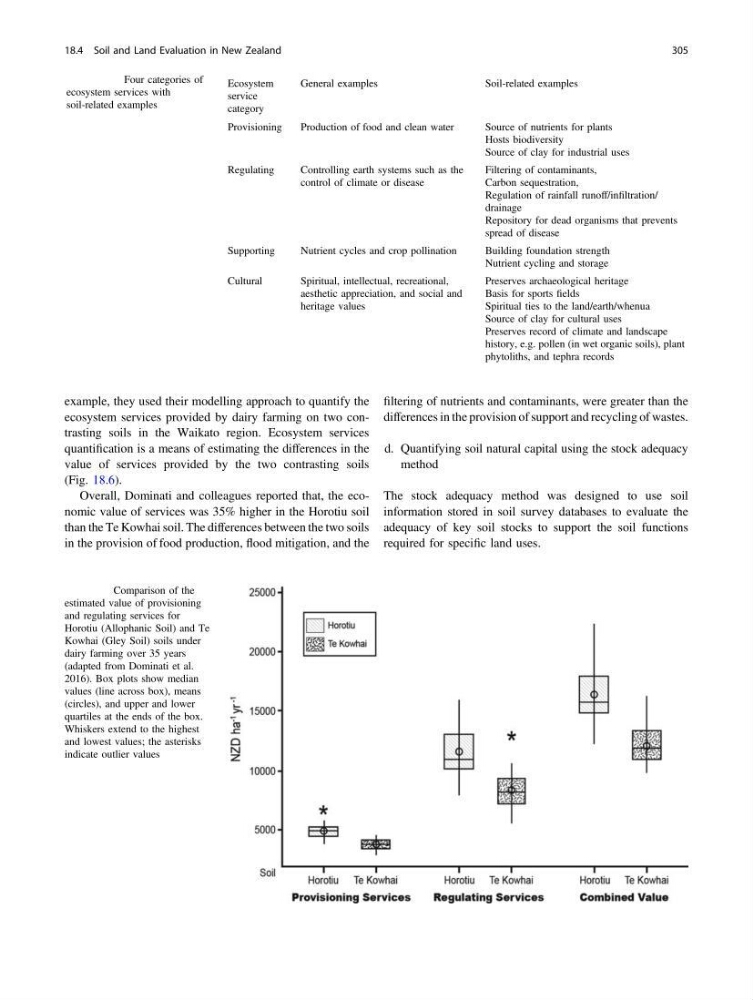
example, they used their modelling approach to quantify the
ecosystem services provided by dairy farming on two contrasting soils in the Waikato region. Ecosystem services
quantification is a means of estimating the differences in the
value of services provided by the two contrasting soils
(Fig. 18.6).
Overall, Dominati and colleagues reported that, the economic value of services was 35% higher in the Horotiu soil
than the Te Kowhai soil. The differences between the two soils
in the provision of food production, flood mitigation, and the
filtering of nutrients and contaminants, were greater than the
differences in the provision of support and recycling of wastes.
d. Quantifying soil natural capital using the stock adequacy
method
The stock adequacy method was designed to use soil
information stored in soil survey databases to evaluate the
adequacy of key soil stocks to support the soil functions
required for specific land uses.
Table 18.6 Four categories of
ecosystem services with
soil-related examples
Ecosystem
service
category
General examples
Soil-related examples
Provisioning
Production of food and clean water
Source of nutrients for plants
Hosts biodiversity
Source of clay for industrial uses
Regulating
Controlling earth systems such as the
control of climate or disease
Filtering of contaminants,
Carbon sequestration,
Regulation of rainfall runoff/infiltration/
drainage
Repository for dead organisms that prevents
spread of disease
Supporting
Nutrient cycles and crop pollination
Building foundation strength
Nutrient cycling and storage
Cultural
Spiritual, intellectual, recreational,
aesthetic appreciation, and social and
heritage values
Preserves archaeological heritage
Basis for sports fields
Spiritual ties to the land/earth/whenua
Source of clay for cultural uses
Preserves record of climate and landscape
history, e.g. pollen (in wet organic soils), plant
phytoliths, and tephra records
Fig. 18.6 Comparison of the
estimated value of provisioning
and regulating services for
Horotiu (Allophanic Soil) and Te
Kowhai (Gley Soil) soils under
dairy farming over 35 years
(adapted from Dominati et al.
2016). Box plots show median
values (line across box), means
(circles), and upper and lower
quartiles at the ends of the box.
Whiskers extend to the highest
and lowest values; the asterisks
indicate outlier values
18.4 Soil and Land Evaluation in New Zealand
305
ecosystem services provided by dairy farming on two contrasting soils in the Waikato region. Ecosystem services
quantification is a means of estimating the differences in the
value of services provided by the two contrasting soils
(Fig. 18.6).
Overall, Dominati and colleagues reported that, the economic value of services was 35% higher in the Horotiu soil
than the Te Kowhai soil. The differences between the two soils
in the provision of food production, flood mitigation, and the
filtering of nutrients and contaminants, were greater than the
differences in the provision of support and recycling of wastes.
d. Quantifying soil natural capital using the stock adequacy
method
The stock adequacy method was designed to use soil
information stored in soil survey databases to evaluate the
adequacy of key soil stocks to support the soil functions
required for specific land uses.
Table 18.6 Four categories of
ecosystem services with
soil-related examples
Ecosystem
service
category
General examples
Soil-related examples
Provisioning
Production of food and clean water
Source of nutrients for plants
Hosts biodiversity
Source of clay for industrial uses
Regulating
Controlling earth systems such as the
control of climate or disease
Filtering of contaminants,
Carbon sequestration,
Regulation of rainfall runoff/infiltration/
drainage
Repository for dead organisms that prevents
spread of disease
Supporting
Nutrient cycles and crop pollination
Building foundation strength
Nutrient cycling and storage
Cultural
Spiritual, intellectual, recreational,
aesthetic appreciation, and social and
heritage values
Preserves archaeological heritage
Basis for sports fields
Spiritual ties to the land/earth/whenua
Source of clay for cultural uses
Preserves record of climate and landscape
history, e.g. pollen (in wet organic soils), plant
phytoliths, and tephra records
Fig. 18.6 Comparison of the
estimated value of provisioning
and regulating services for
Horotiu (Allophanic Soil) and Te
Kowhai (Gley Soil) soils under
dairy farming over 35 years
(adapted from Dominati et al.
2016). Box plots show median
values (line across box), means
(circles), and upper and lower
quartiles at the ends of the box.
Whiskers extend to the highest
and lowest values; the asterisks
indicate outlier values
18.4 Soil and Land Evaluation in New Zealand
305