

16.3.3 Ultic Soils in the Northern Waikato
Region Including the Special Case
of the Kainui Soil
On steeper hill slopes in northern and western Waikato Ultic
Soils occur on exhumed greywacke where tephra cover is
not preserved. A relationship between slope angle and the
occurrence of Ultic Soils was developed by Michael Selby
and Robin Palmer in the 1970s for hilly land underlain by
greywacke in the western Waikato. They found that on
slopes of *20°, only the topsoil horizons of the soils are
derived from tephra deposits, the subsoil horizons being
derived from weathered greywacke. Where slope angles
exceeded *26°, the soils are formed more-or-less entirely
from weathered greywacke alone. Thus, in general, in this
terrain, Ultic Soils occur on slopes 20° and Granular or
Allophanic Soils are found on slopes <20°.
On the pervasive tephra mantle, in the western and
northern Waikato region, Granular Soils (formed on old,
strongly weathered Hamilton Ash beds) are common on
rolling landscapes with Allophanic Soils on flat surfaces, as
described by John Bruce in the Raglan County survey.
However, there is one special case, the Kainui soils, where
the tephra is sufficiently thick, and halloysitic in character so
that an affinity to Ultic rather than Granular Soils is
preferred.
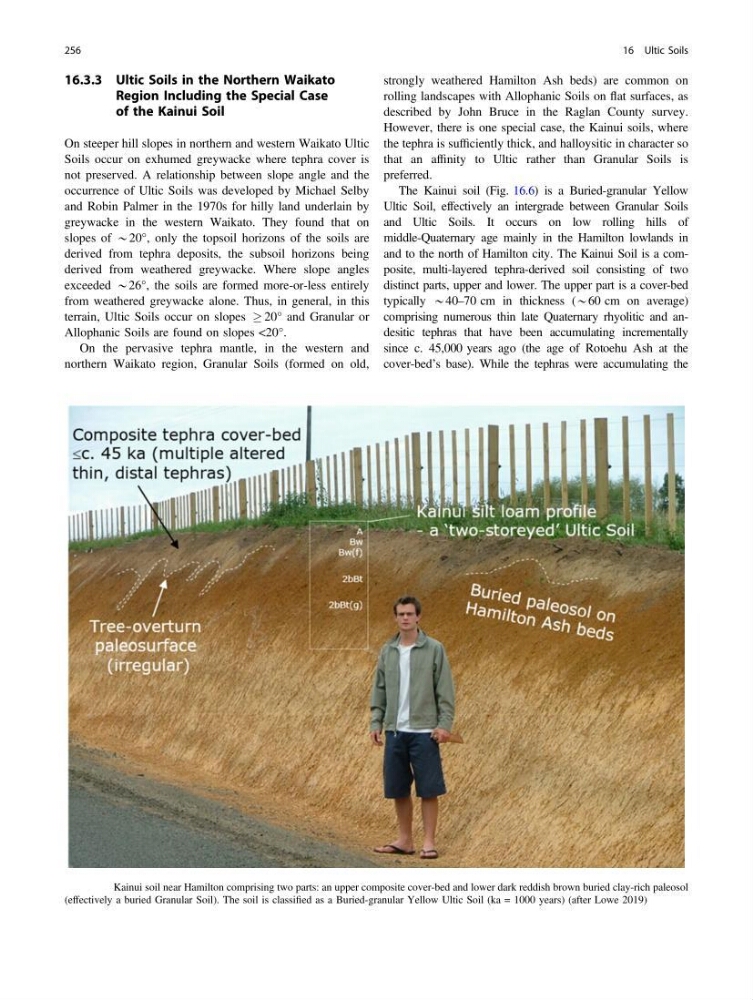
The Kainui soil (Fig. 16.6) is a Buried-granular Yellow
Ultic Soil, effectively an intergrade between Granular Soils
and Ultic Soils. It occurs on low rolling hills of
middle-Quaternary age mainly in the Hamilton lowlands in
and to the north of Hamilton city. The Kainui Soil is a composite, multi-layered tephra-derived soil consisting of two
distinct parts, upper and lower. The upper part is a cover-bed
typically *40–70 cm in thickness (*60 cm on average)
comprising numerous thin late Quaternary rhyolitic and andesitic tephras that have been accumulating incrementally
since c. 45,000 years ago (the age of Rotoehu Ash at the
cover-bed’s base). While the tephras were accumulating the
Fig. 16.6 Kainui soil near Hamilton comprising two parts: an upper composite cover-bed and lower dark reddish brown buried clay-rich paleosol
(effectively a buried Granular Soil). The soil is classified as a Buried-granular Yellow Ultic Soil (ka = 1000 years) (after Lowe 2019)
256
16 Ultic Soils
Region Including the Special Case
of the Kainui Soil
On steeper hill slopes in northern and western Waikato Ultic
Soils occur on exhumed greywacke where tephra cover is
not preserved. A relationship between slope angle and the
occurrence of Ultic Soils was developed by Michael Selby
and Robin Palmer in the 1970s for hilly land underlain by
greywacke in the western Waikato. They found that on
slopes of *20°, only the topsoil horizons of the soils are
derived from tephra deposits, the subsoil horizons being
derived from weathered greywacke. Where slope angles
exceeded *26°, the soils are formed more-or-less entirely
from weathered greywacke alone. Thus, in general, in this
terrain, Ultic Soils occur on slopes 20° and Granular or
Allophanic Soils are found on slopes <20°.
On the pervasive tephra mantle, in the western and
northern Waikato region, Granular Soils (formed on old,
strongly weathered Hamilton Ash beds) are common on
rolling landscapes with Allophanic Soils on flat surfaces, as
described by John Bruce in the Raglan County survey.
However, there is one special case, the Kainui soils, where
the tephra is sufficiently thick, and halloysitic in character so
that an affinity to Ultic rather than Granular Soils is
preferred.
The Kainui soil (Fig. 16.6) is a Buried-granular Yellow
Ultic Soil, effectively an intergrade between Granular Soils
and Ultic Soils. It occurs on low rolling hills of
middle-Quaternary age mainly in the Hamilton lowlands in
and to the north of Hamilton city. The Kainui Soil is a composite, multi-layered tephra-derived soil consisting of two
distinct parts, upper and lower. The upper part is a cover-bed
typically *40–70 cm in thickness (*60 cm on average)
comprising numerous thin late Quaternary rhyolitic and andesitic tephras that have been accumulating incrementally
since c. 45,000 years ago (the age of Rotoehu Ash at the
cover-bed’s base). While the tephras were accumulating the
Fig. 16.6 Kainui soil near Hamilton comprising two parts: an upper composite cover-bed and lower dark reddish brown buried clay-rich paleosol
(effectively a buried Granular Soil). The soil is classified as a Buried-granular Yellow Ultic Soil (ka = 1000 years) (after Lowe 2019)
256
16 Ultic Soils