

(Pohuehue series). Narrow valley floors support Acidic
Orthic Gley Soils (Table 16.1).
Jones found that the soil-landscape relationships related
mainly to a natural drainage sequence ranging from the well
or moderately well drained Typic Yellow Ultic Soils in
upper landscape positions to poorly drained Gley Soils in
low lying areas. The drainage of the soil appears to be
controlled mainly by a combination of topographic position
and the nature of the underlying parent material. The parent
material is saprolitic clay derived from strongly weathered
Tertiary sandstone and siltstone (Waitemata Group), which
is red weathered in places (Sect. 16.3.4). The drainage of the
soil can have a marked influence on tree growth and can
impact on harvesting operations and so the soil-landscape
relationships established are important for forest management despite the limited taxonomic diversity.
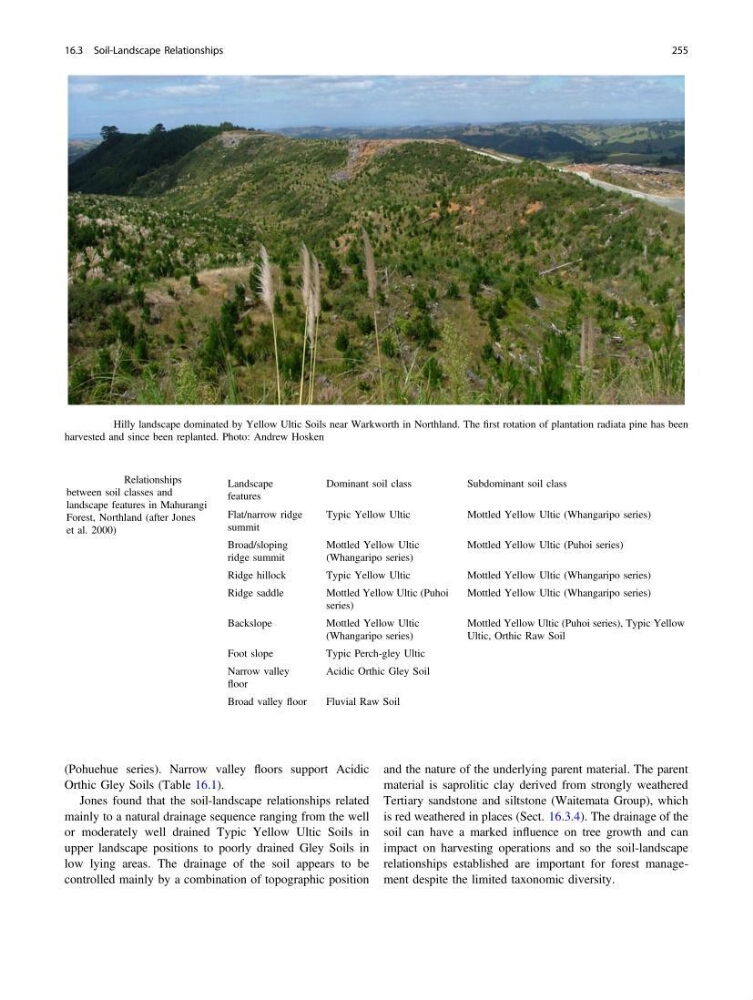
Fig. 16.5 Hilly landscape dominated by Yellow Ultic Soils near Warkworth in Northland. The first rotation of plantation radiata pine has been
harvested and since been replanted. Photo: Andrew Hosken
Table 16.1 Relationships
between soil classes and
landscape features in Mahurangi
Forest, Northland (after Jones
et al. 2000)
Landscape
features
Dominant soil class
Subdominant soil class
Flat/narrow ridge
summit
Typic Yellow Ultic
Mottled Yellow Ultic (Whangaripo series)
Broad/sloping
ridge summit
Mottled Yellow Ultic
(Whangaripo series)
Mottled Yellow Ultic (Puhoi series)
Ridge hillock
Typic Yellow Ultic
Mottled Yellow Ultic (Whangaripo series)
Ridge saddle
Mottled Yellow Ultic (Puhoi
series)
Mottled Yellow Ultic (Whangaripo series)
Backslope
Mottled Yellow Ultic
(Whangaripo series)
Mottled Yellow Ultic (Puhoi series), Typic Yellow
Ultic, Orthic Raw Soil
Foot slope
Typic Perch-gley Ultic
Narrow valley
floor
Acidic Orthic Gley Soil
Broad valley floor
Fluvial Raw Soil
16.3 Soil-Landscape Relationships
255
Orthic Gley Soils (Table 16.1).
Jones found that the soil-landscape relationships related
mainly to a natural drainage sequence ranging from the well
or moderately well drained Typic Yellow Ultic Soils in
upper landscape positions to poorly drained Gley Soils in
low lying areas. The drainage of the soil appears to be
controlled mainly by a combination of topographic position
and the nature of the underlying parent material. The parent
material is saprolitic clay derived from strongly weathered
Tertiary sandstone and siltstone (Waitemata Group), which
is red weathered in places (Sect. 16.3.4). The drainage of the
soil can have a marked influence on tree growth and can
impact on harvesting operations and so the soil-landscape
relationships established are important for forest management despite the limited taxonomic diversity.
Fig. 16.5 Hilly landscape dominated by Yellow Ultic Soils near Warkworth in Northland. The first rotation of plantation radiata pine has been
harvested and since been replanted. Photo: Andrew Hosken
Table 16.1 Relationships
between soil classes and
landscape features in Mahurangi
Forest, Northland (after Jones
et al. 2000)
Landscape
features
Dominant soil class
Subdominant soil class
Flat/narrow ridge
summit
Typic Yellow Ultic
Mottled Yellow Ultic (Whangaripo series)
Broad/sloping
ridge summit
Mottled Yellow Ultic
(Whangaripo series)
Mottled Yellow Ultic (Puhoi series)
Ridge hillock
Typic Yellow Ultic
Mottled Yellow Ultic (Whangaripo series)
Ridge saddle
Mottled Yellow Ultic (Puhoi
series)
Mottled Yellow Ultic (Whangaripo series)
Backslope
Mottled Yellow Ultic
(Whangaripo series)
Mottled Yellow Ultic (Puhoi series), Typic Yellow
Ultic, Orthic Raw Soil
Foot slope
Typic Perch-gley Ultic
Narrow valley
floor
Acidic Orthic Gley Soil
Broad valley floor
Fluvial Raw Soil
16.3 Soil-Landscape Relationships
255