

– Tasman District (Nelson area), where there are extensive
areas of weathered granite on rolling and gentle hills,
close to the sea, where slopes have been long protected
from colluvial modification.
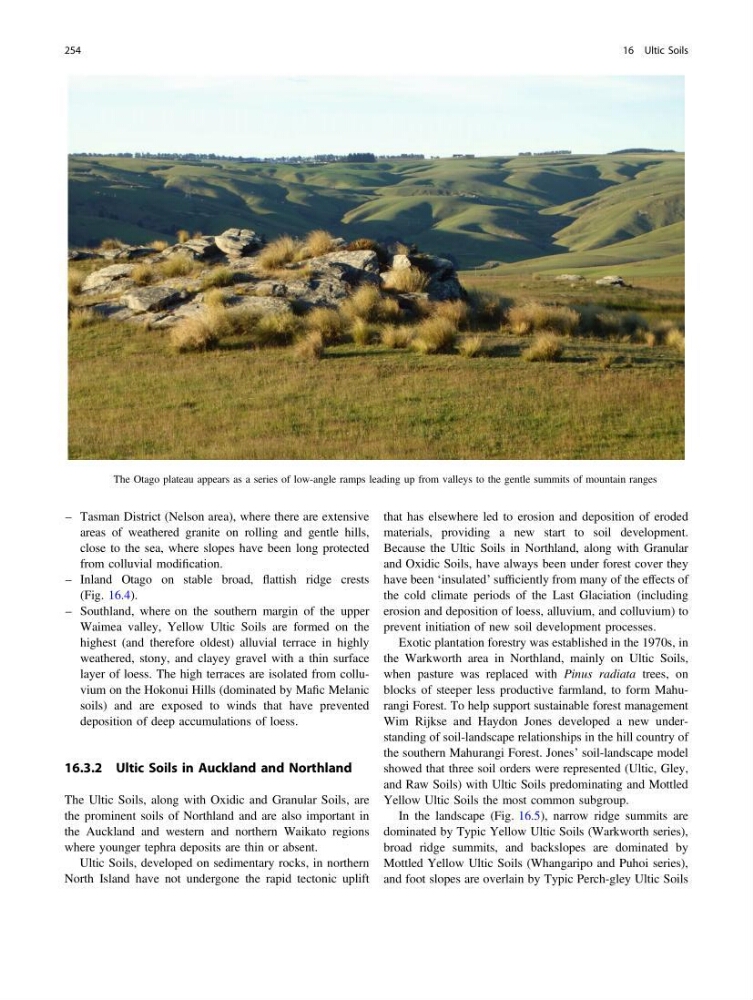
– Inland Otago on stable broad, flattish ridge crests
(Fig. 16.4).
– Southland, where on the southern margin of the upper
Waimea valley, Yellow Ultic Soils are formed on the
highest (and therefore oldest) alluvial terrace in highly
weathered, stony, and clayey gravel with a thin surface
layer of loess. The high terraces are isolated from colluvium on the Hokonui Hills (dominated by Mafic Melanic
soils) and are exposed to winds that have prevented
deposition of deep accumulations of loess.
16.3.2 Ultic Soils in Auckland and Northland
The Ultic Soils, along with Oxidic and Granular Soils, are
the prominent soils of Northland and are also important in
the Auckland and western and northern Waikato regions
where younger tephra deposits are thin or absent.
Ultic Soils, developed on sedimentary rocks, in northern
North Island have not undergone the rapid tectonic uplift
that has elsewhere led to erosion and deposition of eroded
materials, providing a new start to soil development.
Because the Ultic Soils in Northland, along with Granular
and Oxidic Soils, have always been under forest cover they
have been ‘insulated’ sufficiently from many of the effects of
the cold climate periods of the Last Glaciation (including
erosion and deposition of loess, alluvium, and colluvium) to
prevent initiation of new soil development processes.
Exotic plantation forestry was established in the 1970s, in
the Warkworth area in Northland, mainly on Ultic Soils,
when pasture was replaced with Pinus radiata trees, on
blocks of steeper less productive farmland, to form Mahurangi Forest. To help support sustainable forest management
Wim Rijkse and Haydon Jones developed a new understanding of soil-landscape relationships in the hill country of
the southern Mahurangi Forest. Jones’ soil-landscape model
showed that three soil orders were represented (Ultic, Gley,
and Raw Soils) with Ultic Soils predominating and Mottled
Yellow Ultic Soils the most common subgroup.
In the landscape (Fig. 16.5), narrow ridge summits are
dominated by Typic Yellow Ultic Soils (Warkworth series),
broad ridge summits, and backslopes are dominated by
Mottled Yellow Ultic Soils (Whangaripo and Puhoi series),
and foot slopes are overlain by Typic Perch-gley Ultic Soils
Fig. 16.4 The Otago plateau appears as a series of low-angle ramps leading up from valleys to the gentle summits of mountain ranges
254
16 Ultic Soils
areas of weathered granite on rolling and gentle hills,
close to the sea, where slopes have been long protected
from colluvial modification.
– Inland Otago on stable broad, flattish ridge crests
(Fig. 16.4).
– Southland, where on the southern margin of the upper
Waimea valley, Yellow Ultic Soils are formed on the
highest (and therefore oldest) alluvial terrace in highly
weathered, stony, and clayey gravel with a thin surface
layer of loess. The high terraces are isolated from colluvium on the Hokonui Hills (dominated by Mafic Melanic
soils) and are exposed to winds that have prevented
deposition of deep accumulations of loess.
16.3.2 Ultic Soils in Auckland and Northland
The Ultic Soils, along with Oxidic and Granular Soils, are
the prominent soils of Northland and are also important in
the Auckland and western and northern Waikato regions
where younger tephra deposits are thin or absent.
Ultic Soils, developed on sedimentary rocks, in northern
North Island have not undergone the rapid tectonic uplift
that has elsewhere led to erosion and deposition of eroded
materials, providing a new start to soil development.
Because the Ultic Soils in Northland, along with Granular
and Oxidic Soils, have always been under forest cover they
have been ‘insulated’ sufficiently from many of the effects of
the cold climate periods of the Last Glaciation (including
erosion and deposition of loess, alluvium, and colluvium) to
prevent initiation of new soil development processes.
Exotic plantation forestry was established in the 1970s, in
the Warkworth area in Northland, mainly on Ultic Soils,
when pasture was replaced with Pinus radiata trees, on
blocks of steeper less productive farmland, to form Mahurangi Forest. To help support sustainable forest management
Wim Rijkse and Haydon Jones developed a new understanding of soil-landscape relationships in the hill country of
the southern Mahurangi Forest. Jones’ soil-landscape model
showed that three soil orders were represented (Ultic, Gley,
and Raw Soils) with Ultic Soils predominating and Mottled
Yellow Ultic Soils the most common subgroup.
In the landscape (Fig. 16.5), narrow ridge summits are
dominated by Typic Yellow Ultic Soils (Warkworth series),
broad ridge summits, and backslopes are dominated by
Mottled Yellow Ultic Soils (Whangaripo and Puhoi series),
and foot slopes are overlain by Typic Perch-gley Ultic Soils
Fig. 16.4 The Otago plateau appears as a series of low-angle ramps leading up from valleys to the gentle summits of mountain ranges
254
16 Ultic Soils