

soil was gradually developing (being pedogenically altered via
developmental upbuilding pedogenesis) forming soil horizons.
Any original depositional (tephra fall) bedding has been
almost entirely masked by pedogenic alteration including clay
formation (average clay content is *30%) and soil mixing.
The lower horizons of the cover-bed always show redox features including manganese oxide concretions and coatings on
peds (mangans) with soil horizon notation Bw(f).
The moderately well-drained upper profile is dominated
by halloysite (not allophane) in the clay fraction because of
limited desilication as the result of impeded drainage and
seasonal perching on a slowly permeable, buried, clay-rich
paleosol (average clay content is *85%) on upper Hamilton
Ash beds (>c. 45,000 years old) which makes up the lower
part of the two-storeyed Kainui soil. The cover-bed-paleosol
boundary is a lithologic discontinuity (unconformity)
marking a tree-overturn paleosurface that David Lowe
reported (in 2019) may be c. 74,000 years old. The buried
paleosol is strongly weathered and halloysitic with relict clay
skins (forming paleo-argillic and/or paleo-kandic horizons)
and redox features towards the base of the profile. The paleosol is inferred to have formed (via developmental
upbuilding pedogenesis) during the Last Interglacial.
The classification of the tephra-derived Kainui soil has
been problematic. Being non-allophanic, it clearly is not an
Allophanic Soil, nor did it fit well in the Granular Soils
(formed on weathered Hamilton Ash beds) because the
‘granular’ character (distinctive polyhedral pedality or soil
fabric) associated with this order (Chap. 6) was at depths
typically 60 cm or more below the land surface. Instead, the
distinctive ‘two storeyed’ profile and its twin ‘ultic’ and
subsurface ‘granular’ characters are reflected by its classification uniquely as a Buried-granular Yellow Ultic Soil.
16.3.4 Origin of Red Weathering
a. Red weathering in Northland
In the Mahurangi Forest area near Warkworth, Haydon Jones
identified the main parent materials of the Yellow Ultic Soils
as saprolite derived from alternating, volcanic-rich sandstones
and siltstones of the Pakiri Formation (within the Waitemata
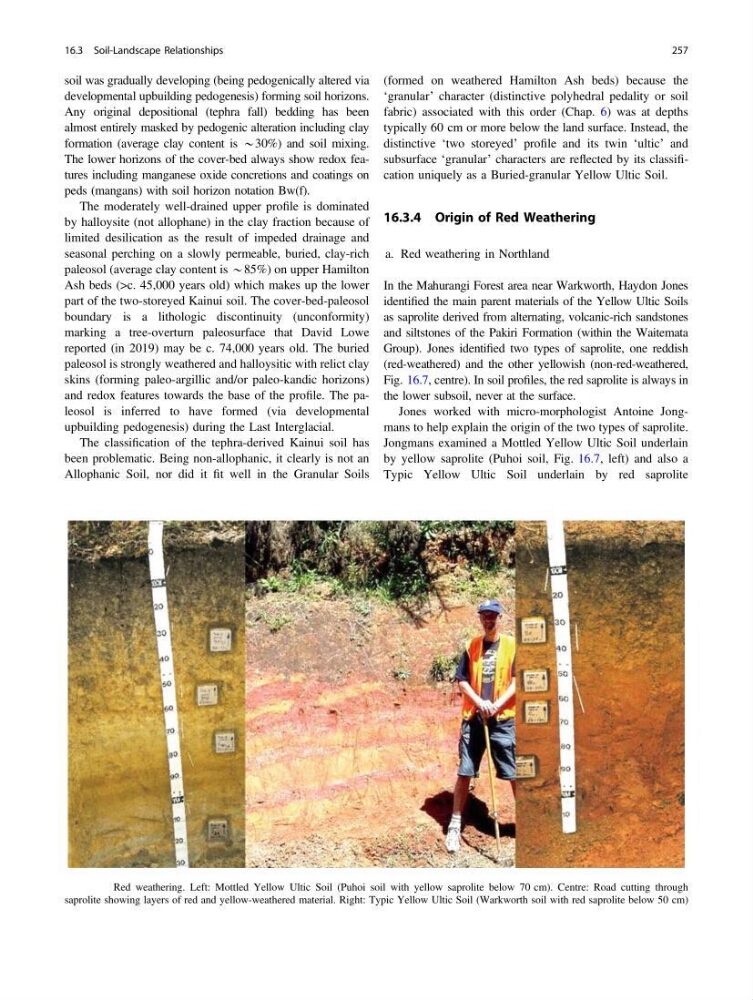
Group). Jones identified two types of saprolite, one reddish
(red-weathered) and the other yellowish (non-red-weathered,
Fig. 16.7, centre). In soil profiles, the red saprolite is always in
the lower subsoil, never at the surface.
Jones worked with micro-morphologist Antoine Jongmans to help explain the origin of the two types of saprolite.
Jongmans examined a Mottled Yellow Ultic Soil underlain
by yellow saprolite (Puhoi soil, Fig. 16.7, left) and also a
Typic Yellow Ultic Soil underlain by red saprolite
Fig. 16.7 Red weathering. Left: Mottled Yellow Ultic Soil (Puhoi soil with yellow saprolite below 70 cm). Centre: Road cutting through
saprolite showing layers of red and yellow-weathered material. Right: Typic Yellow Ultic Soil (Warkworth soil with red saprolite below 50 cm)
16.3 Soil-Landscape Relationships
257
developmental upbuilding pedogenesis) forming soil horizons.
Any original depositional (tephra fall) bedding has been
almost entirely masked by pedogenic alteration including clay
formation (average clay content is *30%) and soil mixing.
The lower horizons of the cover-bed always show redox features including manganese oxide concretions and coatings on
peds (mangans) with soil horizon notation Bw(f).
The moderately well-drained upper profile is dominated
by halloysite (not allophane) in the clay fraction because of
limited desilication as the result of impeded drainage and
seasonal perching on a slowly permeable, buried, clay-rich
paleosol (average clay content is *85%) on upper Hamilton
Ash beds (>c. 45,000 years old) which makes up the lower
part of the two-storeyed Kainui soil. The cover-bed-paleosol
boundary is a lithologic discontinuity (unconformity)
marking a tree-overturn paleosurface that David Lowe
reported (in 2019) may be c. 74,000 years old. The buried
paleosol is strongly weathered and halloysitic with relict clay
skins (forming paleo-argillic and/or paleo-kandic horizons)
and redox features towards the base of the profile. The paleosol is inferred to have formed (via developmental
upbuilding pedogenesis) during the Last Interglacial.
The classification of the tephra-derived Kainui soil has
been problematic. Being non-allophanic, it clearly is not an
Allophanic Soil, nor did it fit well in the Granular Soils
(formed on weathered Hamilton Ash beds) because the
‘granular’ character (distinctive polyhedral pedality or soil
fabric) associated with this order (Chap. 6) was at depths
typically 60 cm or more below the land surface. Instead, the
distinctive ‘two storeyed’ profile and its twin ‘ultic’ and
subsurface ‘granular’ characters are reflected by its classification uniquely as a Buried-granular Yellow Ultic Soil.
16.3.4 Origin of Red Weathering
a. Red weathering in Northland
In the Mahurangi Forest area near Warkworth, Haydon Jones
identified the main parent materials of the Yellow Ultic Soils
as saprolite derived from alternating, volcanic-rich sandstones
and siltstones of the Pakiri Formation (within the Waitemata
Group). Jones identified two types of saprolite, one reddish
(red-weathered) and the other yellowish (non-red-weathered,
Fig. 16.7, centre). In soil profiles, the red saprolite is always in
the lower subsoil, never at the surface.
Jones worked with micro-morphologist Antoine Jongmans to help explain the origin of the two types of saprolite.
Jongmans examined a Mottled Yellow Ultic Soil underlain
by yellow saprolite (Puhoi soil, Fig. 16.7, left) and also a
Typic Yellow Ultic Soil underlain by red saprolite
Fig. 16.7 Red weathering. Left: Mottled Yellow Ultic Soil (Puhoi soil with yellow saprolite below 70 cm). Centre: Road cutting through
saprolite showing layers of red and yellow-weathered material. Right: Typic Yellow Ultic Soil (Warkworth soil with red saprolite below 50 cm)
16.3 Soil-Landscape Relationships
257