

tonnes per hectare. A teaspoon of New Zealand topsoil will
likely have over 100 billion bacteria and more than 15 km of
fungal hyphae threads (Fig. 1.5). The myriads of small insects, worms, and microbes that live in a soil provide nature’s vital recycling service, breaking down organic matter
and re-incorporating the remaining constituents into soil
where the nutrients are stored and released to be available for
the next generation of life. The organic matter in soil also
helps bind soil aggregates together, improving the soil’s
ability to hold and transmit water, and enabling plant roots to
readily extend down through the soil.
Animals interact with, and influence, the soil in many
ways. They remove and move plant material; some make
their homes within the soil, moving soil materials by their
burrowing activities. Animal dung and urine form concentrated bursts of nutrients which are incorporated into the soil.
Humans, for millennia, and more particularly within the
last century, have had profound impacts on soil as they
harvest food, fuel, and other products to support growing
populations and improving standards of living. Many land
management activities impact on soil organisms. Prior to
human arrival many of New Zealand’s soils developed, after
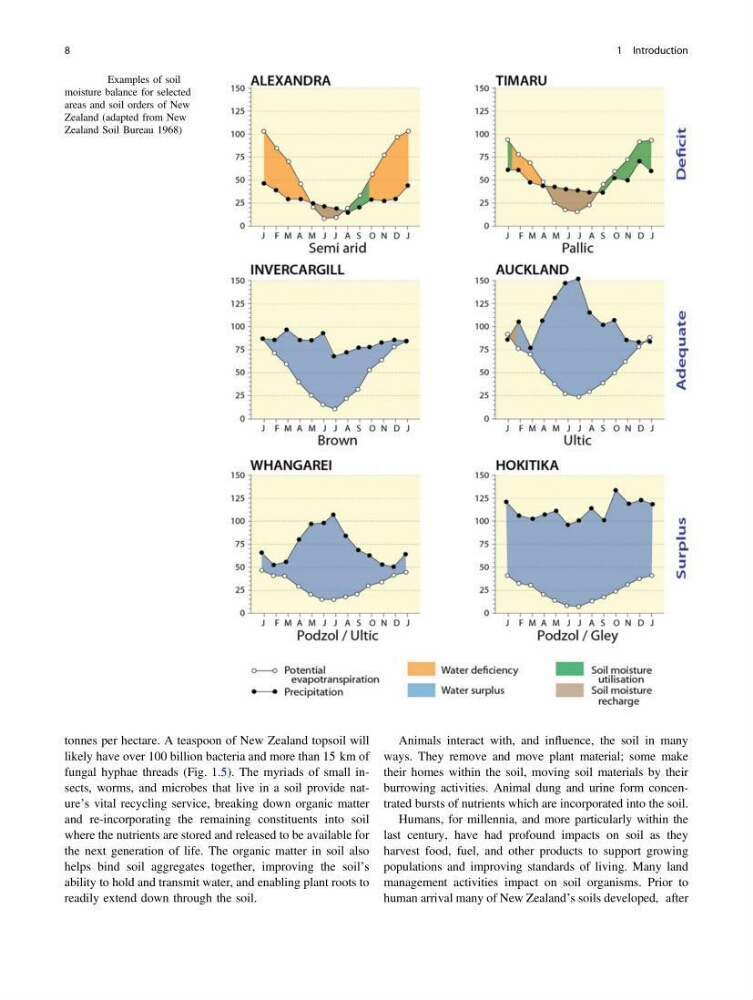
Fig. 1.4 Examples of soil
moisture balance for selected
areas and soil orders of New
Zealand (adapted from New
Zealand Soil Bureau 1968)
8
1 Introduction
likely have over 100 billion bacteria and more than 15 km of
fungal hyphae threads (Fig. 1.5). The myriads of small insects, worms, and microbes that live in a soil provide nature’s vital recycling service, breaking down organic matter
and re-incorporating the remaining constituents into soil
where the nutrients are stored and released to be available for
the next generation of life. The organic matter in soil also
helps bind soil aggregates together, improving the soil’s
ability to hold and transmit water, and enabling plant roots to
readily extend down through the soil.
Animals interact with, and influence, the soil in many
ways. They remove and move plant material; some make
their homes within the soil, moving soil materials by their
burrowing activities. Animal dung and urine form concentrated bursts of nutrients which are incorporated into the soil.
Humans, for millennia, and more particularly within the
last century, have had profound impacts on soil as they
harvest food, fuel, and other products to support growing
populations and improving standards of living. Many land
management activities impact on soil organisms. Prior to
human arrival many of New Zealand’s soils developed, after
Fig. 1.4 Examples of soil
moisture balance for selected
areas and soil orders of New
Zealand (adapted from New
Zealand Soil Bureau 1968)
8
1 Introduction