

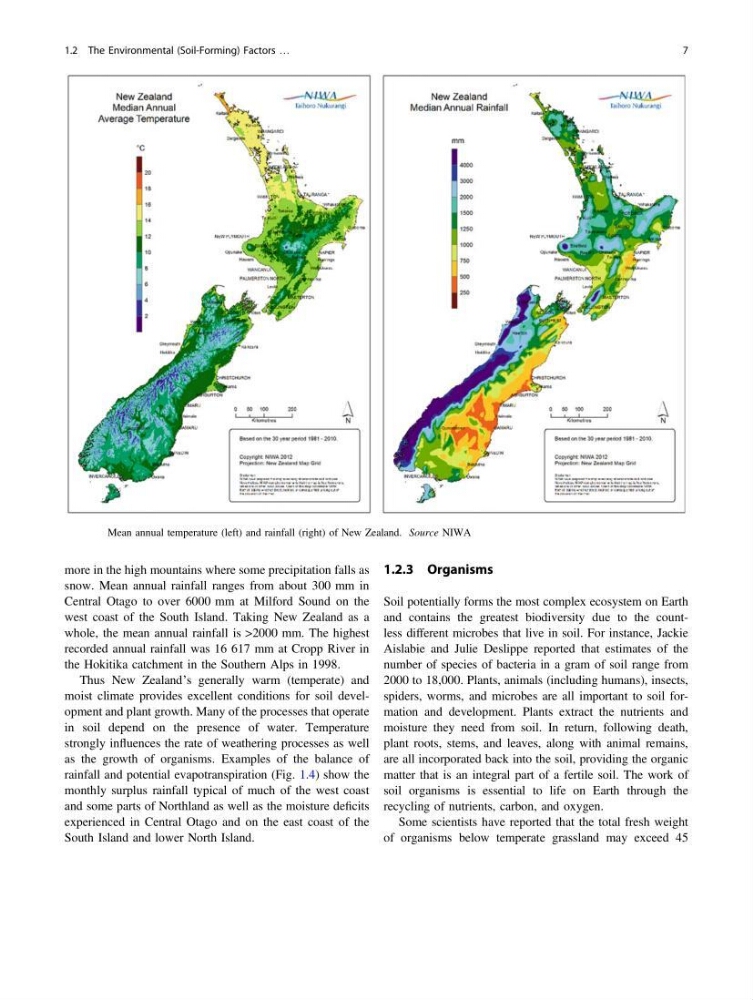
more in the high mountains where some precipitation falls as
snow. Mean annual rainfall ranges from about 300 mm in
Central Otago to over 6000 mm at Milford Sound on the
west coast of the South Island. Taking New Zealand as a
whole, the mean annual rainfall is >2000 mm. The highest
recorded annual rainfall was 16 617 mm at Cropp River in
the Hokitika catchment in the Southern Alps in 1998.
Thus New Zealand’s generally warm (temperate) and
moist climate provides excellent conditions for soil development and plant growth. Many of the processes that operate
in soil depend on the presence of water. Temperature
strongly influences the rate of weathering processes as well
as the growth of organisms. Examples of the balance of
rainfall and potential evapotranspiration (Fig. 1.4) show the
monthly surplus rainfall typical of much of the west coast
and some parts of Northland as well as the moisture deficits
experienced in Central Otago and on the east coast of the
South Island and lower North Island.
1.2.3 Organisms
Soil potentially forms the most complex ecosystem on Earth
and contains the greatest biodiversity due to the countless different microbes that live in soil. For instance, Jackie
Aislabie and Julie Deslippe reported that estimates of the
number of species of bacteria in a gram of soil range from
2000 to 18,000. Plants, animals (including humans), insects,
spiders, worms, and microbes are all important to soil formation and development. Plants extract the nutrients and
moisture they need from soil. In return, following death,
plant roots, stems, and leaves, along with animal remains,
are all incorporated back into the soil, providing the organic
matter that is an integral part of a fertile soil. The work of
soil organisms is essential to life on Earth through the
recycling of nutrients, carbon, and oxygen.
Some scientists have reported that the total fresh weight
of organisms below temperate grassland may exceed 45
Fig. 1.3 Mean annual temperature (left) and rainfall (right) of New Zealand. Source NIWA
1.2 The Environmental (Soil-Forming) Factors …
7
snow. Mean annual rainfall ranges from about 300 mm in
Central Otago to over 6000 mm at Milford Sound on the
west coast of the South Island. Taking New Zealand as a
whole, the mean annual rainfall is >2000 mm. The highest
recorded annual rainfall was 16 617 mm at Cropp River in
the Hokitika catchment in the Southern Alps in 1998.
Thus New Zealand’s generally warm (temperate) and
moist climate provides excellent conditions for soil development and plant growth. Many of the processes that operate
in soil depend on the presence of water. Temperature
strongly influences the rate of weathering processes as well
as the growth of organisms. Examples of the balance of
rainfall and potential evapotranspiration (Fig. 1.4) show the
monthly surplus rainfall typical of much of the west coast
and some parts of Northland as well as the moisture deficits
experienced in Central Otago and on the east coast of the
South Island and lower North Island.
1.2.3 Organisms
Soil potentially forms the most complex ecosystem on Earth
and contains the greatest biodiversity due to the countless different microbes that live in soil. For instance, Jackie
Aislabie and Julie Deslippe reported that estimates of the
number of species of bacteria in a gram of soil range from
2000 to 18,000. Plants, animals (including humans), insects,
spiders, worms, and microbes are all important to soil formation and development. Plants extract the nutrients and
moisture they need from soil. In return, following death,
plant roots, stems, and leaves, along with animal remains,
are all incorporated back into the soil, providing the organic
matter that is an integral part of a fertile soil. The work of
soil organisms is essential to life on Earth through the
recycling of nutrients, carbon, and oxygen.
Some scientists have reported that the total fresh weight
of organisms below temperate grassland may exceed 45
Fig. 1.3 Mean annual temperature (left) and rainfall (right) of New Zealand. Source NIWA
1.2 The Environmental (Soil-Forming) Factors …
7