

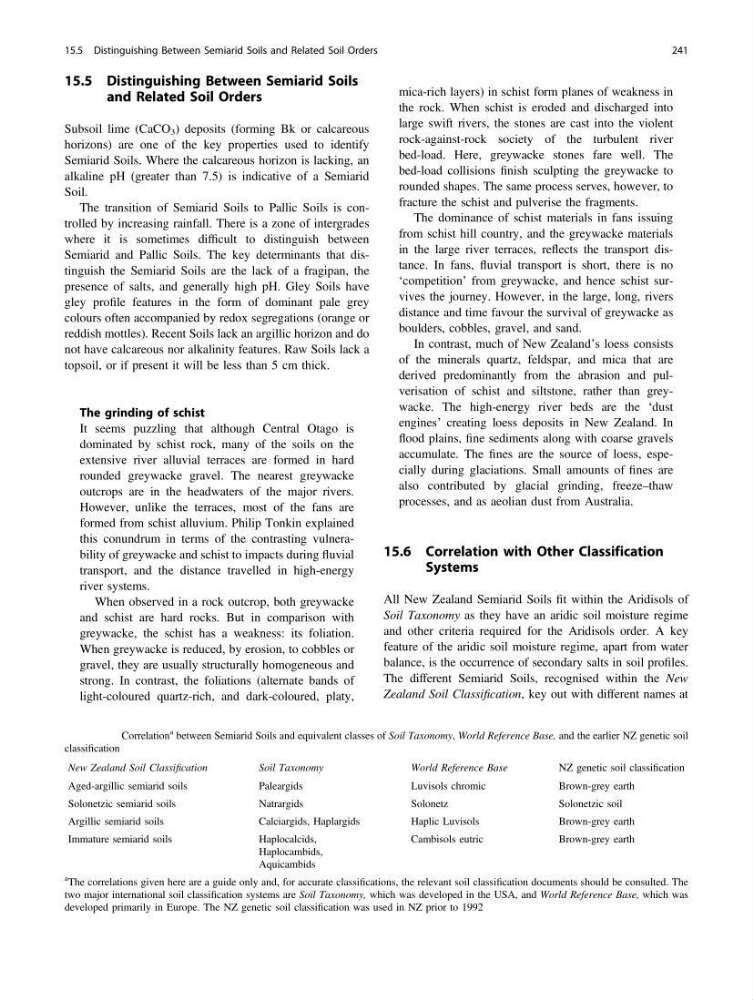
15.5 Distinguishing Between Semiarid Soils
and Related Soil Orders
Subsoil lime (CaCO 3 ) deposits (forming Bk or calcareous
horizons) are one of the key properties used to identify
Semiarid Soils. Where the calcareous horizon is lacking, an
alkaline pH (greater than 7.5) is indicative of a Semiarid
Soil.
The transition of Semiarid Soils to Pallic Soils is controlled by increasing rainfall. There is a zone of intergrades
where it is sometimes difficult to distinguish between
Semiarid and Pallic Soils. The key determinants that distinguish the Semiarid Soils are the lack of a fragipan, the
presence of salts, and generally high pH. Gley Soils have
gley profile features in the form of dominant pale grey
colours often accompanied by redox segregations (orange or
reddish mottles). Recent Soils lack an argillic horizon and do
not have calcareous nor alkalinity features. Raw Soils lack a
topsoil, or if present it will be less than 5 cm thick.
The grinding of schist
It seems puzzling that although Central Otago is
dominated by schist rock, many of the soils on the
extensive river alluvial terraces are formed in hard
rounded greywacke gravel. The nearest greywacke
outcrops are in the headwaters of the major rivers.
However, unlike the terraces, most of the fans are
formed from schist alluvium. Philip Tonkin explained
this conundrum in terms of the contrasting vulnerability of greywacke and schist to impacts during fluvial
transport, and the distance travelled in high-energy
river systems.
When observed in a rock outcrop, both greywacke
and schist are hard rocks. But in comparison with
greywacke, the schist has a weakness: its foliation.
When greywacke is reduced, by erosion, to cobbles or
gravel, they are usually structurally homogeneous and
strong. In contrast, the foliations (alternate bands of
light-coloured quartz-rich, and dark-coloured, platy,
mica-rich layers) in schist form planes of weakness in
the rock. When schist is eroded and discharged into
large swift rivers, the stones are cast into the violent
rock-against-rock society of the turbulent river
bed-load. Here, greywacke stones fare well. The
bed-load collisions finish sculpting the greywacke to
rounded shapes. The same process serves, however, to
fracture the schist and pulverise the fragments.
The dominance of schist materials in fans issuing
from schist hill country, and the greywacke materials
in the large river terraces, reflects the transport distance. In fans, fluvial transport is short, there is no
‘competition’ from greywacke, and hence schist survives the journey. However, in the large, long, rivers
distance and time favour the survival of greywacke as
boulders, cobbles, gravel, and sand.
In contrast, much of New Zealand’s loess consists
of the minerals quartz, feldspar, and mica that are
derived predominantly from the abrasion and pulverisation of schist and siltstone, rather than greywacke. The high-energy river beds are the ‘dust
engines’ creating loess deposits in New Zealand. In
flood plains, fine sediments along with coarse gravels
accumulate. The fines are the source of loess, especially during glaciations. Small amounts of fines are
also contributed by glacial grinding, freeze–thaw
processes, and as aeolian dust from Australia.
15.6 Correlation with Other Classification
Systems
All New Zealand Semiarid Soils fit within the Aridisols of
Soil Taxonomy as they have an aridic soil moisture regime
and other criteria required for the Aridisols order. A key
feature of the aridic soil moisture regime, apart from water
balance, is the occurrence of secondary salts in soil profiles.
The different Semiarid Soils, recognised within the New
Zealand Soil Classification, key out with different names at
Table 15.3 Correlation
a between Semiarid Soils and equivalent classes of Soil Taxonomy, World Reference Base, and the earlier NZ genetic soil
classification
New Zealand Soil Classification
Soil Taxonomy
World Reference Base
NZ genetic soil classification
Aged-argillic semiarid soils
Paleargids
Luvisols chromic
Brown-grey earth
Solonetzic semiarid soils
Natrargids
Solonetz
Solonetzic soil
Argillic semiarid soils
Calciargids, Haplargids
Haplic Luvisols
Brown-grey earth
Immature semiarid soils
Haplocalcids,
Haplocambids,
Aquicambids
Cambisols eutric
Brown-grey earth
a The correlations given here are a guide only and, for accurate classifications, the relevant soil classification documents should be consulted. The
two major international soil classification systems are Soil Taxonomy, which was developed in the USA, and World Reference Base, which was
developed primarily in Europe. The NZ genetic soil classification was used in NZ prior to 1992
15.5 Distinguishing Between Semiarid Soils and Related Soil Orders
241
and Related Soil Orders
Subsoil lime (CaCO 3 ) deposits (forming Bk or calcareous
horizons) are one of the key properties used to identify
Semiarid Soils. Where the calcareous horizon is lacking, an
alkaline pH (greater than 7.5) is indicative of a Semiarid
Soil.
The transition of Semiarid Soils to Pallic Soils is controlled by increasing rainfall. There is a zone of intergrades
where it is sometimes difficult to distinguish between
Semiarid and Pallic Soils. The key determinants that distinguish the Semiarid Soils are the lack of a fragipan, the
presence of salts, and generally high pH. Gley Soils have
gley profile features in the form of dominant pale grey
colours often accompanied by redox segregations (orange or
reddish mottles). Recent Soils lack an argillic horizon and do
not have calcareous nor alkalinity features. Raw Soils lack a
topsoil, or if present it will be less than 5 cm thick.
The grinding of schist
It seems puzzling that although Central Otago is
dominated by schist rock, many of the soils on the
extensive river alluvial terraces are formed in hard
rounded greywacke gravel. The nearest greywacke
outcrops are in the headwaters of the major rivers.
However, unlike the terraces, most of the fans are
formed from schist alluvium. Philip Tonkin explained
this conundrum in terms of the contrasting vulnerability of greywacke and schist to impacts during fluvial
transport, and the distance travelled in high-energy
river systems.
When observed in a rock outcrop, both greywacke
and schist are hard rocks. But in comparison with
greywacke, the schist has a weakness: its foliation.
When greywacke is reduced, by erosion, to cobbles or
gravel, they are usually structurally homogeneous and
strong. In contrast, the foliations (alternate bands of
light-coloured quartz-rich, and dark-coloured, platy,
mica-rich layers) in schist form planes of weakness in
the rock. When schist is eroded and discharged into
large swift rivers, the stones are cast into the violent
rock-against-rock society of the turbulent river
bed-load. Here, greywacke stones fare well. The
bed-load collisions finish sculpting the greywacke to
rounded shapes. The same process serves, however, to
fracture the schist and pulverise the fragments.
The dominance of schist materials in fans issuing
from schist hill country, and the greywacke materials
in the large river terraces, reflects the transport distance. In fans, fluvial transport is short, there is no
‘competition’ from greywacke, and hence schist survives the journey. However, in the large, long, rivers
distance and time favour the survival of greywacke as
boulders, cobbles, gravel, and sand.
In contrast, much of New Zealand’s loess consists
of the minerals quartz, feldspar, and mica that are
derived predominantly from the abrasion and pulverisation of schist and siltstone, rather than greywacke. The high-energy river beds are the ‘dust
engines’ creating loess deposits in New Zealand. In
flood plains, fine sediments along with coarse gravels
accumulate. The fines are the source of loess, especially during glaciations. Small amounts of fines are
also contributed by glacial grinding, freeze–thaw
processes, and as aeolian dust from Australia.
15.6 Correlation with Other Classification
Systems
All New Zealand Semiarid Soils fit within the Aridisols of
Soil Taxonomy as they have an aridic soil moisture regime
and other criteria required for the Aridisols order. A key
feature of the aridic soil moisture regime, apart from water
balance, is the occurrence of secondary salts in soil profiles.
The different Semiarid Soils, recognised within the New
Zealand Soil Classification, key out with different names at
Table 15.3 Correlation
a between Semiarid Soils and equivalent classes of Soil Taxonomy, World Reference Base, and the earlier NZ genetic soil
classification
New Zealand Soil Classification
Soil Taxonomy
World Reference Base
NZ genetic soil classification
Aged-argillic semiarid soils
Paleargids
Luvisols chromic
Brown-grey earth
Solonetzic semiarid soils
Natrargids
Solonetz
Solonetzic soil
Argillic semiarid soils
Calciargids, Haplargids
Haplic Luvisols
Brown-grey earth
Immature semiarid soils
Haplocalcids,
Haplocambids,
Aquicambids
Cambisols eutric
Brown-grey earth
a The correlations given here are a guide only and, for accurate classifications, the relevant soil classification documents should be consulted. The
two major international soil classification systems are Soil Taxonomy, which was developed in the USA, and World Reference Base, which was
developed primarily in Europe. The NZ genetic soil classification was used in NZ prior to 1992
15.5 Distinguishing Between Semiarid Soils and Related Soil Orders
241