

the suborder and great group levels of Soil Taxonomy
(Table 15.3). The World Reference Base (WRB) classification does not have a soil order equivalent to the Semiarid
Soils, which therefore correlate with a range of WRB soil
classifications, depending mainly on their degree of weathering. The brown-grey earths in the New Zealand genetic
soil classification all fall within the Semiarid Soils. The
solonetzic soils of the New Zealand genetic soil classification are also included in Semiarid Soils, with the solonetzic
features being recognised at soil group level.
15.7 Use and Management of Semiarid Soils
15.7.1 Introduction
There is evidence from preserved plant and bird remains in
the Earnscleugh Cave, and from the pollen record, that
immediately prior to human arrival the Central Otago landscape was largely dominated by coniferous forest. Since
humans entered the inland basins, the soils and their environment have been subjected to a number of impacts. The
first was the burning of forest by Polynesians to enable easier
penetration inland to herd moa and other game. When
Europeans arrived in the early nineteenth century, the
landscape comprised mainly tussock grasslands and shrublands with most forest vegetation lost to repeated fires,
except in small refuges. Sheep farming followed with further
burning to promote grass growth. The gold rush in the
1860s intensified the impacts with large numbers of new
settlers arriving in the region. The effects of sheep grazing,
along with the introduction of rabbits, which reached plague
proportions, resulted in the removal of vegetation (including
the litter, hence exposing bare soil to frost-heave and wind
erosion) and set off a period of accelerated soil erosion.
The unique climate and plentiful water supplies, carried
by the Clutha River from the high rainfall regions to the west
and from snow melt, support irrigated pasture and intensive
stone fruit and wine production in the region. Some Central
Otago fruit, such as cherries, have a unique global niche,
ripening in time for the Northern Hemisphere Christmas
market. Land management issues for the Semiarid Soils are
different from those in other regions of New Zealand, with
irrigation and erosion management both important. The
spectacular landscapes are an attraction for tourists. Hence,
there is a concern to protect landscape heritage values
including the remarkable, and globally extremely rare,
tor-dominated landscapes and other periglacial features including patterned ground, both relict and active, such as
relict stone stripes and active plough blocks in alpine zones.
15.7.2 Soil Management Considerations
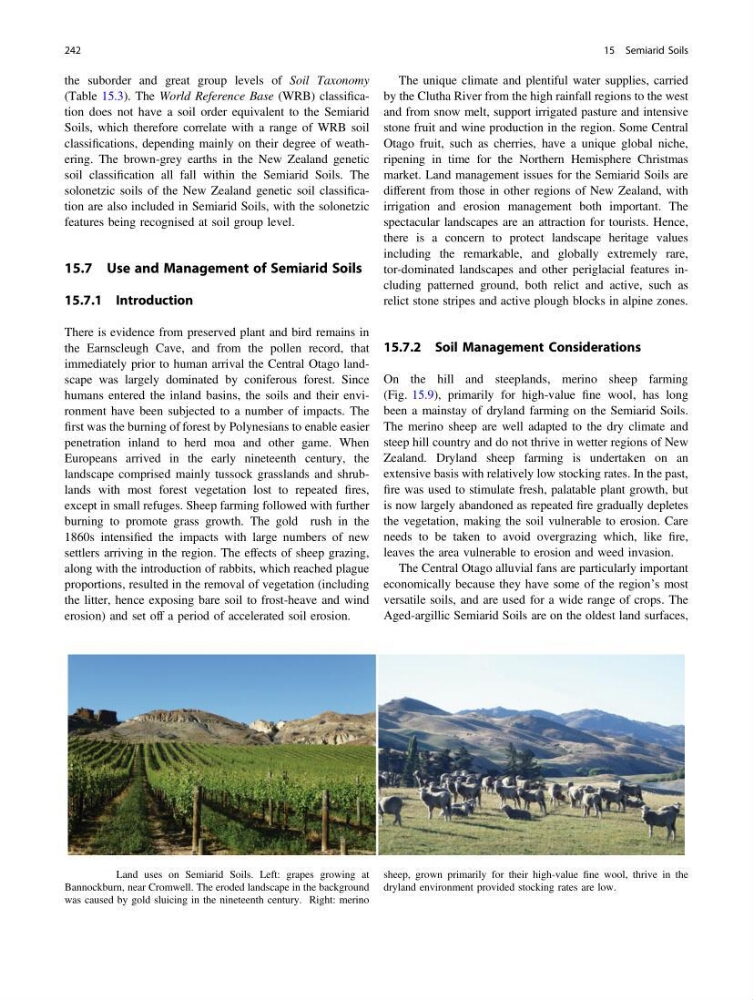
On the hill and steeplands, merino sheep farming
(Fig. 15.9), primarily for high-value fine wool, has long
been a mainstay of dryland farming on the Semiarid Soils.
The merino sheep are well adapted to the dry climate and
steep hill country and do not thrive in wetter regions of New
Zealand. Dryland sheep farming is undertaken on an
extensive basis with relatively low stocking rates. In the past,
fire was used to stimulate fresh, palatable plant growth, but
is now largely abandoned as repeated fire gradually depletes
the vegetation, making the soil vulnerable to erosion. Care
needs to be taken to avoid overgrazing which, like fire,
leaves the area vulnerable to erosion and weed invasion.
The Central Otago alluvial fans are particularly important
economically because they have some of the region’s most
versatile soils, and are used for a wide range of crops. The
Aged-argillic Semiarid Soils are on the oldest land surfaces,
Fig. 15.9 Land uses on Semiarid Soils. Left: grapes growing at
Bannockburn, near Cromwell. The eroded landscape in the background
was caused by gold sluicing in the nineteenth century. Right: merino
sheep, grown primarily for their high-value fine wool, thrive in the
dryland environment provided stocking rates are low.
242
15 Semiarid Soils
(Table 15.3). The World Reference Base (WRB) classification does not have a soil order equivalent to the Semiarid
Soils, which therefore correlate with a range of WRB soil
classifications, depending mainly on their degree of weathering. The brown-grey earths in the New Zealand genetic
soil classification all fall within the Semiarid Soils. The
solonetzic soils of the New Zealand genetic soil classification are also included in Semiarid Soils, with the solonetzic
features being recognised at soil group level.
15.7 Use and Management of Semiarid Soils
15.7.1 Introduction
There is evidence from preserved plant and bird remains in
the Earnscleugh Cave, and from the pollen record, that
immediately prior to human arrival the Central Otago landscape was largely dominated by coniferous forest. Since
humans entered the inland basins, the soils and their environment have been subjected to a number of impacts. The
first was the burning of forest by Polynesians to enable easier
penetration inland to herd moa and other game. When
Europeans arrived in the early nineteenth century, the
landscape comprised mainly tussock grasslands and shrublands with most forest vegetation lost to repeated fires,
except in small refuges. Sheep farming followed with further
burning to promote grass growth. The gold rush in the
1860s intensified the impacts with large numbers of new
settlers arriving in the region. The effects of sheep grazing,
along with the introduction of rabbits, which reached plague
proportions, resulted in the removal of vegetation (including
the litter, hence exposing bare soil to frost-heave and wind
erosion) and set off a period of accelerated soil erosion.
The unique climate and plentiful water supplies, carried
by the Clutha River from the high rainfall regions to the west
and from snow melt, support irrigated pasture and intensive
stone fruit and wine production in the region. Some Central
Otago fruit, such as cherries, have a unique global niche,
ripening in time for the Northern Hemisphere Christmas
market. Land management issues for the Semiarid Soils are
different from those in other regions of New Zealand, with
irrigation and erosion management both important. The
spectacular landscapes are an attraction for tourists. Hence,
there is a concern to protect landscape heritage values
including the remarkable, and globally extremely rare,
tor-dominated landscapes and other periglacial features including patterned ground, both relict and active, such as
relict stone stripes and active plough blocks in alpine zones.
15.7.2 Soil Management Considerations
On the hill and steeplands, merino sheep farming
(Fig. 15.9), primarily for high-value fine wool, has long
been a mainstay of dryland farming on the Semiarid Soils.
The merino sheep are well adapted to the dry climate and
steep hill country and do not thrive in wetter regions of New
Zealand. Dryland sheep farming is undertaken on an
extensive basis with relatively low stocking rates. In the past,
fire was used to stimulate fresh, palatable plant growth, but
is now largely abandoned as repeated fire gradually depletes
the vegetation, making the soil vulnerable to erosion. Care
needs to be taken to avoid overgrazing which, like fire,
leaves the area vulnerable to erosion and weed invasion.
The Central Otago alluvial fans are particularly important
economically because they have some of the region’s most
versatile soils, and are used for a wide range of crops. The
Aged-argillic Semiarid Soils are on the oldest land surfaces,
Fig. 15.9 Land uses on Semiarid Soils. Left: grapes growing at
Bannockburn, near Cromwell. The eroded landscape in the background
was caused by gold sluicing in the nineteenth century. Right: merino
sheep, grown primarily for their high-value fine wool, thrive in the
dryland environment provided stocking rates are low.
242
15 Semiarid Soils