

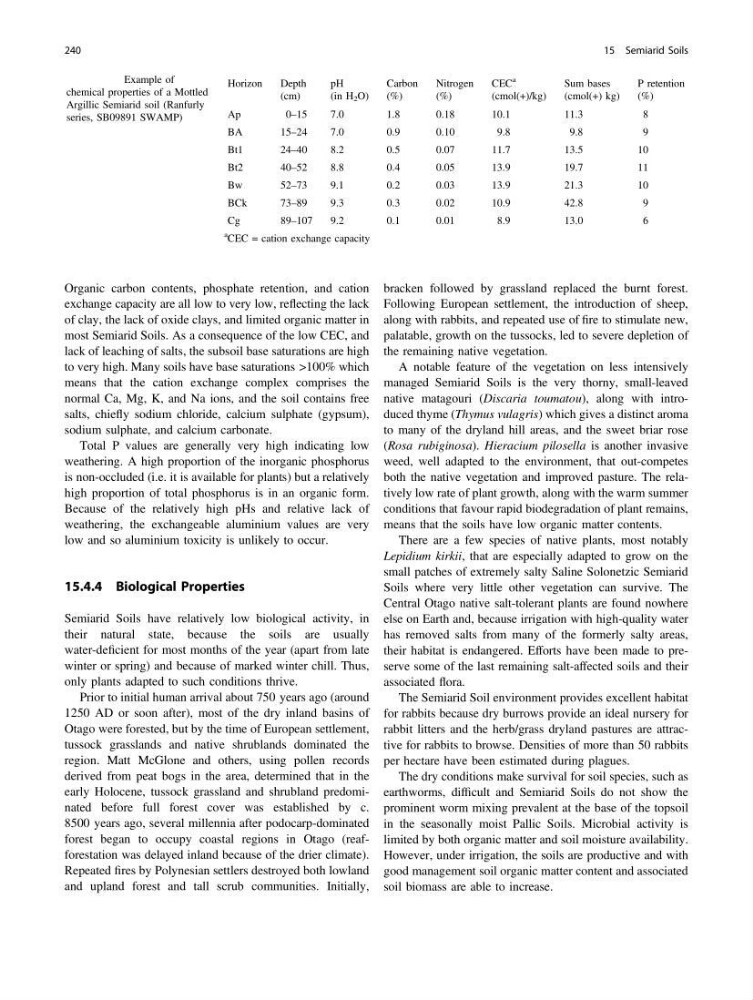
Organic carbon contents, phosphate retention, and cation
exchange capacity are all low to very low, reflecting the lack
of clay, the lack of oxide clays, and limited organic matter in
most Semiarid Soils. As a consequence of the low CEC, and
lack of leaching of salts, the subsoil base saturations are high
to very high. Many soils have base saturations >100% which
means that the cation exchange complex comprises the
normal Ca, Mg, K, and Na ions, and the soil contains free
salts, chiefly sodium chloride, calcium sulphate (gypsum),
sodium sulphate, and calcium carbonate.
Total P values are generally very high indicating low
weathering. A high proportion of the inorganic phosphorus
is non-occluded (i.e. it is available for plants) but a relatively
high proportion of total phosphorus is in an organic form.
Because of the relatively high pHs and relative lack of
weathering, the exchangeable aluminium values are very
low and so aluminium toxicity is unlikely to occur.
15.4.4 Biological Properties
Semiarid Soils have relatively low biological activity, in
their natural state, because the soils are usually
water-deficient for most months of the year (apart from late
winter or spring) and because of marked winter chill. Thus,
only plants adapted to such conditions thrive.
Prior to initial human arrival about 750 years ago (around
1250 AD or soon after), most of the dry inland basins of
Otago were forested, but by the time of European settlement,
tussock grasslands and native shrublands dominated the
region. Matt McGlone and others, using pollen records
derived from peat bogs in the area, determined that in the
early Holocene, tussock grassland and shrubland predominated before full forest cover was established by c.
8500 years ago, several millennia after podocarp-dominated
forest began to occupy coastal regions in Otago (reafforestation was delayed inland because of the drier climate).
Repeated fires by Polynesian settlers destroyed both lowland
and upland forest and tall scrub communities. Initially,
bracken followed by grassland replaced the burnt forest.
Following European settlement, the introduction of sheep,
along with rabbits, and repeated use of fire to stimulate new,
palatable, growth on the tussocks, led to severe depletion of
the remaining native vegetation.
A notable feature of the vegetation on less intensively
managed Semiarid Soils is the very thorny, small-leaved
native matagouri (Discaria toumatou), along with introduced thyme (Thymus vulagris) which gives a distinct aroma
to many of the dryland hill areas, and the sweet briar rose
(Rosa rubiginosa). Hieracium pilosella is another invasive
weed, well adapted to the environment, that out-competes
both the native vegetation and improved pasture. The relatively low rate of plant growth, along with the warm summer
conditions that favour rapid biodegradation of plant remains,
means that the soils have low organic matter contents.
There are a few species of native plants, most notably
Lepidium kirkii, that are especially adapted to grow on the
small patches of extremely salty Saline Solonetzic Semiarid
Soils where very little other vegetation can survive. The
Central Otago native salt-tolerant plants are found nowhere
else on Earth and, because irrigation with high-quality water
has removed salts from many of the formerly salty areas,
their habitat is endangered. Efforts have been made to preserve some of the last remaining salt-affected soils and their
associated flora.
The Semiarid Soil environment provides excellent habitat
for rabbits because dry burrows provide an ideal nursery for
rabbit litters and the herb/grass dryland pastures are attractive for rabbits to browse. Densities of more than 50 rabbits
per hectare have been estimated during plagues.
The dry conditions make survival for soil species, such as
earthworms, difficult and Semiarid Soils do not show the
prominent worm mixing prevalent at the base of the topsoil
in the seasonally moist Pallic Soils. Microbial activity is
limited by both organic matter and soil moisture availability.
However, under irrigation, the soils are productive and with
good management soil organic matter content and associated
soil biomass are able to increase.
Table 15.2 Example of
chemical properties of a Mottled
Argillic Semiarid soil (Ranfurly
series, SB09891 SWAMP)
Horizon
Depth
(cm)
pH
(in H 2 O)
Carbon
(%)
Nitrogen
(%)
CEC
a
(cmol(+)/kg)
Sum bases
(cmol(+) kg)
P retention
(%)
Ap
0–15
7.0
1.8
0.18
10.1
11.3
8
BA
15–24
7.0
0.9
0.10
9.8
9.8
9
Bt1
24–40
8.2
0.5
0.07
11.7
13.5
10
Bt2
40–52
8.8
0.4
0.05
13.9
19.7
11
Bw
52–73
9.1
0.2
0.03
13.9
21.3
10
BCk
73–89
9.3
0.3
0.02
10.9
42.8
9
Cg
89–107
9.2
0.1
0.01
8.9
13.0
6
a CEC = cation exchange capacity
240
15 Semiarid Soils
exchange capacity are all low to very low, reflecting the lack
of clay, the lack of oxide clays, and limited organic matter in
most Semiarid Soils. As a consequence of the low CEC, and
lack of leaching of salts, the subsoil base saturations are high
to very high. Many soils have base saturations >100% which
means that the cation exchange complex comprises the
normal Ca, Mg, K, and Na ions, and the soil contains free
salts, chiefly sodium chloride, calcium sulphate (gypsum),
sodium sulphate, and calcium carbonate.
Total P values are generally very high indicating low
weathering. A high proportion of the inorganic phosphorus
is non-occluded (i.e. it is available for plants) but a relatively
high proportion of total phosphorus is in an organic form.
Because of the relatively high pHs and relative lack of
weathering, the exchangeable aluminium values are very
low and so aluminium toxicity is unlikely to occur.
15.4.4 Biological Properties
Semiarid Soils have relatively low biological activity, in
their natural state, because the soils are usually
water-deficient for most months of the year (apart from late
winter or spring) and because of marked winter chill. Thus,
only plants adapted to such conditions thrive.
Prior to initial human arrival about 750 years ago (around
1250 AD or soon after), most of the dry inland basins of
Otago were forested, but by the time of European settlement,
tussock grasslands and native shrublands dominated the
region. Matt McGlone and others, using pollen records
derived from peat bogs in the area, determined that in the
early Holocene, tussock grassland and shrubland predominated before full forest cover was established by c.
8500 years ago, several millennia after podocarp-dominated
forest began to occupy coastal regions in Otago (reafforestation was delayed inland because of the drier climate).
Repeated fires by Polynesian settlers destroyed both lowland
and upland forest and tall scrub communities. Initially,
bracken followed by grassland replaced the burnt forest.
Following European settlement, the introduction of sheep,
along with rabbits, and repeated use of fire to stimulate new,
palatable, growth on the tussocks, led to severe depletion of
the remaining native vegetation.
A notable feature of the vegetation on less intensively
managed Semiarid Soils is the very thorny, small-leaved
native matagouri (Discaria toumatou), along with introduced thyme (Thymus vulagris) which gives a distinct aroma
to many of the dryland hill areas, and the sweet briar rose
(Rosa rubiginosa). Hieracium pilosella is another invasive
weed, well adapted to the environment, that out-competes
both the native vegetation and improved pasture. The relatively low rate of plant growth, along with the warm summer
conditions that favour rapid biodegradation of plant remains,
means that the soils have low organic matter contents.
There are a few species of native plants, most notably
Lepidium kirkii, that are especially adapted to grow on the
small patches of extremely salty Saline Solonetzic Semiarid
Soils where very little other vegetation can survive. The
Central Otago native salt-tolerant plants are found nowhere
else on Earth and, because irrigation with high-quality water
has removed salts from many of the formerly salty areas,
their habitat is endangered. Efforts have been made to preserve some of the last remaining salt-affected soils and their
associated flora.
The Semiarid Soil environment provides excellent habitat
for rabbits because dry burrows provide an ideal nursery for
rabbit litters and the herb/grass dryland pastures are attractive for rabbits to browse. Densities of more than 50 rabbits
per hectare have been estimated during plagues.
The dry conditions make survival for soil species, such as
earthworms, difficult and Semiarid Soils do not show the
prominent worm mixing prevalent at the base of the topsoil
in the seasonally moist Pallic Soils. Microbial activity is
limited by both organic matter and soil moisture availability.
However, under irrigation, the soils are productive and with
good management soil organic matter content and associated
soil biomass are able to increase.
Table 15.2 Example of
chemical properties of a Mottled
Argillic Semiarid soil (Ranfurly
series, SB09891 SWAMP)
Horizon
Depth
(cm)
pH
(in H 2 O)
Carbon
(%)
Nitrogen
(%)
CEC
a
(cmol(+)/kg)
Sum bases
(cmol(+) kg)
P retention
(%)
Ap
0–15
7.0
1.8
0.18
10.1
11.3
8
BA
15–24
7.0
0.9
0.10
9.8
9.8
9
Bt1
24–40
8.2
0.5
0.07
11.7
13.5
10
Bt2
40–52
8.8
0.4
0.05
13.9
19.7
11
Bw
52–73
9.1
0.2
0.03
13.9
21.3
10
BCk
73–89
9.3
0.3
0.02
10.9
42.8
9
Cg
89–107
9.2
0.1
0.01
8.9
13.0
6
a CEC = cation exchange capacity
240
15 Semiarid Soils