

origin. The calcium carbonate is formed from the release (by
hydrolysis) of calcium and other ions from silicate minerals
in non-calcareous parent materials, typically gravelly and
sandy alluvium, and carbon dioxide contributed from the
respiration of microbes living in the pores of the soil.
Over time, sodium may displace calcium and accumulate
in the soil. Sodium is of particular interest and concern as
sodium accumulation may impact on soil structure and
permeability as well as plant growth and survival. Sodium in
soils occurs mainly in two chemical states. First, it exists as
salts commonly as sodium chloride (common table salt) or
sodium sulphate, together with calcium salts. In dry soil, the
salts are crystalline whereas in wet soil they are dissolved in
the soil water. The second state occurs when sodium cations
become attached to the negatively charged cation exchange
complex of the clay minerals and soil organic matter. These
two chemical states of sodium give rise to three soil forms:
– saline soils dominated by sodium salts—e.g. Saline
Immature Semiarid Soils;
– sodic soils dominated by exchangeable sodium—
Solonetzic Semiarid Soils; and
– saline-sodic soils where sodium is present both as salt
and in the exchangeable state—Saline Solonetzic Semiarid Soil.
The three soil forms three soil forms underpin a soil
development sequence. The initial soil has a cation exchange
complex dominated by calcium and magnesium bivalent
cations, for example, the Typic Immature Semiarid Soil
(Figs. 15.1, 15.4) which contains free calcium carbonate.
With the incursion of a shallow saline water table, monovalent
sodium cations will gradually displace the bivalent cations
and, with gradual dominance of sodium, a saline-sodic soil
forms. While the soil solution salinity remains high, the soil
structure will remain flocculated, and the soil will remain
permeable. If the water table is lowered, rain water (or irrigation water) of low ionic strength will leach out the saline
soil solution, but sodium cations that are relatively firmly
bonded to cation exchange sites will remain in the exchange
complex, and a sodic soil is formed. Soil aggregates may then
disperse, fine clay platelets will migrate in suspension down
the soil profile to settle out on ped faces or void walls (which
act as filters), or flocculate (where charges and pH are
favourable) to form a clay-enriched (argillic) horizon.
In the New Zealand Soil Classification, the three soil
forms are defined by the electrical conductivity (EC), which
estimates the total salt content, and the exchangeable sodium
percentage (ESP), which estimates the percentage of cation
exchange capacity occupied by exchangeable sodium.
Alkalinity is associated with sodicity and so a pH below 8.5
indicates saline soils, and pH above 8.5 indicates sodic soils.
Saline sodic soils have pH values near or above 8.5.
The soil/salt development sequence is consistent with the
distribution of the soil types in the Central Otago landscape,
where saline and saline-sodic soils occur on younger, or
lower, parts of the landscape where water tables remain high.
Sodic soils with characteristic argillic horizons are on higher
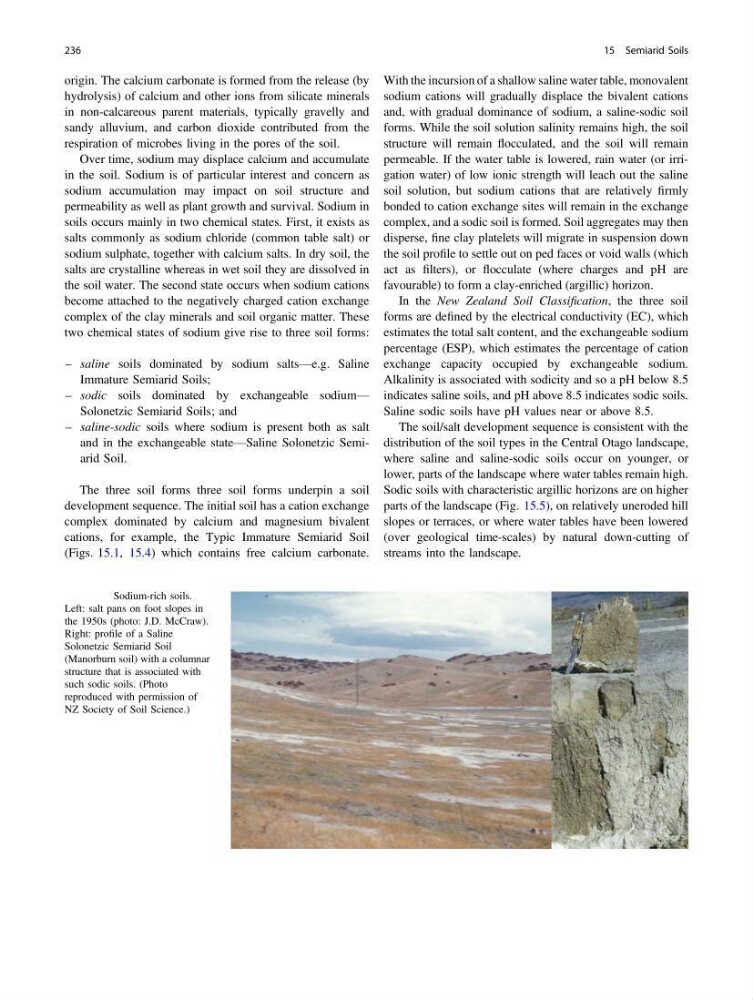
parts of the landscape (Fig. 15.5), on relatively uneroded hill
slopes or terraces, or where water tables have been lowered
(over geological time-scales) by natural down-cutting of
streams into the landscape.
Fig. 15.5 Sodium-rich soils.
Left: salt pans on foot slopes in
the 1950s (photo: J.D. McCraw).
Right: profile of a Saline
Solonetzic Semiarid Soil
(Manorburn soil) with a columnar
structure that is associated with
such sodic soils. (Photo
reproduced with permission of
NZ Society of Soil Science.)
236
15 Semiarid Soils
hydrolysis) of calcium and other ions from silicate minerals
in non-calcareous parent materials, typically gravelly and
sandy alluvium, and carbon dioxide contributed from the
respiration of microbes living in the pores of the soil.
Over time, sodium may displace calcium and accumulate
in the soil. Sodium is of particular interest and concern as
sodium accumulation may impact on soil structure and
permeability as well as plant growth and survival. Sodium in
soils occurs mainly in two chemical states. First, it exists as
salts commonly as sodium chloride (common table salt) or
sodium sulphate, together with calcium salts. In dry soil, the
salts are crystalline whereas in wet soil they are dissolved in
the soil water. The second state occurs when sodium cations
become attached to the negatively charged cation exchange
complex of the clay minerals and soil organic matter. These
two chemical states of sodium give rise to three soil forms:
– saline soils dominated by sodium salts—e.g. Saline
Immature Semiarid Soils;
– sodic soils dominated by exchangeable sodium—
Solonetzic Semiarid Soils; and
– saline-sodic soils where sodium is present both as salt
and in the exchangeable state—Saline Solonetzic Semiarid Soil.
The three soil forms three soil forms underpin a soil
development sequence. The initial soil has a cation exchange
complex dominated by calcium and magnesium bivalent
cations, for example, the Typic Immature Semiarid Soil
(Figs. 15.1, 15.4) which contains free calcium carbonate.
With the incursion of a shallow saline water table, monovalent
sodium cations will gradually displace the bivalent cations
and, with gradual dominance of sodium, a saline-sodic soil
forms. While the soil solution salinity remains high, the soil
structure will remain flocculated, and the soil will remain
permeable. If the water table is lowered, rain water (or irrigation water) of low ionic strength will leach out the saline
soil solution, but sodium cations that are relatively firmly
bonded to cation exchange sites will remain in the exchange
complex, and a sodic soil is formed. Soil aggregates may then
disperse, fine clay platelets will migrate in suspension down
the soil profile to settle out on ped faces or void walls (which
act as filters), or flocculate (where charges and pH are
favourable) to form a clay-enriched (argillic) horizon.
In the New Zealand Soil Classification, the three soil
forms are defined by the electrical conductivity (EC), which
estimates the total salt content, and the exchangeable sodium
percentage (ESP), which estimates the percentage of cation
exchange capacity occupied by exchangeable sodium.
Alkalinity is associated with sodicity and so a pH below 8.5
indicates saline soils, and pH above 8.5 indicates sodic soils.
Saline sodic soils have pH values near or above 8.5.
The soil/salt development sequence is consistent with the
distribution of the soil types in the Central Otago landscape,
where saline and saline-sodic soils occur on younger, or
lower, parts of the landscape where water tables remain high.
Sodic soils with characteristic argillic horizons are on higher
parts of the landscape (Fig. 15.5), on relatively uneroded hill
slopes or terraces, or where water tables have been lowered
(over geological time-scales) by natural down-cutting of
streams into the landscape.
Fig. 15.5 Sodium-rich soils.
Left: salt pans on foot slopes in
the 1950s (photo: J.D. McCraw).
Right: profile of a Saline
Solonetzic Semiarid Soil
(Manorburn soil) with a columnar
structure that is associated with
such sodic soils. (Photo
reproduced with permission of
NZ Society of Soil Science.)
236
15 Semiarid Soils