

on the easily eroded mudstone substrates in eastern North
Island, there is a mosaic soil pattern comprising:
• young scars or landslide deposits that have not been
weathered greatly and so are Orthic Raw Soils;
• older landslide scars and deposits that have a distinct
topsoil formed and so are Recent Soils; and
• un-eroded areas that comprise the ‘climax’ soil of the
area, e.g. Brown, Pallic, Podzol, Granular, or Ultic Soils.
13.4 Key Soil Properties
For most of the Raw Soil groups, the normal soil profile
morphology, comprising pedogenically modified material in
the form of soil horizons, is not applicable, and so the usual
suite of physical, chemical, and biological analyses have not
been undertaken. Nevertheless, the properties of many of the
earth materials which make up Raw Soils have been studied
by geotechnical scientists, engineers, soil conservators, and
pedologists seeking ‘time zero’ soils for studies on soil
evolution. Such knowledge contributes to understanding the
genesis, behaviour, and management requirements of Raw
Soils.
The soil mineralogy is inherited from the generally relatively unweathered parent material. Coarse fragments and
sand particles are typically without coatings, although clasts
in scree may have weathering rinds and hydrothermally
altered material may include secondary products.
Fluid Raw Soils have been studied by soil scientists and
engineers particularly in The Netherlands where land above
the water table is at a premium. Fluid Raw Soils occur in
young sediments that have a continuously high water table,
such as in tidal mudflats, and exist in an ‘unripened’ state.
Ripening is the process of consolidation of sediment due to
dewatering and consequent settlement of the material with
an increase in bulk density and development of strength and
cohesion. The simplest method of estimating the state of
‘ripening’ of a sample is to squeeze a sample in the hand and
judge its fluidity. A fist-full of soil is squeezed firmly in the
hand and a ripened soil will not flow out of the hand, or
between the fingers, under this pressure.
A quantitative method for determining a state of ripening
(n) was determined in The Netherlands by Pons and Zonneveld in 1965 as follows:
n ¼ A À 0:2R
ð
Þ = L þ bH
ð
Þ
where
n = degree of ripening (or the water factor) in g of water
adsorbed by 1 g of the clay fraction,
A = is gravimetric water content (g/100 g dry soil),
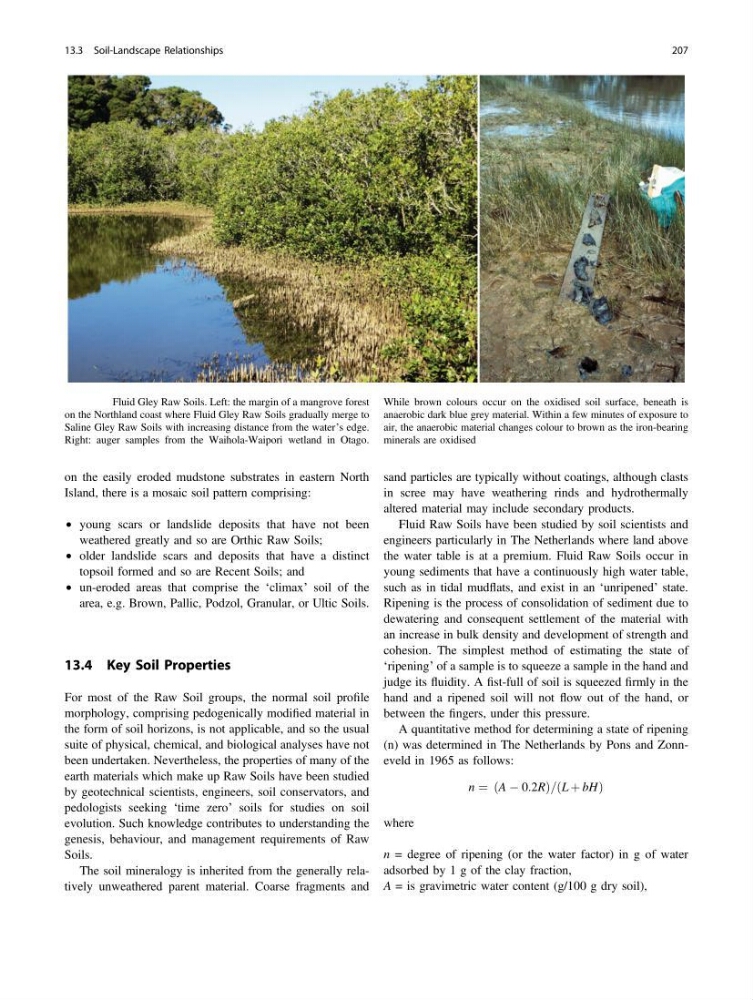
Fig. 13.7 Fluid Gley Raw Soils. Left: the margin of a mangrove forest
on the Northland coast where Fluid Gley Raw Soils gradually merge to
Saline Gley Raw Soils with increasing distance from the water’s edge.
Right: auger samples from the Waihola-Waipori wetland in Otago.
While brown colours occur on the oxidised soil surface, beneath is
anaerobic dark blue grey material. Within a few minutes of exposure to
air, the anaerobic material changes colour to brown as the iron-bearing
minerals are oxidised
13.3 Soil-Landscape Relationships
207
Island, there is a mosaic soil pattern comprising:
• young scars or landslide deposits that have not been
weathered greatly and so are Orthic Raw Soils;
• older landslide scars and deposits that have a distinct
topsoil formed and so are Recent Soils; and
• un-eroded areas that comprise the ‘climax’ soil of the
area, e.g. Brown, Pallic, Podzol, Granular, or Ultic Soils.
13.4 Key Soil Properties
For most of the Raw Soil groups, the normal soil profile
morphology, comprising pedogenically modified material in
the form of soil horizons, is not applicable, and so the usual
suite of physical, chemical, and biological analyses have not
been undertaken. Nevertheless, the properties of many of the
earth materials which make up Raw Soils have been studied
by geotechnical scientists, engineers, soil conservators, and
pedologists seeking ‘time zero’ soils for studies on soil
evolution. Such knowledge contributes to understanding the
genesis, behaviour, and management requirements of Raw
Soils.
The soil mineralogy is inherited from the generally relatively unweathered parent material. Coarse fragments and
sand particles are typically without coatings, although clasts
in scree may have weathering rinds and hydrothermally
altered material may include secondary products.
Fluid Raw Soils have been studied by soil scientists and
engineers particularly in The Netherlands where land above
the water table is at a premium. Fluid Raw Soils occur in
young sediments that have a continuously high water table,
such as in tidal mudflats, and exist in an ‘unripened’ state.
Ripening is the process of consolidation of sediment due to
dewatering and consequent settlement of the material with
an increase in bulk density and development of strength and
cohesion. The simplest method of estimating the state of
‘ripening’ of a sample is to squeeze a sample in the hand and
judge its fluidity. A fist-full of soil is squeezed firmly in the
hand and a ripened soil will not flow out of the hand, or
between the fingers, under this pressure.
A quantitative method for determining a state of ripening
(n) was determined in The Netherlands by Pons and Zonneveld in 1965 as follows:
n ¼ A À 0:2R
ð
Þ = L þ bH
ð
Þ
where
n = degree of ripening (or the water factor) in g of water
adsorbed by 1 g of the clay fraction,
A = is gravimetric water content (g/100 g dry soil),
Fig. 13.7 Fluid Gley Raw Soils. Left: the margin of a mangrove forest
on the Northland coast where Fluid Gley Raw Soils gradually merge to
Saline Gley Raw Soils with increasing distance from the water’s edge.
Right: auger samples from the Waihola-Waipori wetland in Otago.
While brown colours occur on the oxidised soil surface, beneath is
anaerobic dark blue grey material. Within a few minutes of exposure to
air, the anaerobic material changes colour to brown as the iron-bearing
minerals are oxidised
13.3 Soil-Landscape Relationships
207