

at least 25 cm (or the pumice layer is 35 cm in thickness
within the upper 60 cm of the profile).
Where pumice is not obvious, and allophanic soil material is not positively identified, then the glass (vitric material)
content of the sand fraction needs to be estimated. The
presence of a weathered Bw horizon at least 5 cm thick
distinguishes a Pumice Soil from a Recent Soil. The Tephric
Recent Soil group is distinguished from the Pumice Soils by
specifically lacking pumice, instead comprising tephric soil
material 30 cm thick in the upper profile. Fluvially
redeposited pumice materials that immediately post-date the
Taupo eruption occur extensively on terraces and other
landforms along the Waikato, Rangitaiki, Waipunga, and
Whanganui rivers. Where the soils formed in pumiceous
deposits (Taupo Pumice Alluvium) lack the 5-cm-thick
Bw horizon needed for Pumice Soils they are instead classed
as Recent Soils.
Other soils, including Allophanic Soils and Brown Soils,
may incorporate pumiceous tephra that was deposited in
small amounts on the periphery of eruption fall-out or
reworked as tephric loess or alluvium. In such soils, the
amount of glassy pumiceous material is too low to dominate
the soil properties.
12.6 Correlation with Other Classification
Systems
Both Soil Taxonomy and the World Reference Base combine
what in New Zealand are called Allophanic Soils and
Pumice Soils, into one soil order—Andisols (in Soil Taxonomy) and Andosols (in World Reference Base). New
Zealand has recognised the Pumice and Allophanic Soils as
two separate soil orders because they are largely geographically distinct, have contrasting properties that require different management, and between them make up about 28%
of the North Island. The Pumice Soils key out as ‘vitric’ in
the international systems reflecting the high content of volcanic glass (Table 12.3).
12.7 Use and Management of Pumice Soils
12.7.1 Introduction
Pollen evidence shows that the forest was re-established
within about 200 years after the *232 AD Taupo eruption.
However, deforestation began about 1280 AD, which is
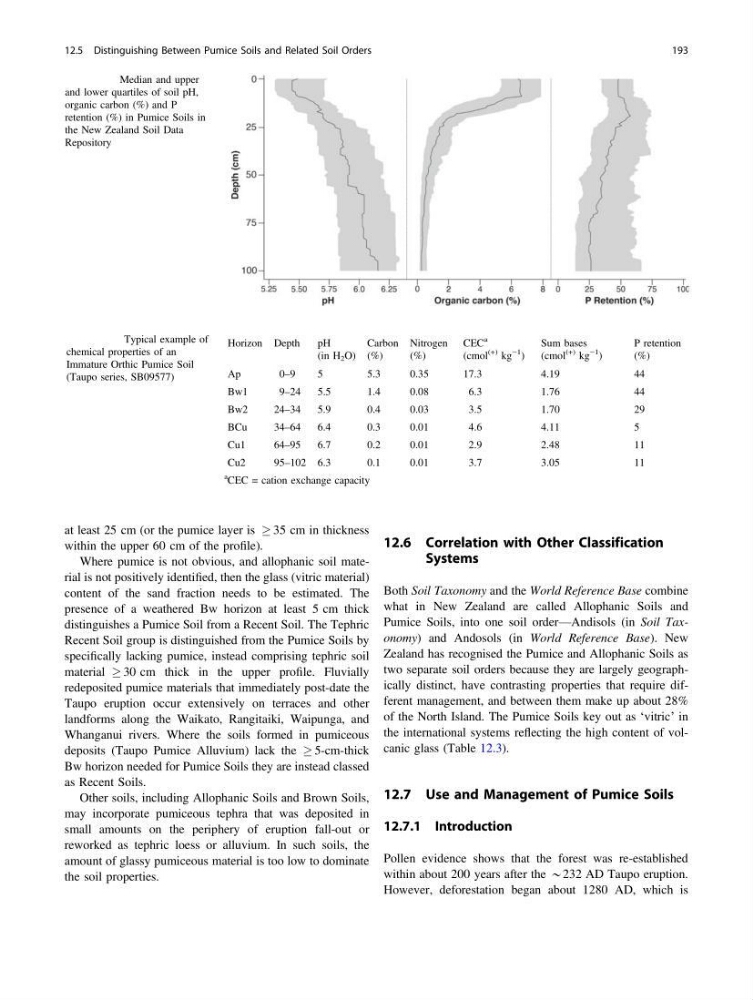
Fig. 12.12 Median and upper
and lower quartiles of soil pH,
organic carbon (%) and P
retention (%) in Pumice Soils in
the New Zealand Soil Data
Repository
Table 12.2 Typical example of
chemical properties of an
Immature Orthic Pumice Soil
(Taupo series, SB09577)
Horizon Depth
pH
(in H 2 O)
Carbon
(%)
Nitrogen
(%)
CEC
a
(cmol
(+) kg
−1
)
Sum bases
(cmol
(+) kg
−1
)
P retention
(%)
Ap
0–9
5
5.3
0.35
17.3
4.19
44
Bw1
9–24
5.5
1.4
0.08
6.3
1.76
44
Bw2
24–34
5.9
0.4
0.03
3.5
1.70
29
BCu
34–64
6.4
0.3
0.01
4.6
4.11
5
Cu1
64–95
6.7
0.2
0.01
2.9
2.48
11
Cu2
95–102 6.3
0.1
0.01
3.7
3.05
11
a CEC = cation exchange capacity
12.5 Distinguishing Between Pumice Soils and Related Soil Orders
193
within the upper 60 cm of the profile).
Where pumice is not obvious, and allophanic soil material is not positively identified, then the glass (vitric material)
content of the sand fraction needs to be estimated. The
presence of a weathered Bw horizon at least 5 cm thick
distinguishes a Pumice Soil from a Recent Soil. The Tephric
Recent Soil group is distinguished from the Pumice Soils by
specifically lacking pumice, instead comprising tephric soil
material 30 cm thick in the upper profile. Fluvially
redeposited pumice materials that immediately post-date the
Taupo eruption occur extensively on terraces and other
landforms along the Waikato, Rangitaiki, Waipunga, and
Whanganui rivers. Where the soils formed in pumiceous
deposits (Taupo Pumice Alluvium) lack the 5-cm-thick
Bw horizon needed for Pumice Soils they are instead classed
as Recent Soils.
Other soils, including Allophanic Soils and Brown Soils,
may incorporate pumiceous tephra that was deposited in
small amounts on the periphery of eruption fall-out or
reworked as tephric loess or alluvium. In such soils, the
amount of glassy pumiceous material is too low to dominate
the soil properties.
12.6 Correlation with Other Classification
Systems
Both Soil Taxonomy and the World Reference Base combine
what in New Zealand are called Allophanic Soils and
Pumice Soils, into one soil order—Andisols (in Soil Taxonomy) and Andosols (in World Reference Base). New
Zealand has recognised the Pumice and Allophanic Soils as
two separate soil orders because they are largely geographically distinct, have contrasting properties that require different management, and between them make up about 28%
of the North Island. The Pumice Soils key out as ‘vitric’ in
the international systems reflecting the high content of volcanic glass (Table 12.3).
12.7 Use and Management of Pumice Soils
12.7.1 Introduction
Pollen evidence shows that the forest was re-established
within about 200 years after the *232 AD Taupo eruption.
However, deforestation began about 1280 AD, which is
Fig. 12.12 Median and upper
and lower quartiles of soil pH,
organic carbon (%) and P
retention (%) in Pumice Soils in
the New Zealand Soil Data
Repository
Table 12.2 Typical example of
chemical properties of an
Immature Orthic Pumice Soil
(Taupo series, SB09577)
Horizon Depth
pH
(in H 2 O)
Carbon
(%)
Nitrogen
(%)
CEC
a
(cmol
(+) kg
−1
)
Sum bases
(cmol
(+) kg
−1
)
P retention
(%)
Ap
0–9
5
5.3
0.35
17.3
4.19
44
Bw1
9–24
5.5
1.4
0.08
6.3
1.76
44
Bw2
24–34
5.9
0.4
0.03
3.5
1.70
29
BCu
34–64
6.4
0.3
0.01
4.6
4.11
5
Cu1
64–95
6.7
0.2
0.01
2.9
2.48
11
Cu2
95–102 6.3
0.1
0.01
3.7
3.05
11
a CEC = cation exchange capacity
12.5 Distinguishing Between Pumice Soils and Related Soil Orders
193