

attributed to rapid and continuing use of fire following the
arrival of Polynesians. When Europeans arrived at the central Volcanic Plateau, the vegetation was predominantly
fern-land, tussock grassland, and scrubland with a little
forest. European settlers brought sheep and cattle to the
region hoping they would prosper as had the sheep grazing
farmers in the South Island tussock grasslands. Initial growth
of clover was encouraging, but sheep and cattle grazing on
the Pumice Soils suffered continuing ill-thrift or a ‘wasting’
livestock disease first reported in 1893. Agricultural chemist,
Bernard Aston, described the condition in 1911. The stock
became thin and sickly, suffered anaemia, and offspring born
in the area could not be reared, and many animals (especially
lambs) died. The illness, called ‘bush sickness’, was
described by Aston as ‘occurring in ruminants pastured on
land which has been recently reclaimed from forest, or in
open country … laid down in English pasture for over
twenty years’. As well, the depredations of wild dogs,
rampant weeds, and high transport costs further inhibited
development. Thus, many farming operations on Pumice
Soils were abandoned in the 1900s to 1920s and plantation
forests were planted as trees proved to grow successfully,
culminating in the establishment of the Kaingaroa Forest, the
second-largest plantation forest in the Southern Hemisphere.
12.7.2 Chemical Limitations Including Cobalt
Deficiency
The condition of ‘bush sickness’ in ruminants, so prevalent
on the Pumice Soils, was also recognised elsewhere
including in the King Country (‘Mairoa dopiness’), the
Nelson area (‘Glenhope ailment’), and Southland (‘Morton
Mains disease’). However, the most extensive occurrences
were on the Pumice Soils. Many possible causes were advanced. Pasture plants were tested for toxins, along with
animal tissues, but with no identification of a clear cause.
Meantime in the quest for a cure to bush sickness, thinking
shifted onto possible deficiencies because the characteristic
anaemia suggested iron deficiency, and a possible link with
soil type was later considered as well.
Veterinarian C.J. Reakes (Director of Agriculture) suggested (in 1912) that bush sickness was caused by an iron
deficiency. Leslie Grange in 1929 was the first to name and
map soil-forming tephra deposits in the Rotorua area, and he
suggested that some deposits related more to the incidence of
bush sickness than others. A relationship between ‘geology’
(parent material) and bush sickness was also implied by
Norman Taylor in 1930. Grange and Taylor (in 1932) confirmed the connection between the Pumice Soils (on Taupo
and Kaharoa eruptives) and bush sickness. They noted that
areas that had tephra inputs of iron-rich basaltic material
from the 1886 Tarawera eruption were no longer prone to
bush sickness.
An encouraging animal health response was found in
1931 by administering an iron oxide that has been known
as ‘limonite’ (which mainly comprises the mineral goethite). It seemed the case was solved. For some time up
until 1934, the research focussed on better ways of delivering iron to animals. But variation in the effectiveness of
limonite mined from different sources suggested there may
be some aspect of the ore, such as its solubility or grain
size, or that a ‘contaminating element’ might be responsible
for the curative effectiveness. In a study that got tantalisingly close by identifying trace elements including cobalt,
but failed to recognise its importance, Dick Grimmett and
Brian Shorland (1934) reported the analyses—by Fred
Seelye–of four limonite ores (all derived from strongly
weathered Oxidic Soils developed on basalt in Northland).
They discovered trace amounts of cobalt in three of them
along with copper, chromium, arsenic, antimony, and
nickel. Various forms of the ores were trialled on bush-sick
farms (all on Pumice Soils) at Atiamuri, Tokoroa, and
Putaruru. In 1934 Grimmett and Shorland concluded that
‘The differences in chemical composition between the
various deposits would appear, however, totally inadequate
to account for the variations observed in the feeding value
of the ores’.
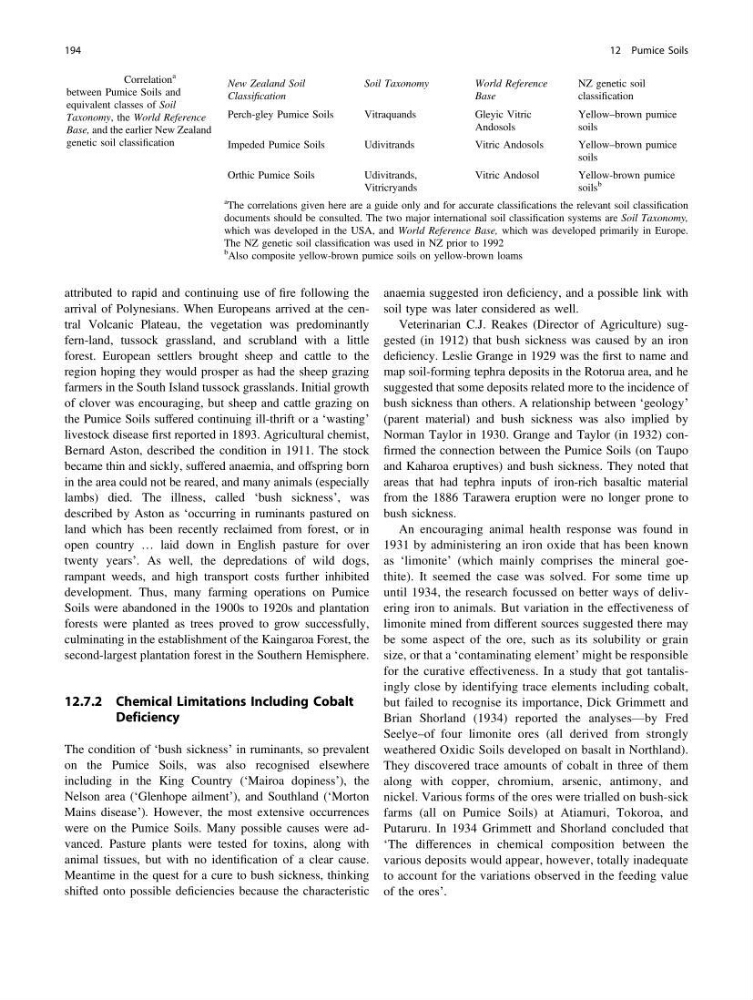
Table 12.3 Correlation
a
between Pumice Soils and
equivalent classes of Soil
Taxonomy, the World Reference
Base, and the earlier New Zealand
genetic soil classification
New Zealand Soil
Classification
Soil Taxonomy
World Reference
Base
NZ genetic soil
classification
Perch-gley Pumice Soils
Vitraquands
Gleyic Vitric
Andosols
Yellow–brown pumice
soils
Impeded Pumice Soils
Udivitrands
Vitric Andosols
Yellow–brown pumice
soils
Orthic Pumice Soils
Udivitrands,
Vitricryands
Vitric Andosol
Yellow-brown pumice
soils
b
a The correlations given here are a guide only and for accurate classifications the relevant soil classification
documents should be consulted. The two major international soil classification systems are Soil Taxonomy,
which was developed in the USA, and World Reference Base, which was developed primarily in Europe.
The NZ genetic soil classification was used in NZ prior to 1992
b
Also composite yellow-brown pumice soils on yellow-brown loams
194
12 Pumice Soils
arrival of Polynesians. When Europeans arrived at the central Volcanic Plateau, the vegetation was predominantly
fern-land, tussock grassland, and scrubland with a little
forest. European settlers brought sheep and cattle to the
region hoping they would prosper as had the sheep grazing
farmers in the South Island tussock grasslands. Initial growth
of clover was encouraging, but sheep and cattle grazing on
the Pumice Soils suffered continuing ill-thrift or a ‘wasting’
livestock disease first reported in 1893. Agricultural chemist,
Bernard Aston, described the condition in 1911. The stock
became thin and sickly, suffered anaemia, and offspring born
in the area could not be reared, and many animals (especially
lambs) died. The illness, called ‘bush sickness’, was
described by Aston as ‘occurring in ruminants pastured on
land which has been recently reclaimed from forest, or in
open country … laid down in English pasture for over
twenty years’. As well, the depredations of wild dogs,
rampant weeds, and high transport costs further inhibited
development. Thus, many farming operations on Pumice
Soils were abandoned in the 1900s to 1920s and plantation
forests were planted as trees proved to grow successfully,
culminating in the establishment of the Kaingaroa Forest, the
second-largest plantation forest in the Southern Hemisphere.
12.7.2 Chemical Limitations Including Cobalt
Deficiency
The condition of ‘bush sickness’ in ruminants, so prevalent
on the Pumice Soils, was also recognised elsewhere
including in the King Country (‘Mairoa dopiness’), the
Nelson area (‘Glenhope ailment’), and Southland (‘Morton
Mains disease’). However, the most extensive occurrences
were on the Pumice Soils. Many possible causes were advanced. Pasture plants were tested for toxins, along with
animal tissues, but with no identification of a clear cause.
Meantime in the quest for a cure to bush sickness, thinking
shifted onto possible deficiencies because the characteristic
anaemia suggested iron deficiency, and a possible link with
soil type was later considered as well.
Veterinarian C.J. Reakes (Director of Agriculture) suggested (in 1912) that bush sickness was caused by an iron
deficiency. Leslie Grange in 1929 was the first to name and
map soil-forming tephra deposits in the Rotorua area, and he
suggested that some deposits related more to the incidence of
bush sickness than others. A relationship between ‘geology’
(parent material) and bush sickness was also implied by
Norman Taylor in 1930. Grange and Taylor (in 1932) confirmed the connection between the Pumice Soils (on Taupo
and Kaharoa eruptives) and bush sickness. They noted that
areas that had tephra inputs of iron-rich basaltic material
from the 1886 Tarawera eruption were no longer prone to
bush sickness.
An encouraging animal health response was found in
1931 by administering an iron oxide that has been known
as ‘limonite’ (which mainly comprises the mineral goethite). It seemed the case was solved. For some time up
until 1934, the research focussed on better ways of delivering iron to animals. But variation in the effectiveness of
limonite mined from different sources suggested there may
be some aspect of the ore, such as its solubility or grain
size, or that a ‘contaminating element’ might be responsible
for the curative effectiveness. In a study that got tantalisingly close by identifying trace elements including cobalt,
but failed to recognise its importance, Dick Grimmett and
Brian Shorland (1934) reported the analyses—by Fred
Seelye–of four limonite ores (all derived from strongly
weathered Oxidic Soils developed on basalt in Northland).
They discovered trace amounts of cobalt in three of them
along with copper, chromium, arsenic, antimony, and
nickel. Various forms of the ores were trialled on bush-sick
farms (all on Pumice Soils) at Atiamuri, Tokoroa, and
Putaruru. In 1934 Grimmett and Shorland concluded that
‘The differences in chemical composition between the
various deposits would appear, however, totally inadequate
to account for the variations observed in the feeding value
of the ores’.
Table 12.3 Correlation
a
between Pumice Soils and
equivalent classes of Soil
Taxonomy, the World Reference
Base, and the earlier New Zealand
genetic soil classification
New Zealand Soil
Classification
Soil Taxonomy
World Reference
Base
NZ genetic soil
classification
Perch-gley Pumice Soils
Vitraquands
Gleyic Vitric
Andosols
Yellow–brown pumice
soils
Impeded Pumice Soils
Udivitrands
Vitric Andosols
Yellow–brown pumice
soils
Orthic Pumice Soils
Udivitrands,
Vitricryands
Vitric Andosol
Yellow-brown pumice
soils
b
a The correlations given here are a guide only and for accurate classifications the relevant soil classification
documents should be consulted. The two major international soil classification systems are Soil Taxonomy,
which was developed in the USA, and World Reference Base, which was developed primarily in Europe.
The NZ genetic soil classification was used in NZ prior to 1992
b
Also composite yellow-brown pumice soils on yellow-brown loams
194
12 Pumice Soils