

are important sources of water and nutrients for plants
(particularly pine trees) whose roots can penetrate through
the coarse lapilli horizons to the underlying paleosols.
Pumice Soils generally have deep rooting potential,
although plant roots may be limited in the Impeded Pumice
Soils group where the root barrier is a massive, compact
layer with high undisturbed soil strength. In Pumice Soils
that have coarse lapilli horizons near the soil surface, the
rapidly draining and drying lapilli can be a barrier for grass
root penetration. There is often a proliferation of roots at the
top of such horizons as the plants seek access to moisture.
Near Taupo, the lithic- and crystal-rich layers (the basal
part of layer 1 of the Taupo ignimbrite) underlying the
uppermost pumice-rich ignimbrite (layer 2, Fig. 12.5) are
often loose. The looseness can cause problems with stability
of built structures (e.g. power poles). In places, thin deposits
of mainly andesitic tephra, from more recent volcanic
eruptions, overlie the pumice deposits including the area
around the Tongariro Volcanic Centre (notably visible in
cuttings on the Desert Road, i.e. State Highway 1 and on
State Highway 47).
12.4.3 Chemical Properties
The pumice, mineral, and lithic grains in Pumice Soils vary
from unweathered to weakly weathered. Because the glassy
rhyolitic pumices are very high in SiO 2 (c. 75–78 wt%), the
deposits have low reserves of major nutrient elements and
trace elements. Sulphur, potassium, nitrogen, phosphorus,
and magnesium are usually required for agricultural or
horticultural crops, and heavy initial fertiliser applications
(especially for phosphorus) are essential. Reserve potassium
is low and exchangeable magnesium is very low, particularly
in subsoils. Trace elements including cobalt, copper,
molybdenum, boron, iodine, and selenium are likely to be
deficient. Phosphate-retention is medium and soil carbon is
medium in topsoils and very low in the subsoil (Fig. 12.12,
Table 12.2). Soil pH is moderately acid in the topsoil,
slightly acid beneath and so lime applications rarely increase
pasture growth. Pinus radiata forestry does increase acidity
in topsoils over time (compared with soils under manuka
scrub). Soil pH levels may be maintained by small annual
lime applications to counter the acidification that occurs
under pastoral management.
12.4.4 Biological Properties
Soil animal populations are low with most species concentrated in the topsoil. Generally, high porosity should provide
a good range of soil habitats but seasonal drought, low soil
organic matter contents, and low content of weathering
products are significant limitations. The coarse nature of
subsoil materials is a limitation for earthworm survival in
Pumice Soils. Trace element deficiencies (including copper,
molybdenum, boron, iodine, and selenium), left uncorrected,
may strongly affect grazing animals and may also affect
organisms in the soil. P. radiata has been successfully
grown on Pumice Soils. Where the pine roots can reach into
subsurface paleosols, such as that on the Whakatane tephra
(Figs. 12.7 and 12.10), then the tree has access to a good
store of water and nutrients which help it to thrive. On soils
with a deep layer of Taupo pumice that prevent roots from
reaching the underlying paleosols, deficiencies of a range of
nutrients, most notably boron, may restrict pine productivity.
12.5 Distinguishing Between Pumice Soils
and Related Soil Orders
Wim Rijkse characterised the Pumice Soils as an ‘intermediate’ state between Recent Soils in recently deposited
tephra and Allophanic Soils in older tephra (strictly, the age
and degree of weathering of the *700-year-old Pumice
Soils match those of many Recent Soils—the key difference,
though, is their preponderance of glass-dominated pumice).
Pumice Soils are easy to recognise due to the abundance of
pumice clasts which distinguishes them from Allophanic
Soils. Towards the outer margins of its depositional range,
the thinning pumice typically overlies pre-existing allophanic soil materials in the profile (see Sect. 12.2). The resultant multi-layered soils are Buried-allophanic Orthic
Pumice Soils if the depth of pumice from the land surface is
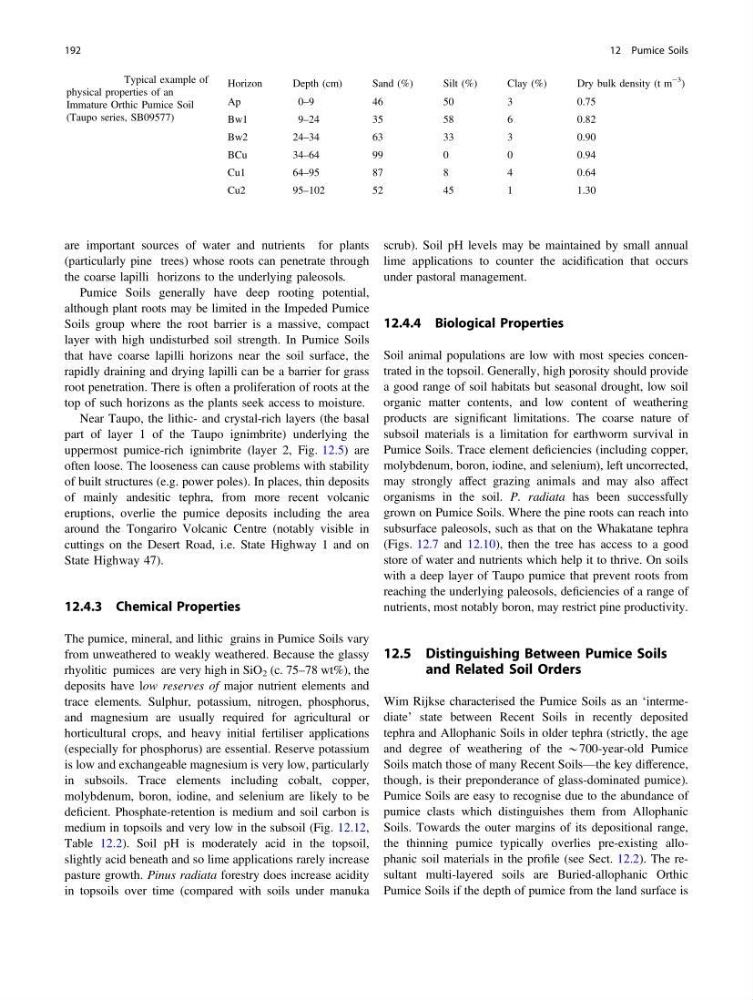
Table 12.1 Typical example of
physical properties of an
Immature Orthic Pumice Soil
(Taupo series, SB09577)
Horizon
Depth (cm)
Sand (%)
Silt (%)
Clay (%)
Dry bulk density (t m
−3
)
Ap
0–9
46
50
3
0.75
Bw1
9–24
35
58
6
0.82
Bw2
24–34
63
33
3
0.90
BCu
34–64
99
0
0
0.94
Cu1
64–95
87
8
4
0.64
Cu2
95–102
52
45
1
1.30
192
12 Pumice Soils
(particularly pine trees) whose roots can penetrate through
the coarse lapilli horizons to the underlying paleosols.
Pumice Soils generally have deep rooting potential,
although plant roots may be limited in the Impeded Pumice
Soils group where the root barrier is a massive, compact
layer with high undisturbed soil strength. In Pumice Soils
that have coarse lapilli horizons near the soil surface, the
rapidly draining and drying lapilli can be a barrier for grass
root penetration. There is often a proliferation of roots at the
top of such horizons as the plants seek access to moisture.
Near Taupo, the lithic- and crystal-rich layers (the basal
part of layer 1 of the Taupo ignimbrite) underlying the
uppermost pumice-rich ignimbrite (layer 2, Fig. 12.5) are
often loose. The looseness can cause problems with stability
of built structures (e.g. power poles). In places, thin deposits
of mainly andesitic tephra, from more recent volcanic
eruptions, overlie the pumice deposits including the area
around the Tongariro Volcanic Centre (notably visible in
cuttings on the Desert Road, i.e. State Highway 1 and on
State Highway 47).
12.4.3 Chemical Properties
The pumice, mineral, and lithic grains in Pumice Soils vary
from unweathered to weakly weathered. Because the glassy
rhyolitic pumices are very high in SiO 2 (c. 75–78 wt%), the
deposits have low reserves of major nutrient elements and
trace elements. Sulphur, potassium, nitrogen, phosphorus,
and magnesium are usually required for agricultural or
horticultural crops, and heavy initial fertiliser applications
(especially for phosphorus) are essential. Reserve potassium
is low and exchangeable magnesium is very low, particularly
in subsoils. Trace elements including cobalt, copper,
molybdenum, boron, iodine, and selenium are likely to be
deficient. Phosphate-retention is medium and soil carbon is
medium in topsoils and very low in the subsoil (Fig. 12.12,
Table 12.2). Soil pH is moderately acid in the topsoil,
slightly acid beneath and so lime applications rarely increase
pasture growth. Pinus radiata forestry does increase acidity
in topsoils over time (compared with soils under manuka
scrub). Soil pH levels may be maintained by small annual
lime applications to counter the acidification that occurs
under pastoral management.
12.4.4 Biological Properties
Soil animal populations are low with most species concentrated in the topsoil. Generally, high porosity should provide
a good range of soil habitats but seasonal drought, low soil
organic matter contents, and low content of weathering
products are significant limitations. The coarse nature of
subsoil materials is a limitation for earthworm survival in
Pumice Soils. Trace element deficiencies (including copper,
molybdenum, boron, iodine, and selenium), left uncorrected,
may strongly affect grazing animals and may also affect
organisms in the soil. P. radiata has been successfully
grown on Pumice Soils. Where the pine roots can reach into
subsurface paleosols, such as that on the Whakatane tephra
(Figs. 12.7 and 12.10), then the tree has access to a good
store of water and nutrients which help it to thrive. On soils
with a deep layer of Taupo pumice that prevent roots from
reaching the underlying paleosols, deficiencies of a range of
nutrients, most notably boron, may restrict pine productivity.
12.5 Distinguishing Between Pumice Soils
and Related Soil Orders
Wim Rijkse characterised the Pumice Soils as an ‘intermediate’ state between Recent Soils in recently deposited
tephra and Allophanic Soils in older tephra (strictly, the age
and degree of weathering of the *700-year-old Pumice
Soils match those of many Recent Soils—the key difference,
though, is their preponderance of glass-dominated pumice).
Pumice Soils are easy to recognise due to the abundance of
pumice clasts which distinguishes them from Allophanic
Soils. Towards the outer margins of its depositional range,
the thinning pumice typically overlies pre-existing allophanic soil materials in the profile (see Sect. 12.2). The resultant multi-layered soils are Buried-allophanic Orthic
Pumice Soils if the depth of pumice from the land surface is
Table 12.1 Typical example of
physical properties of an
Immature Orthic Pumice Soil
(Taupo series, SB09577)
Horizon
Depth (cm)
Sand (%)
Silt (%)
Clay (%)
Dry bulk density (t m
−3
)
Ap
0–9
46
50
3
0.75
Bw1
9–24
35
58
6
0.82
Bw2
24–34
63
33
3
0.90
BCu
34–64
99
0
0
0.94
Cu1
64–95
87
8
4
0.64
Cu2
95–102
52
45
1
1.30
192
12 Pumice Soils