

Allophanic (to Allophanic Soils), and Immature (to Recent
Soils). Extragrading subgroups depart in some specific way
from the soil group (Welded, and Buried-allophanic). The
subgroup closest to the central concept of the group is
identified as Typic.
12.1.4 Origin of Soil Order Name
The Pumice Soils are named for the pumice which dominates the parent material and the soil’s properties.
12.2 Soil Profile Genesis
12.2.1 Introduction
Most Pumice Soils are derived largely from unconsolidated
or loose, silica-rich pumice deposited by two major rhyolitic
volcanic eruptions: (1) the Taupo eruption in AD 232 ± 10
(i.e. about 1800 years ago), from vents in the 25,400-yr-old
Oruanui caldera now occupied by Lake Taupo, and (2) the
Kaharoa eruption in AD 1314 ± 12 (about 700 years ago)
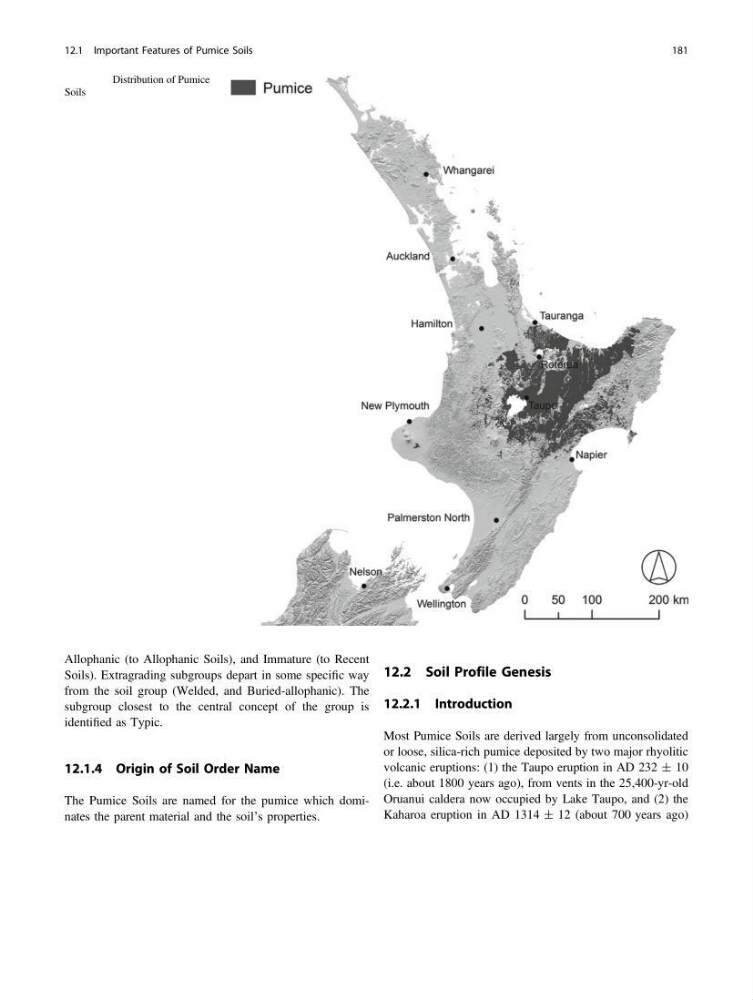
Fig. 12.2 Distribution of Pumice
Soils
12.1 Important Features of Pumice Soils
181
Soils). Extragrading subgroups depart in some specific way
from the soil group (Welded, and Buried-allophanic). The
subgroup closest to the central concept of the group is
identified as Typic.
12.1.4 Origin of Soil Order Name
The Pumice Soils are named for the pumice which dominates the parent material and the soil’s properties.
12.2 Soil Profile Genesis
12.2.1 Introduction
Most Pumice Soils are derived largely from unconsolidated
or loose, silica-rich pumice deposited by two major rhyolitic
volcanic eruptions: (1) the Taupo eruption in AD 232 ± 10
(i.e. about 1800 years ago), from vents in the 25,400-yr-old
Oruanui caldera now occupied by Lake Taupo, and (2) the
Kaharoa eruption in AD 1314 ± 12 (about 700 years ago)
Fig. 12.2 Distribution of Pumice
Soils
12.1 Important Features of Pumice Soils
181