

development from Raw Soils (not depicted in Fig. 11.7) to
Recent Soils, Gley Soils (alternatively, acidic Brown Soils
may occur depending on local drainage), and then Podzol
Soils, reflects the progressive phase of ecosystem development. Fertility builds up and the soil profiles become differentiated into distinct horizons. Following this, a period of
relative stability occurs, and then, as nutrients are gradually
leached from the soil the ecosystem becomes nutrient limited
so that soil fertility and associated plant growth gradually
decline (retrogressive phase).
From soil initiation and through the progressive phases,
phosphorus (P) is released by hydrolysis from minerals in
the parent materials at rates sufficient to ensure that
ecosystem development is not nutrient limited. Over time,
the release of plant-available phosphorus slows because of P
losses in leaching or runoff, and by sequestration (where an
increasing proportion of total P becomes unavailable to
plants by becoming locked up in clay minerals and organic
compounds). The proportions of primary (rock) and secondary (clay) minerals control the main supply of nutrients
for biological and ecosystem processes through the
sequence. Eventually, P becomes the limiting nutrient, and if
there is no disturbance and insufficient aeolian inputs to
provide fresh parent material for weathering, the regressive
stage of ecosystem change takes hold. Over the time span of
the Franz Josef chronosequence (*120,000 years), soil
phosphorus shows an eightfold decline. As P is a key
nutrient in the control of plant biomass, the decline is
demonstrated in many ecosystem features including reduced
tree height, forest density, diversity, litter decomposition
rates, and biomass.
11.4 Key Soil Properties
11.4.1 Soil Composition
Podzol Soils can occur in a wide range of parent materials,
both rock and regolith, but the podzol form is most clearly
expressed in sand derived from weathered or reworked
quartzo-feldspathic sedimentary rocks (schist, greywacke,
sandstones), and in silica-rich tephra deposits including
fine-gained pumice. It has been shown that kauri do not
cause podzolization on more iron-rich andesitic or basaltic
deposits.
Complexes of iron and aluminium oxides, allophane (±
ferrihydrite, imogolite), together with organic matter, are
strongly differentiated in the profile and produce the distinct
horizon colours. In A and E horizons, sand and silt grains are
uncoated, and the clear sugar-like grains of quartz or feldspar
Table 11.1 Sand, silt, and clay
contents of a Humose Orthic
Podzol Soil (Mamaku soil,
SB09580)
Horizon
Depth
Sand
(%)
Silt
(%)
Clay
(%)
Ah
0–8
4 2
5 5
2
Eu
8–15
35
63
1
2bBs1
15–25
43
55
2
2bBs2
25–43
48
45
7
3bBs
43–58
54
31
15
4bBs
58–100
37
44
19
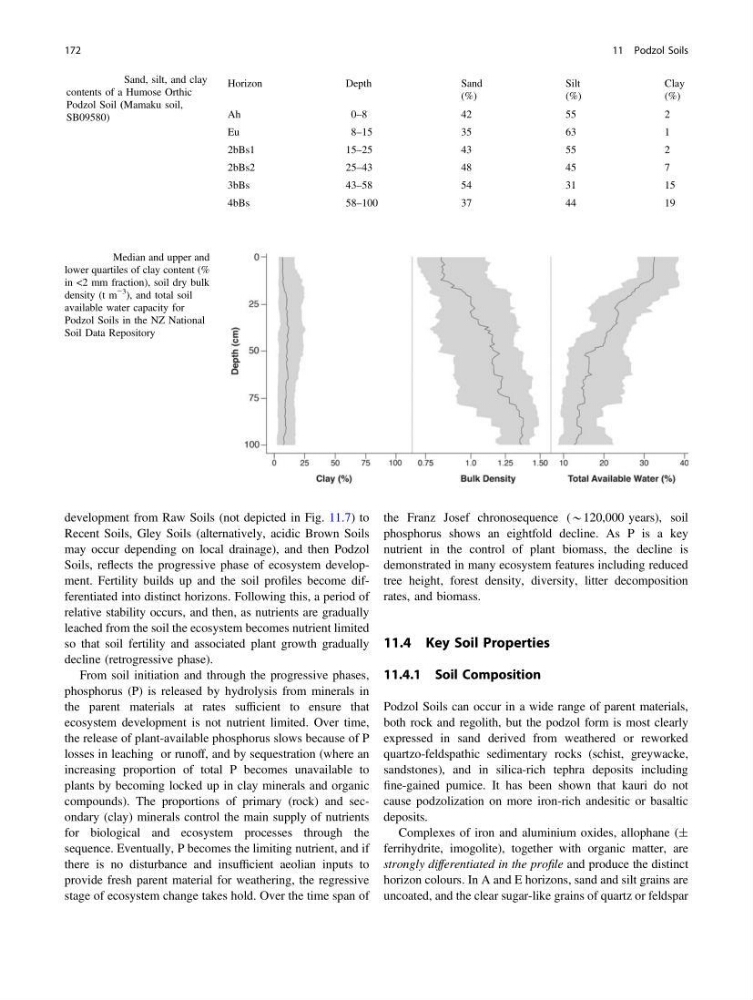
Fig. 11.8 Median and upper and
lower quartiles of clay content (%
in <2 mm fraction), soil dry bulk
density (t m
−3
), and total soil
available water capacity for
Podzol Soils in the NZ National
Soil Data Repository
172
11 Podzol Soils
Recent Soils, Gley Soils (alternatively, acidic Brown Soils
may occur depending on local drainage), and then Podzol
Soils, reflects the progressive phase of ecosystem development. Fertility builds up and the soil profiles become differentiated into distinct horizons. Following this, a period of
relative stability occurs, and then, as nutrients are gradually
leached from the soil the ecosystem becomes nutrient limited
so that soil fertility and associated plant growth gradually
decline (retrogressive phase).
From soil initiation and through the progressive phases,
phosphorus (P) is released by hydrolysis from minerals in
the parent materials at rates sufficient to ensure that
ecosystem development is not nutrient limited. Over time,
the release of plant-available phosphorus slows because of P
losses in leaching or runoff, and by sequestration (where an
increasing proportion of total P becomes unavailable to
plants by becoming locked up in clay minerals and organic
compounds). The proportions of primary (rock) and secondary (clay) minerals control the main supply of nutrients
for biological and ecosystem processes through the
sequence. Eventually, P becomes the limiting nutrient, and if
there is no disturbance and insufficient aeolian inputs to
provide fresh parent material for weathering, the regressive
stage of ecosystem change takes hold. Over the time span of
the Franz Josef chronosequence (*120,000 years), soil
phosphorus shows an eightfold decline. As P is a key
nutrient in the control of plant biomass, the decline is
demonstrated in many ecosystem features including reduced
tree height, forest density, diversity, litter decomposition
rates, and biomass.
11.4 Key Soil Properties
11.4.1 Soil Composition
Podzol Soils can occur in a wide range of parent materials,
both rock and regolith, but the podzol form is most clearly
expressed in sand derived from weathered or reworked
quartzo-feldspathic sedimentary rocks (schist, greywacke,
sandstones), and in silica-rich tephra deposits including
fine-gained pumice. It has been shown that kauri do not
cause podzolization on more iron-rich andesitic or basaltic
deposits.
Complexes of iron and aluminium oxides, allophane (±
ferrihydrite, imogolite), together with organic matter, are
strongly differentiated in the profile and produce the distinct
horizon colours. In A and E horizons, sand and silt grains are
uncoated, and the clear sugar-like grains of quartz or feldspar
Table 11.1 Sand, silt, and clay
contents of a Humose Orthic
Podzol Soil (Mamaku soil,
SB09580)
Horizon
Depth
Sand
(%)
Silt
(%)
Clay
(%)
Ah
0–8
4 2
5 5
2
Eu
8–15
35
63
1
2bBs1
15–25
43
55
2
2bBs2
25–43
48
45
7
3bBs
43–58
54
31
15
4bBs
58–100
37
44
19
Fig. 11.8 Median and upper and
lower quartiles of clay content (%
in <2 mm fraction), soil dry bulk
density (t m
−3
), and total soil
available water capacity for
Podzol Soils in the NZ National
Soil Data Repository
172
11 Podzol Soils