

may be seen glinting in sunlight. The grains in B horizons
are coated, and in some soils cemented, by the complex
oxides, nanominerals, and organic matter.
Podzol Soil profiles have distinct mineralogy with
mica-smectite or smectite frequently occurring in A and E
horizons (some probably derived from aeolian dust), and
hydroxy-coated or interlayered minerals, and usually allophane, and possibly ferrihydrite or imogolite, in B horizons.
In some Northland soils, secondary silica is dominant in B
horizons.
11.4.2 Physical Properties
Physical properties of Podzol Soils are dominated by either
the parent material or the manner in which the material has
been modified by soil formation. Thus there is no one typical
set of soil physical properties (Fig. 11.8, Table 11.1).
However, Podzol Soils, especially those on (youthful) sand
dunes and pumice materials are commonly sandy with low
clay contents. Clay contents range from near 0 to 40% of the
soil, with the majority of Podzol Soils having <25% clay
(Fig. 11.8).
The wide range of soil dry bulk densities that may occur
is evident in Fig. 11.8. In Densipan Podzols, the original
material of the E horizon has been strongly enleached with
apparent loss of stabilising secondary oxides and consequent
reduction of porosity and increasing density. The densipan
may be as dense as a fragipan. Podzols in sand (including
pumice) are dominated by the permeability of sand but as B
horizon pans are formed (humus- or ortstein-pans or placic
horizons) the permeability and porosity (depending on the
continuity of the pans) may be sharply reduced.
Barriers to root extension in Podzol Soils include pans,
dense layers, acidity, aluminium toxicity, rock, and strong
gleying causing limitations of available oxygen. The sandy
nature of many Podzol Soils, along with leaching of potential
aggregate-binding organic and oxide materials means there is
often minimal soil aggregation, particularly in E horizons.
11.4.3 Chemical Properties
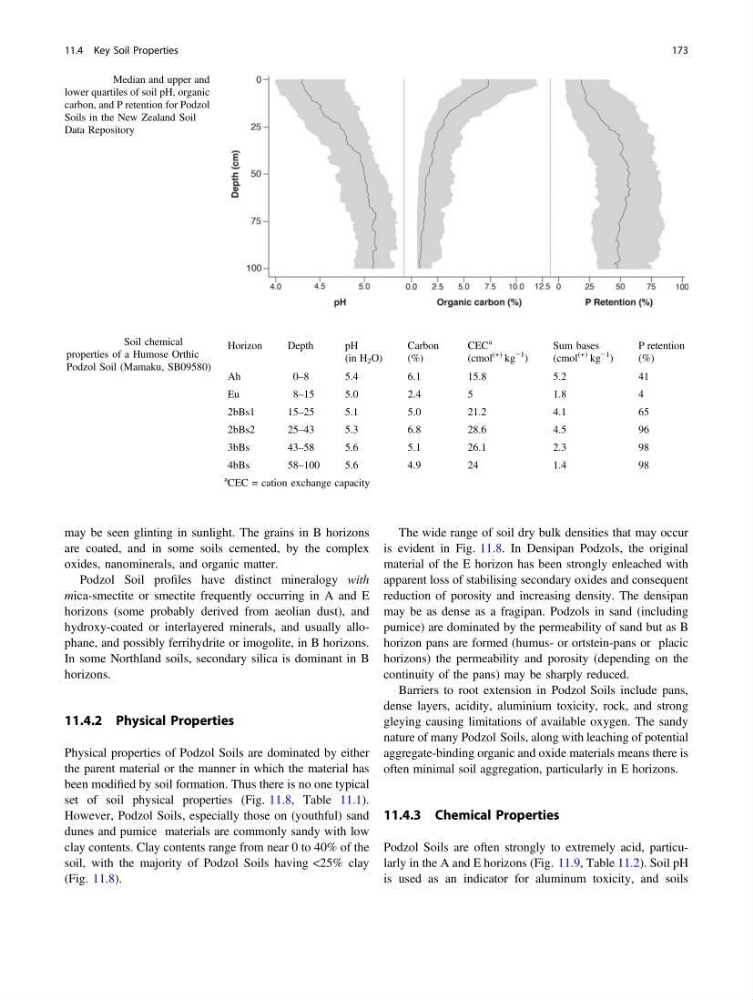
Podzol Soils are often strongly to extremely acid, particularly in the A and E horizons (Fig. 11.9, Table 11.2). Soil pH
is used as an indicator for aluminum toxicity, and soils
Fig. 11.9 Median and upper and
lower quartiles of soil pH, organic
carbon, and P retention for Podzol
Soils in the New Zealand Soil
Data Repository
Table 11.2 Soil chemical
properties of a Humose Orthic
Podzol Soil (Mamaku, SB09580)
Horizon
Depth
pH
(in H 2 O)
Carbon
(%)
CEC
a
(cmol
(+) kg
−1
)
Sum bases
(cmol
(+) kg
−1
)
P retention
(%)
Ah
0–8
5.4
6.1
15.8
5.2
41
Eu
8–15
5.0
2.4
5
1.8
4
2bBs1
15–25
5.1
5.0
21.2
4.1
65
2bBs2
25–43
5.3
6.8
28.6
4.5
96
3bBs
43–58
5.6
5.1
26.1
2.3
98
4bBs
58–100
5.6
4.9
24
1.4
98
a CEC = cation exchange capacity
11.4 Key Soil Properties
173
are coated, and in some soils cemented, by the complex
oxides, nanominerals, and organic matter.
Podzol Soil profiles have distinct mineralogy with
mica-smectite or smectite frequently occurring in A and E
horizons (some probably derived from aeolian dust), and
hydroxy-coated or interlayered minerals, and usually allophane, and possibly ferrihydrite or imogolite, in B horizons.
In some Northland soils, secondary silica is dominant in B
horizons.
11.4.2 Physical Properties
Physical properties of Podzol Soils are dominated by either
the parent material or the manner in which the material has
been modified by soil formation. Thus there is no one typical
set of soil physical properties (Fig. 11.8, Table 11.1).
However, Podzol Soils, especially those on (youthful) sand
dunes and pumice materials are commonly sandy with low
clay contents. Clay contents range from near 0 to 40% of the
soil, with the majority of Podzol Soils having <25% clay
(Fig. 11.8).
The wide range of soil dry bulk densities that may occur
is evident in Fig. 11.8. In Densipan Podzols, the original
material of the E horizon has been strongly enleached with
apparent loss of stabilising secondary oxides and consequent
reduction of porosity and increasing density. The densipan
may be as dense as a fragipan. Podzols in sand (including
pumice) are dominated by the permeability of sand but as B
horizon pans are formed (humus- or ortstein-pans or placic
horizons) the permeability and porosity (depending on the
continuity of the pans) may be sharply reduced.
Barriers to root extension in Podzol Soils include pans,
dense layers, acidity, aluminium toxicity, rock, and strong
gleying causing limitations of available oxygen. The sandy
nature of many Podzol Soils, along with leaching of potential
aggregate-binding organic and oxide materials means there is
often minimal soil aggregation, particularly in E horizons.
11.4.3 Chemical Properties
Podzol Soils are often strongly to extremely acid, particularly in the A and E horizons (Fig. 11.9, Table 11.2). Soil pH
is used as an indicator for aluminum toxicity, and soils
Fig. 11.9 Median and upper and
lower quartiles of soil pH, organic
carbon, and P retention for Podzol
Soils in the New Zealand Soil
Data Repository
Table 11.2 Soil chemical
properties of a Humose Orthic
Podzol Soil (Mamaku, SB09580)
Horizon
Depth
pH
(in H 2 O)
Carbon
(%)
CEC
a
(cmol
(+) kg
−1
)
Sum bases
(cmol
(+) kg
−1
)
P retention
(%)
Ah
0–8
5.4
6.1
15.8
5.2
41
Eu
8–15
5.0
2.4
5
1.8
4
2bBs1
15–25
5.1
5.0
21.2
4.1
65
2bBs2
25–43
5.3
6.8
28.6
4.5
96
3bBs
43–58
5.6
5.1
26.1
2.3
98
4bBs
58–100
5.6
4.9
24
1.4
98
a CEC = cation exchange capacity
11.4 Key Soil Properties
173