

11.3.3 Franz Josef Chronosequence
The chronosequence near Franz Josef glacier is a sequence
of soil and vegetation sites carefully located across the
landscape so that the age of the sites varies from a few years
to tens of thousands of years. The sites have yielded much
new understanding about soil and ecosystem development,
especially the processes that release phosphorus by weathering (particularly through the work of Tom Walker, Keith
Syers, and Peter Stephens).
The Waiho River drains the snout of the Franz Josef
glacier in south Westland. Typical of glacial rivers it is
choked with stony alluvium, generated by the grinding and
conveying actions of the glacier during its advances and
retreats in response to changes in temperature and precipitation. The river’s broad alluvial fan is bounded by
400-m-high lateral moraines dating from the Last Glacial
Maximum, approximately 30,000 to 18,000 years ago. The
till making up the moraines is a chaotic mix of boulders,
cobbles, gravels, sand, and silt. Compared to low terraces
and moraines, the upper land surfaces, of high terraces and
moraines, are older and the soils have developed over longer
periods of time. Dating of the landforms, and particularly the
more stable gently sloped land surfaces, including the Waiho
Loop moraine, has provided a series of sites that form a time
sequence (chronosequence) of landforms, ecosystems, and
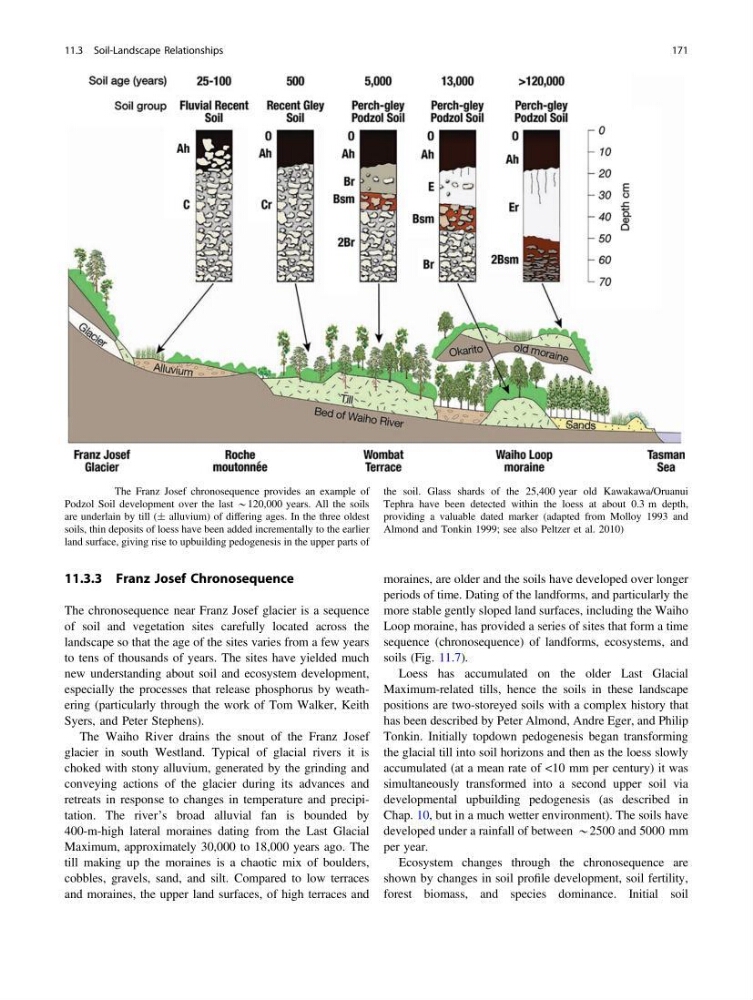
soils (Fig. 11.7).
Loess has accumulated on the older Last Glacial
Maximum-related tills, hence the soils in these landscape
positions are two-storeyed soils with a complex history that
has been described by Peter Almond, Andre Eger, and Philip
Tonkin. Initially topdown pedogenesis began transforming
the glacial till into soil horizons and then as the loess slowly
accumulated (at a mean rate of <10 mm per century) it was
simultaneously transformed into a second upper soil via
developmental upbuilding pedogenesis (as described in
Chap. 10, but in a much wetter environment). The soils have
developed under a rainfall of between *2500 and 5000 mm
per year.
Ecosystem changes through the chronosequence are
shown by changes in soil profile development, soil fertility,
forest biomass, and species dominance. Initial soil
Fig. 11.7 The Franz Josef chronosequence provides an example of
Podzol Soil development over the last *120,000 years. All the soils
are underlain by till (± alluvium) of differing ages. In the three oldest
soils, thin deposits of loess have been added incrementally to the earlier
land surface, giving rise to upbuilding pedogenesis in the upper parts of
the soil. Glass shards of the 25,400 year old Kawakawa/Oruanui
Tephra have been detected within the loess at about 0.3 m depth,
providing a valuable dated marker (adapted from Molloy 1993 and
Almond and Tonkin 1999; see also Peltzer et al. 2010)
11.3 Soil-Landscape Relationships
171
The chronosequence near Franz Josef glacier is a sequence
of soil and vegetation sites carefully located across the
landscape so that the age of the sites varies from a few years
to tens of thousands of years. The sites have yielded much
new understanding about soil and ecosystem development,
especially the processes that release phosphorus by weathering (particularly through the work of Tom Walker, Keith
Syers, and Peter Stephens).
The Waiho River drains the snout of the Franz Josef
glacier in south Westland. Typical of glacial rivers it is
choked with stony alluvium, generated by the grinding and
conveying actions of the glacier during its advances and
retreats in response to changes in temperature and precipitation. The river’s broad alluvial fan is bounded by
400-m-high lateral moraines dating from the Last Glacial
Maximum, approximately 30,000 to 18,000 years ago. The
till making up the moraines is a chaotic mix of boulders,
cobbles, gravels, sand, and silt. Compared to low terraces
and moraines, the upper land surfaces, of high terraces and
moraines, are older and the soils have developed over longer
periods of time. Dating of the landforms, and particularly the
more stable gently sloped land surfaces, including the Waiho
Loop moraine, has provided a series of sites that form a time
sequence (chronosequence) of landforms, ecosystems, and
soils (Fig. 11.7).
Loess has accumulated on the older Last Glacial
Maximum-related tills, hence the soils in these landscape
positions are two-storeyed soils with a complex history that
has been described by Peter Almond, Andre Eger, and Philip
Tonkin. Initially topdown pedogenesis began transforming
the glacial till into soil horizons and then as the loess slowly
accumulated (at a mean rate of <10 mm per century) it was
simultaneously transformed into a second upper soil via
developmental upbuilding pedogenesis (as described in
Chap. 10, but in a much wetter environment). The soils have
developed under a rainfall of between *2500 and 5000 mm
per year.
Ecosystem changes through the chronosequence are
shown by changes in soil profile development, soil fertility,
forest biomass, and species dominance. Initial soil
Fig. 11.7 The Franz Josef chronosequence provides an example of
Podzol Soil development over the last *120,000 years. All the soils
are underlain by till (± alluvium) of differing ages. In the three oldest
soils, thin deposits of loess have been added incrementally to the earlier
land surface, giving rise to upbuilding pedogenesis in the upper parts of
the soil. Glass shards of the 25,400 year old Kawakawa/Oruanui
Tephra have been detected within the loess at about 0.3 m depth,
providing a valuable dated marker (adapted from Molloy 1993 and
Almond and Tonkin 1999; see also Peltzer et al. 2010)
11.3 Soil-Landscape Relationships
171