

On Podzol Soils and trees
At the time of early European exploration, it was often
assumed that tall forest trees indicated high soil fertility. However, in New Zealand such ideas proved to
be wrong and tall podocarps were found to be flourishing on low fertility Podzol Soils. So how can it be
possible that big trees can be established in low fertility soils? There are two options: the soil developed
first and the tree ‘selected’ the site, or the tree happened to grow at the site and caused the soil to develop
towards a lower fertility state. In the case of the Podzol
Soils, the evidence strongly suggests the latter option.
The ‘egg-cup’ Podzol Soils (Fig. 11.5) form
directly beneath mature podocarps. Away from the
tree, the soil may not be a Podzol. The egg-cup shape
is intriguing and graphically demonstrates the ability
of an individual tree to drive the podzolization processes to create its own soil. It is curious, though, that
the tree would produce a very low fertility, extremely
acid, soil for its home.
The most spectacular egg-cup Podzol Soils form
under massive, slow-growing kauri where the acidic,
low fertility environment helps the tree compete with
its faster growing competitors. By supressing its
competition, the kauri can out-compete them in the
struggle for nitrogen. The kauri’s competitive advantage was not just the production of acidity, which kauri
can tolerate, but also its remarkably efficient recycling
of nitrogen. A kauri tree produces nearly twice the
amount of wood, bark, and cones for a given amount
of nitrogen than most other forest trees. Dutch soil
scientist Eric Verkaik and others showed that the
nitrogen that accumulates in the litter below kauri trees
is protected from N-mineralisation (breakdown) by
kauri tannins that protect proteins. Thus, the availability of nitrogen, as well as phosphorus and calcium,
is lower under kauri than in the surrounding vegetation. As kauri seedlings are more tolerant of low
nutrient availability, and drought, than other tree
seedlings, the conditions under mature kauri give kauri
seedlings a competitive advantage. The low nutrient
availability under mature kauri trees supports the idea
of a positive soil–plant feedback driven by the poor
‘decomposability’ of kauri litter.
Soil scientists have observed that mature kauri
exploit their great longevity—many live for 600–
1200 years, some even longer. The dense, strong, root
systems help prevent landslides, thus preventing land
disturbance, and the litter buildup and acid leaching
from low fertility Podzol Soils. The stable landscape
and low soil fertility ensure that return to early stage
forest regeneration (with competitors) is avoided or
postponed as kauri exploits its ability to out-live other
species. Thus the kauri could be described as a
‘landscape engineer’.
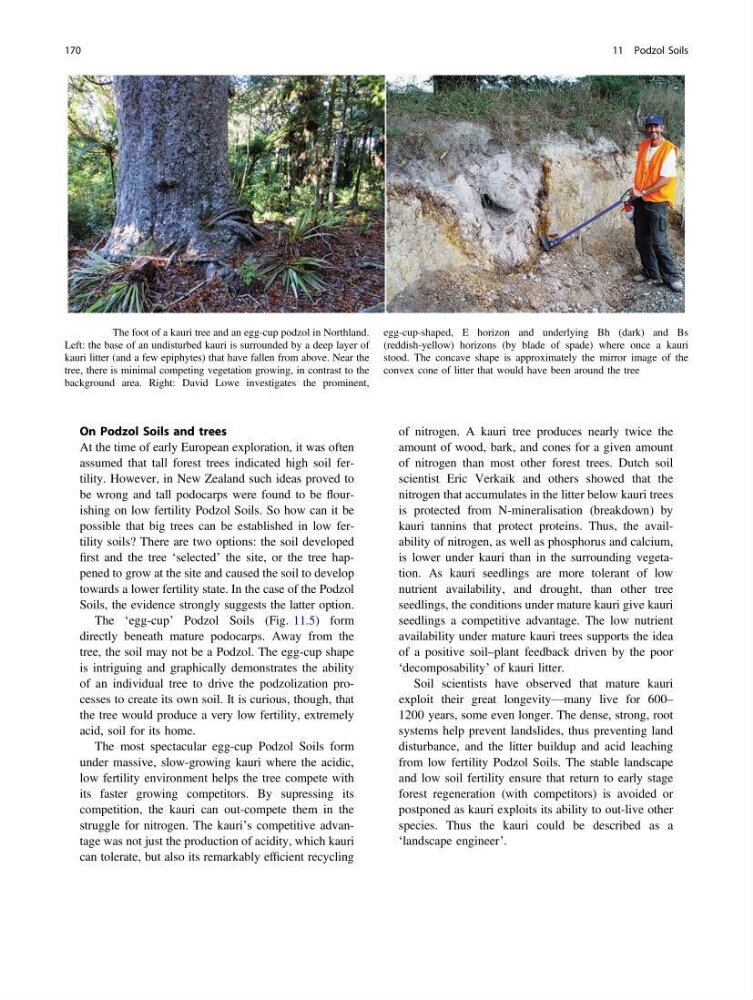
Fig. 11.6 The foot of a kauri tree and an egg-cup podzol in Northland.
Left: the base of an undisturbed kauri is surrounded by a deep layer of
kauri litter (and a few epiphytes) that have fallen from above. Near the
tree, there is minimal competing vegetation growing, in contrast to the
background area. Right: David Lowe investigates the prominent,
egg-cup-shaped, E horizon and underlying Bh (dark) and Bs
(reddish-yellow) horizons (by blade of spade) where once a kauri
stood. The concave shape is approximately the mirror image of the
convex cone of litter that would have been around the tree
170
11 Podzol Soils
At the time of early European exploration, it was often
assumed that tall forest trees indicated high soil fertility. However, in New Zealand such ideas proved to
be wrong and tall podocarps were found to be flourishing on low fertility Podzol Soils. So how can it be
possible that big trees can be established in low fertility soils? There are two options: the soil developed
first and the tree ‘selected’ the site, or the tree happened to grow at the site and caused the soil to develop
towards a lower fertility state. In the case of the Podzol
Soils, the evidence strongly suggests the latter option.
The ‘egg-cup’ Podzol Soils (Fig. 11.5) form
directly beneath mature podocarps. Away from the
tree, the soil may not be a Podzol. The egg-cup shape
is intriguing and graphically demonstrates the ability
of an individual tree to drive the podzolization processes to create its own soil. It is curious, though, that
the tree would produce a very low fertility, extremely
acid, soil for its home.
The most spectacular egg-cup Podzol Soils form
under massive, slow-growing kauri where the acidic,
low fertility environment helps the tree compete with
its faster growing competitors. By supressing its
competition, the kauri can out-compete them in the
struggle for nitrogen. The kauri’s competitive advantage was not just the production of acidity, which kauri
can tolerate, but also its remarkably efficient recycling
of nitrogen. A kauri tree produces nearly twice the
amount of wood, bark, and cones for a given amount
of nitrogen than most other forest trees. Dutch soil
scientist Eric Verkaik and others showed that the
nitrogen that accumulates in the litter below kauri trees
is protected from N-mineralisation (breakdown) by
kauri tannins that protect proteins. Thus, the availability of nitrogen, as well as phosphorus and calcium,
is lower under kauri than in the surrounding vegetation. As kauri seedlings are more tolerant of low
nutrient availability, and drought, than other tree
seedlings, the conditions under mature kauri give kauri
seedlings a competitive advantage. The low nutrient
availability under mature kauri trees supports the idea
of a positive soil–plant feedback driven by the poor
‘decomposability’ of kauri litter.
Soil scientists have observed that mature kauri
exploit their great longevity—many live for 600–
1200 years, some even longer. The dense, strong, root
systems help prevent landslides, thus preventing land
disturbance, and the litter buildup and acid leaching
from low fertility Podzol Soils. The stable landscape
and low soil fertility ensure that return to early stage
forest regeneration (with competitors) is avoided or
postponed as kauri exploits its ability to out-live other
species. Thus the kauri could be described as a
‘landscape engineer’.
Fig. 11.6 The foot of a kauri tree and an egg-cup podzol in Northland.
Left: the base of an undisturbed kauri is surrounded by a deep layer of
kauri litter (and a few epiphytes) that have fallen from above. Near the
tree, there is minimal competing vegetation growing, in contrast to the
background area. Right: David Lowe investigates the prominent,
egg-cup-shaped, E horizon and underlying Bh (dark) and Bs
(reddish-yellow) horizons (by blade of spade) where once a kauri
stood. The concave shape is approximately the mirror image of the
convex cone of litter that would have been around the tree
170
11 Podzol Soils