

Most Pallic Soils form in regions where there is a summer
drought. While the loess was accumulating, the land surface
slowly built up (mean rate *10–20 mm per century) and
the loess was transformed into soil horizons that are weakly
expressed because the material soon became buried too
deeply for topdown pedogenic processes to be effective.
Therefore, each part of the profile has at one time been at the
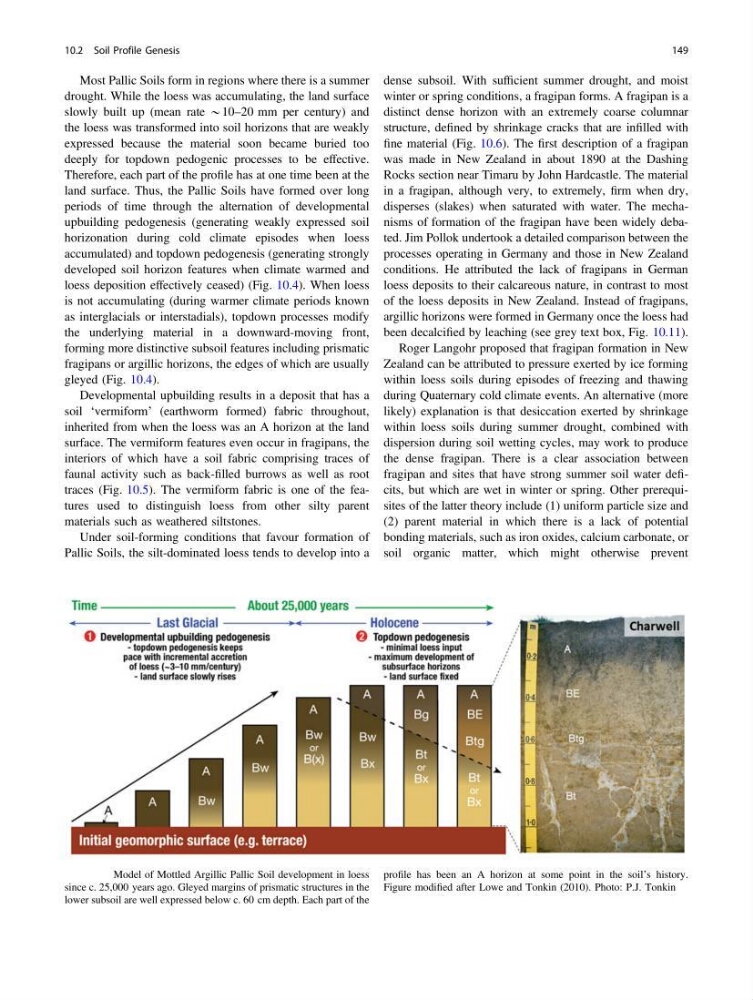
land surface. Thus, the Pallic Soils have formed over long
periods of time through the alternation of developmental
upbuilding pedogenesis (generating weakly expressed soil
horizonation during cold climate episodes when loess
accumulated) and topdown pedogenesis (generating strongly
developed soil horizon features when climate warmed and
loess deposition effectively ceased) (Fig. 10.4). When loess
is not accumulating (during warmer climate periods known
as interglacials or interstadials), topdown processes modify
the underlying material in a downward-moving front,
forming more distinctive subsoil features including prismatic
fragipans or argillic horizons, the edges of which are usually
gleyed (Fig. 10.4).
Developmental upbuilding results in a deposit that has a
soil ‘vermiform’ (earthworm formed) fabric throughout,
inherited from when the loess was an A horizon at the land
surface. The vermiform features even occur in fragipans, the
interiors of which have a soil fabric comprising traces of
faunal activity such as back-filled burrows as well as root
traces (Fig. 10.5). The vermiform fabric is one of the features used to distinguish loess from other silty parent
materials such as weathered siltstones.
Under soil-forming conditions that favour formation of
Pallic Soils, the silt-dominated loess tends to develop into a
dense subsoil. With sufficient summer drought, and moist
winter or spring conditions, a fragipan forms. A fragipan is a
distinct dense horizon with an extremely coarse columnar
structure, defined by shrinkage cracks that are infilled with
fine material (Fig. 10.6). The first description of a fragipan
was made in New Zealand in about 1890 at the Dashing
Rocks section near Timaru by John Hardcastle. The material
in a fragipan, although very, to extremely, firm when dry,
disperses (slakes) when saturated with water. The mechanisms of formation of the fragipan have been widely debated. Jim Pollok undertook a detailed comparison between the
processes operating in Germany and those in New Zealand
conditions. He attributed the lack of fragipans in German
loess deposits to their calcareous nature, in contrast to most
of the loess deposits in New Zealand. Instead of fragipans,
argillic horizons were formed in Germany once the loess had
been decalcified by leaching (see grey text box, Fig. 10.11).
Roger Langohr proposed that fragipan formation in New
Zealand can be attributed to pressure exerted by ice forming
within loess soils during episodes of freezing and thawing
during Quaternary cold climate events. An alternative (more
likely) explanation is that desiccation exerted by shrinkage
within loess soils during summer drought, combined with
dispersion during soil wetting cycles, may work to produce
the dense fragipan. There is a clear association between
fragipan and sites that have strong summer soil water deficits, but which are wet in winter or spring. Other prerequisites of the latter theory include (1) uniform particle size and
(2) parent material in which there is a lack of potential
bonding materials, such as iron oxides, calcium carbonate, or
soil organic matter, which might otherwise prevent
Fig. 10.4 Model of Mottled Argillic Pallic Soil development in loess
since c. 25,000 years ago. Gleyed margins of prismatic structures in the
lower subsoil are well expressed below c. 60 cm depth. Each part of the
profile has been an A horizon at some point in the soil’s history.
Figure modified after Lowe and Tonkin (2010). Photo: P.J. Tonkin
10.2 Soil Profile Genesis
149
drought. While the loess was accumulating, the land surface
slowly built up (mean rate *10–20 mm per century) and
the loess was transformed into soil horizons that are weakly
expressed because the material soon became buried too
deeply for topdown pedogenic processes to be effective.
Therefore, each part of the profile has at one time been at the
land surface. Thus, the Pallic Soils have formed over long
periods of time through the alternation of developmental
upbuilding pedogenesis (generating weakly expressed soil
horizonation during cold climate episodes when loess
accumulated) and topdown pedogenesis (generating strongly
developed soil horizon features when climate warmed and
loess deposition effectively ceased) (Fig. 10.4). When loess
is not accumulating (during warmer climate periods known
as interglacials or interstadials), topdown processes modify
the underlying material in a downward-moving front,
forming more distinctive subsoil features including prismatic
fragipans or argillic horizons, the edges of which are usually
gleyed (Fig. 10.4).
Developmental upbuilding results in a deposit that has a
soil ‘vermiform’ (earthworm formed) fabric throughout,
inherited from when the loess was an A horizon at the land
surface. The vermiform features even occur in fragipans, the
interiors of which have a soil fabric comprising traces of
faunal activity such as back-filled burrows as well as root
traces (Fig. 10.5). The vermiform fabric is one of the features used to distinguish loess from other silty parent
materials such as weathered siltstones.
Under soil-forming conditions that favour formation of
Pallic Soils, the silt-dominated loess tends to develop into a
dense subsoil. With sufficient summer drought, and moist
winter or spring conditions, a fragipan forms. A fragipan is a
distinct dense horizon with an extremely coarse columnar
structure, defined by shrinkage cracks that are infilled with
fine material (Fig. 10.6). The first description of a fragipan
was made in New Zealand in about 1890 at the Dashing
Rocks section near Timaru by John Hardcastle. The material
in a fragipan, although very, to extremely, firm when dry,
disperses (slakes) when saturated with water. The mechanisms of formation of the fragipan have been widely debated. Jim Pollok undertook a detailed comparison between the
processes operating in Germany and those in New Zealand
conditions. He attributed the lack of fragipans in German
loess deposits to their calcareous nature, in contrast to most
of the loess deposits in New Zealand. Instead of fragipans,
argillic horizons were formed in Germany once the loess had
been decalcified by leaching (see grey text box, Fig. 10.11).
Roger Langohr proposed that fragipan formation in New
Zealand can be attributed to pressure exerted by ice forming
within loess soils during episodes of freezing and thawing
during Quaternary cold climate events. An alternative (more
likely) explanation is that desiccation exerted by shrinkage
within loess soils during summer drought, combined with
dispersion during soil wetting cycles, may work to produce
the dense fragipan. There is a clear association between
fragipan and sites that have strong summer soil water deficits, but which are wet in winter or spring. Other prerequisites of the latter theory include (1) uniform particle size and
(2) parent material in which there is a lack of potential
bonding materials, such as iron oxides, calcium carbonate, or
soil organic matter, which might otherwise prevent
Fig. 10.4 Model of Mottled Argillic Pallic Soil development in loess
since c. 25,000 years ago. Gleyed margins of prismatic structures in the
lower subsoil are well expressed below c. 60 cm depth. Each part of the
profile has been an A horizon at some point in the soil’s history.
Figure modified after Lowe and Tonkin (2010). Photo: P.J. Tonkin
10.2 Soil Profile Genesis
149