

adjustment of the silt fabric to a denser packing arrangement.
Most New Zealand loess meets these prerequisites in its
narrow silt- to fine-sand-size grading and very low contents
of soil organic matter, secondary oxide weathering products,
clay, and calcium carbonates. Thus New Zealand loess has
the ideal soil fabric and composition to enable densification
in response to wetting and drying cycles.
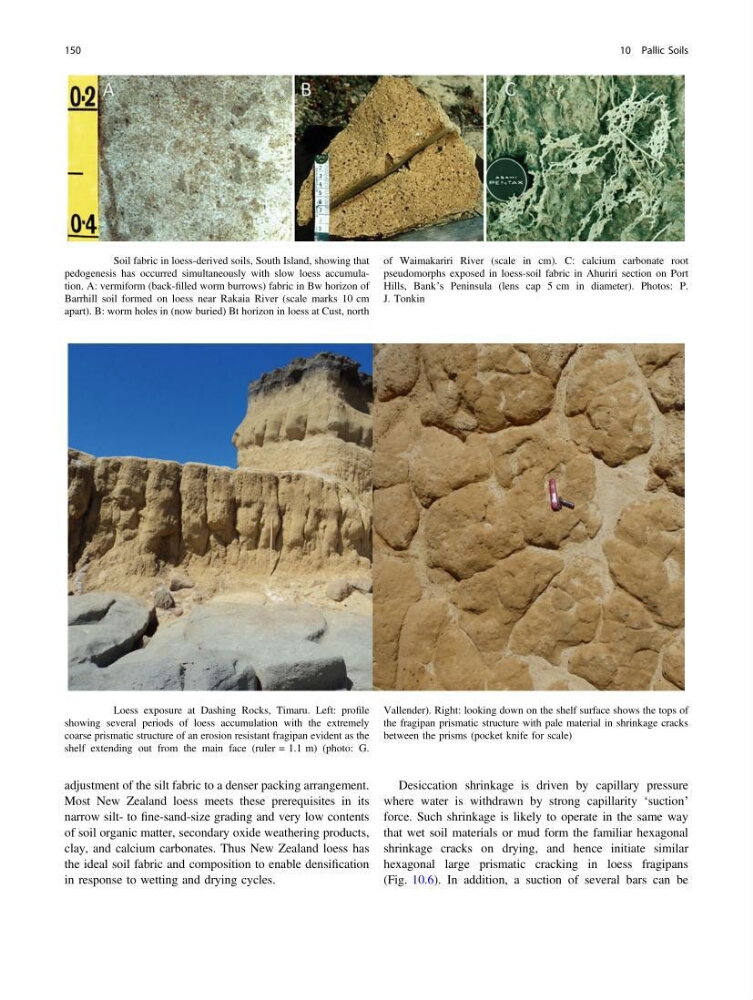
Desiccation shrinkage is driven by capillary pressure
where water is withdrawn by strong capillarity ‘suction’
force. Such shrinkage is likely to operate in the same way
that wet soil materials or mud form the familiar hexagonal
shrinkage cracks on drying, and hence initiate similar
hexagonal large prismatic cracking in loess fragipans
(Fig. 10.6). In addition, a suction of several bars can be
Fig. 10.5 Soil fabric in loess-derived soils, South Island, showing that
pedogenesis has occurred simultaneously with slow loess accumulation. A: vermiform (back-filled worm burrows) fabric in Bw horizon of
Barrhill soil formed on loess near Rakaia River (scale marks 10 cm
apart). B: worm holes in (now buried) Bt horizon in loess at Cust, north
of Waimakariri River (scale in cm). C: calcium carbonate root
pseudomorphs exposed in loess-soil fabric in Ahuriri section on Port
Hills, Bank’s Peninsula (lens cap 5 cm in diameter). Photos: P.
J. Tonkin
Fig. 10.6 Loess exposure at Dashing Rocks, Timaru. Left: profile
showing several periods of loess accumulation with the extremely
coarse prismatic structure of an erosion resistant fragipan evident as the
shelf extending out from the main face (ruler = 1.1 m) (photo: G.
Vallender). Right: looking down on the shelf surface shows the tops of
the fragipan prismatic structure with pale material in shrinkage cracks
between the prisms (pocket knife for scale)
150
10 Pallic Soils
Most New Zealand loess meets these prerequisites in its
narrow silt- to fine-sand-size grading and very low contents
of soil organic matter, secondary oxide weathering products,
clay, and calcium carbonates. Thus New Zealand loess has
the ideal soil fabric and composition to enable densification
in response to wetting and drying cycles.
Desiccation shrinkage is driven by capillary pressure
where water is withdrawn by strong capillarity ‘suction’
force. Such shrinkage is likely to operate in the same way
that wet soil materials or mud form the familiar hexagonal
shrinkage cracks on drying, and hence initiate similar
hexagonal large prismatic cracking in loess fragipans
(Fig. 10.6). In addition, a suction of several bars can be
Fig. 10.5 Soil fabric in loess-derived soils, South Island, showing that
pedogenesis has occurred simultaneously with slow loess accumulation. A: vermiform (back-filled worm burrows) fabric in Bw horizon of
Barrhill soil formed on loess near Rakaia River (scale marks 10 cm
apart). B: worm holes in (now buried) Bt horizon in loess at Cust, north
of Waimakariri River (scale in cm). C: calcium carbonate root
pseudomorphs exposed in loess-soil fabric in Ahuriri section on Port
Hills, Bank’s Peninsula (lens cap 5 cm in diameter). Photos: P.
J. Tonkin
Fig. 10.6 Loess exposure at Dashing Rocks, Timaru. Left: profile
showing several periods of loess accumulation with the extremely
coarse prismatic structure of an erosion resistant fragipan evident as the
shelf extending out from the main face (ruler = 1.1 m) (photo: G.
Vallender). Right: looking down on the shelf surface shows the tops of
the fragipan prismatic structure with pale material in shrinkage cracks
between the prisms (pocket knife for scale)
150
10 Pallic Soils