

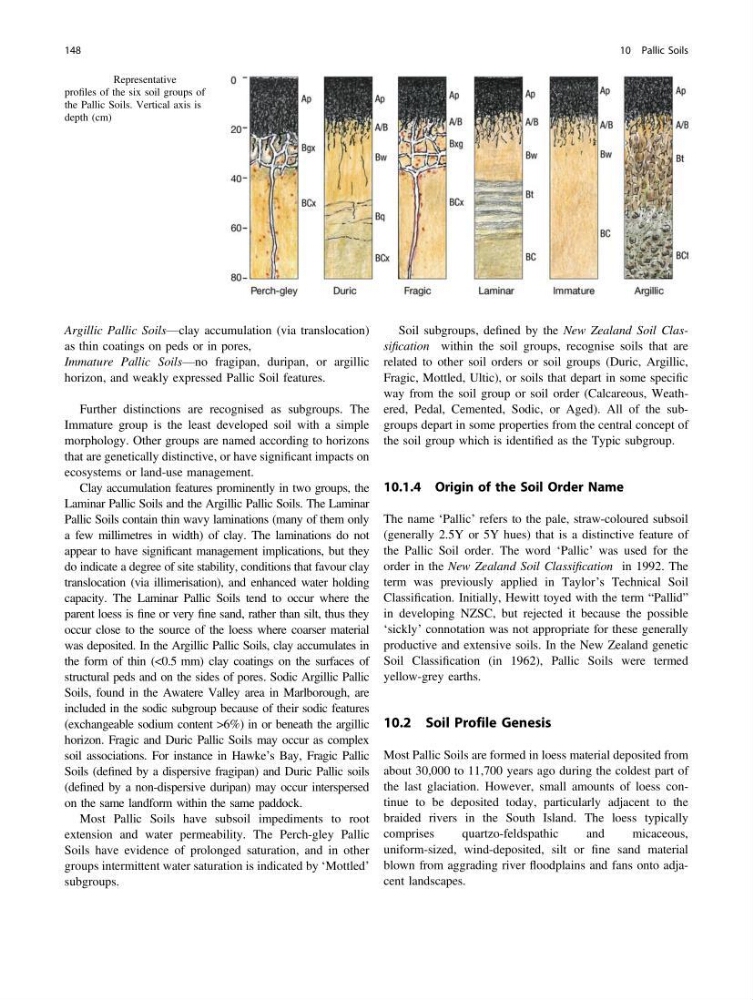
Argillic Pallic Soils—clay accumulation (via translocation)
as thin coatings on peds or in pores,
Immature Pallic Soils—no fragipan, duripan, or argillic
horizon, and weakly expressed Pallic Soil features.
Further distinctions are recognised as subgroups. The
Immature group is the least developed soil with a simple
morphology. Other groups are named according to horizons
that are genetically distinctive, or have significant impacts on
ecosystems or land-use management.
Clay accumulation features prominently in two groups, the
Laminar Pallic Soils and the Argillic Pallic Soils. The Laminar
Pallic Soils contain thin wavy laminations (many of them only
a few millimetres in width) of clay. The laminations do not
appear to have significant management implications, but they
do indicate a degree of site stability, conditions that favour clay
translocation (via illimerisation), and enhanced water holding
capacity. The Laminar Pallic Soils tend to occur where the
parent loess is fine or very fine sand, rather than silt, thus they
occur close to the source of the loess where coarser material
was deposited. In the Argillic Pallic Soils, clay accumulates in
the form of thin (<0.5 mm) clay coatings on the surfaces of
structural peds and on the sides of pores. Sodic Argillic Pallic
Soils, found in the Awatere Valley area in Marlborough, are
included in the sodic subgroup because of their sodic features
(exchangeable sodium content >6%) in or beneath the argillic
horizon. Fragic and Duric Pallic Soils may occur as complex
soil associations. For instance in Hawke’s Bay, Fragic Pallic
Soils (defined by a dispersive fragipan) and Duric Pallic soils
(defined by a non-dispersive duripan) may occur interspersed
on the same landform within the same paddock.
Most Pallic Soils have subsoil impediments to root
extension and water permeability. The Perch-gley Pallic
Soils have evidence of prolonged saturation, and in other
groups intermittent water saturation is indicated by ‘Mottled’
subgroups.
Soil subgroups, defined by the New Zealand Soil Classification within the soil groups, recognise soils that are
related to other soil orders or soil groups (Duric, Argillic,
Fragic, Mottled, Ultic), or soils that depart in some specific
way from the soil group or soil order (Calcareous, Weathered, Pedal, Cemented, Sodic, or Aged). All of the subgroups depart in some properties from the central concept of
the soil group which is identified as the Typic subgroup.
10.1.4 Origin of the Soil Order Name
The name ‘Pallic’ refers to the pale, straw-coloured subsoil
(generally 2.5Y or 5Y hues) that is a distinctive feature of
the Pallic Soil order. The word ‘Pallic’ was used for the
order in the New Zealand Soil Classification in 1992. The
term was previously applied in Taylor’s Technical Soil
Classification. Initially, Hewitt toyed with the term “Pallid”
in developing NZSC, but rejected it because the possible
‘sickly’ connotation was not appropriate for these generally
productive and extensive soils. In the New Zealand genetic
Soil Classification (in 1962), Pallic Soils were termed
yellow-grey earths.
10.2 Soil Profile Genesis
Most Pallic Soils are formed in loess material deposited from
about 30,000 to 11,700 years ago during the coldest part of
the last glaciation. However, small amounts of loess continue to be deposited today, particularly adjacent to the
braided rivers in the South Island. The loess typically
comprises
quartzo-feldspathic
and
micaceous,
uniform-sized, wind-deposited, silt or fine sand material
blown from aggrading river floodplains and fans onto adjacent landscapes.
Fig. 10.3 Representative
profiles of the six soil groups of
the Pallic Soils. Vertical axis is
depth (cm)
148
10 Pallic Soils
as thin coatings on peds or in pores,
Immature Pallic Soils—no fragipan, duripan, or argillic
horizon, and weakly expressed Pallic Soil features.
Further distinctions are recognised as subgroups. The
Immature group is the least developed soil with a simple
morphology. Other groups are named according to horizons
that are genetically distinctive, or have significant impacts on
ecosystems or land-use management.
Clay accumulation features prominently in two groups, the
Laminar Pallic Soils and the Argillic Pallic Soils. The Laminar
Pallic Soils contain thin wavy laminations (many of them only
a few millimetres in width) of clay. The laminations do not
appear to have significant management implications, but they
do indicate a degree of site stability, conditions that favour clay
translocation (via illimerisation), and enhanced water holding
capacity. The Laminar Pallic Soils tend to occur where the
parent loess is fine or very fine sand, rather than silt, thus they
occur close to the source of the loess where coarser material
was deposited. In the Argillic Pallic Soils, clay accumulates in
the form of thin (<0.5 mm) clay coatings on the surfaces of
structural peds and on the sides of pores. Sodic Argillic Pallic
Soils, found in the Awatere Valley area in Marlborough, are
included in the sodic subgroup because of their sodic features
(exchangeable sodium content >6%) in or beneath the argillic
horizon. Fragic and Duric Pallic Soils may occur as complex
soil associations. For instance in Hawke’s Bay, Fragic Pallic
Soils (defined by a dispersive fragipan) and Duric Pallic soils
(defined by a non-dispersive duripan) may occur interspersed
on the same landform within the same paddock.
Most Pallic Soils have subsoil impediments to root
extension and water permeability. The Perch-gley Pallic
Soils have evidence of prolonged saturation, and in other
groups intermittent water saturation is indicated by ‘Mottled’
subgroups.
Soil subgroups, defined by the New Zealand Soil Classification within the soil groups, recognise soils that are
related to other soil orders or soil groups (Duric, Argillic,
Fragic, Mottled, Ultic), or soils that depart in some specific
way from the soil group or soil order (Calcareous, Weathered, Pedal, Cemented, Sodic, or Aged). All of the subgroups depart in some properties from the central concept of
the soil group which is identified as the Typic subgroup.
10.1.4 Origin of the Soil Order Name
The name ‘Pallic’ refers to the pale, straw-coloured subsoil
(generally 2.5Y or 5Y hues) that is a distinctive feature of
the Pallic Soil order. The word ‘Pallic’ was used for the
order in the New Zealand Soil Classification in 1992. The
term was previously applied in Taylor’s Technical Soil
Classification. Initially, Hewitt toyed with the term “Pallid”
in developing NZSC, but rejected it because the possible
‘sickly’ connotation was not appropriate for these generally
productive and extensive soils. In the New Zealand genetic
Soil Classification (in 1962), Pallic Soils were termed
yellow-grey earths.
10.2 Soil Profile Genesis
Most Pallic Soils are formed in loess material deposited from
about 30,000 to 11,700 years ago during the coldest part of
the last glaciation. However, small amounts of loess continue to be deposited today, particularly adjacent to the
braided rivers in the South Island. The loess typically
comprises
quartzo-feldspathic
and
micaceous,
uniform-sized, wind-deposited, silt or fine sand material
blown from aggrading river floodplains and fans onto adjacent landscapes.
Fig. 10.3 Representative
profiles of the six soil groups of
the Pallic Soils. Vertical axis is
depth (cm)
148
10 Pallic Soils