

downward root extension particularly in well-drained soils.
Such a limitation is indicated by macro-porosity values in
some subsoils of less than 10% and as low as 4%.
Water logging and poor aeration may occur during wet
periods in the Gley Oxidic group, and temporary perching
(lasting 1–2 days in well-drained soils, and 4 days or more
in less-well drained soils) may occur after intense rain.
Permeability decreases with depth to low, or very low, with
the consequence that perching may occur on lower horizons
although high clay contents and limited root penetration may
reduce plant access to stored water in dry periods.
9.4.3 Chemical Properties
The chemical properties of Oxidic Soils are dominated by
their highly weathered and strongly leached status. The
clays, dominated by Fe- and Al-oxides and kaolin-subgroup
clays, may be referred to as ‘low activity clays’ because they
have relatively few charged surface sites that can hold and
exchange cations. Thus the soils are also weakly buffered.
Due to the strong leaching, unless fertiliser has been added,
the cation exchange sites are dominated by H
+ and Al
3+
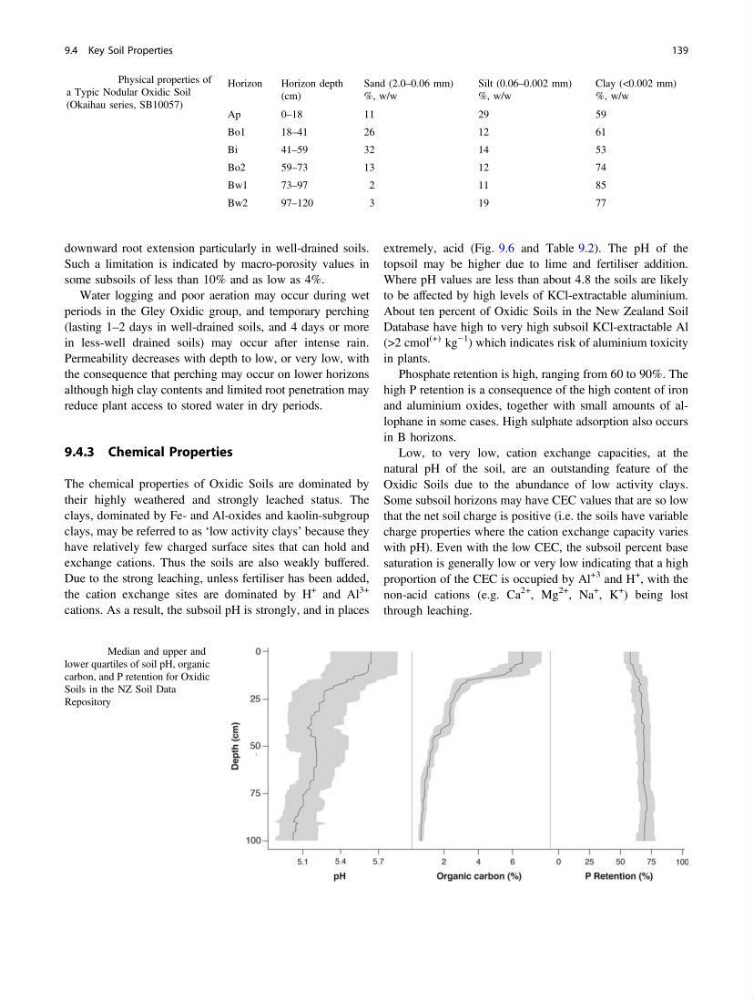
cations. As a result, the subsoil pH is strongly, and in places
extremely, acid (Fig. 9.6 and Table 9.2). The pH of the
topsoil may be higher due to lime and fertiliser addition.
Where pH values are less than about 4.8 the soils are likely
to be affected by high levels of KCl-extractable aluminium.
About ten percent of Oxidic Soils in the New Zealand Soil
Database have high to very high subsoil KCl-extractable Al
(>2 cmol
(+) kg
−1 ) which indicates risk of aluminium toxicity
in plants.
Phosphate retention is high, ranging from 60 to 90%. The
high P retention is a consequence of the high content of iron
and aluminium oxides, together with small amounts of allophane in some cases. High sulphate adsorption also occurs
in B horizons.
Low, to very low, cation exchange capacities, at the
natural pH of the soil, are an outstanding feature of the
Oxidic Soils due to the abundance of low activity clays.
Some subsoil horizons may have CEC values that are so low
that the net soil charge is positive (i.e. the soils have variable
charge properties where the cation exchange capacity varies
with pH). Even with the low CEC, the subsoil percent base
saturation is generally low or very low indicating that a high
proportion of the CEC is occupied by Al
+3 and H
+
, with the
non-acid cations (e.g. Ca
2+ , Mg
2+ , Na
+ , K
+ ) being lost
through leaching.
Table 9.1 Physical properties of
a Typic Nodular Oxidic Soil
(Okaihau series, SB10057)
Horizon
Horizon depth
(cm)
Sand (2.0–0.06 mm)
%, w/w
Silt (0.06–0.002 mm)
%, w/w
Clay (<0.002 mm)
%, w/w
Ap
0–18
11
29
59
Bo1
18–41
26
12
61
Bi
41–59
32
14
53
Bo2
59–73
13
12
74
Bw1
73–97
2
11
85
Bw2
97–120
3
19
77
Fig. 9.6 Median and upper and
lower quartiles of soil pH, organic
carbon, and P retention for Oxidic
Soils in the NZ Soil Data
Repository
9.4 Key Soil Properties
139
Such a limitation is indicated by macro-porosity values in
some subsoils of less than 10% and as low as 4%.
Water logging and poor aeration may occur during wet
periods in the Gley Oxidic group, and temporary perching
(lasting 1–2 days in well-drained soils, and 4 days or more
in less-well drained soils) may occur after intense rain.
Permeability decreases with depth to low, or very low, with
the consequence that perching may occur on lower horizons
although high clay contents and limited root penetration may
reduce plant access to stored water in dry periods.
9.4.3 Chemical Properties
The chemical properties of Oxidic Soils are dominated by
their highly weathered and strongly leached status. The
clays, dominated by Fe- and Al-oxides and kaolin-subgroup
clays, may be referred to as ‘low activity clays’ because they
have relatively few charged surface sites that can hold and
exchange cations. Thus the soils are also weakly buffered.
Due to the strong leaching, unless fertiliser has been added,
the cation exchange sites are dominated by H
+ and Al
3+
cations. As a result, the subsoil pH is strongly, and in places
extremely, acid (Fig. 9.6 and Table 9.2). The pH of the
topsoil may be higher due to lime and fertiliser addition.
Where pH values are less than about 4.8 the soils are likely
to be affected by high levels of KCl-extractable aluminium.
About ten percent of Oxidic Soils in the New Zealand Soil
Database have high to very high subsoil KCl-extractable Al
(>2 cmol
(+) kg
−1 ) which indicates risk of aluminium toxicity
in plants.
Phosphate retention is high, ranging from 60 to 90%. The
high P retention is a consequence of the high content of iron
and aluminium oxides, together with small amounts of allophane in some cases. High sulphate adsorption also occurs
in B horizons.
Low, to very low, cation exchange capacities, at the
natural pH of the soil, are an outstanding feature of the
Oxidic Soils due to the abundance of low activity clays.
Some subsoil horizons may have CEC values that are so low
that the net soil charge is positive (i.e. the soils have variable
charge properties where the cation exchange capacity varies
with pH). Even with the low CEC, the subsoil percent base
saturation is generally low or very low indicating that a high
proportion of the CEC is occupied by Al
+3 and H
+
, with the
non-acid cations (e.g. Ca
2+ , Mg
2+ , Na
+ , K
+ ) being lost
through leaching.
Table 9.1 Physical properties of
a Typic Nodular Oxidic Soil
(Okaihau series, SB10057)
Horizon
Horizon depth
(cm)
Sand (2.0–0.06 mm)
%, w/w
Silt (0.06–0.002 mm)
%, w/w
Clay (<0.002 mm)
%, w/w
Ap
0–18
11
29
59
Bo1
18–41
26
12
61
Bi
41–59
32
14
53
Bo2
59–73
13
12
74
Bw1
73–97
2
11
85
Bw2
97–120
3
19
77
Fig. 9.6 Median and upper and
lower quartiles of soil pH, organic
carbon, and P retention for Oxidic
Soils in the NZ Soil Data
Repository
9.4 Key Soil Properties
139