

stable continental shields of South America and Africa
where land surfaces are among the oldest on Earth,
with exposure to weathering and leaching for prolonged periods of time. Oxisols are also extensive in
humid tropical areas of easily weatherable basic volcanic rocks, such as South East Asia and on basalts in
northern Australia.
Large areas of Oxisols provide only meagre food
production. While their physical properties are to be
appreciated, the soil chemistry presents challenges to
nutrient management. Under low input, subsistence,
agriculture of the soil-plant system will recycle nutrients by returns to the soil via litter fall and root
extension. However, the low nutrient storage capacity
of the soil means careful soil management is important
to maintain soil organic matter and prevent erosion.
More intensive production requires correction of
multiple deficiencies including nitrogen, potassium,
calcium, magnesium, sulphur, zinc, boron, and copper,
along with considerable management finesse. Research
is refining nutrient management. Since about 2010,
Brazil has successfully developed vast areas of Oxisols
into highly productive, sustainably managed, crop-land
with carefully managed inputs of lime and fertiliser. As
a result, Brazil has moved from being an importer of
grain to one of the larger global exporters. Brazil is
providing an example which undoubtedly others will
follow with potentially world-changing effect.
9.4 Key Soil Properties
9.4.1 Soil Composition
The Oxidic Soil parent materials are mainly derived from
dark coloured mafic or ultramafic rocks and associated
deposits, especially basalts, andesites, dolerites, and peridotites of Tertiary to Quaternary age. Oxidic Soils may also
form in sediments derived from the mafic rocks. The soils are
strongly weathered with 50–90% of parent material altered to
clay. The clay fraction comprises a mixture of minerals
including substantial amounts of iron oxides (especially
goethite together with haematite and ferrihydrite), aluminium
oxide (gibbsite), and kaolin-subgroup clays (halloysite and/or
kaolinite). Vermiculite may also be present, mainly in upper
profiles and is likely to be derived from aeolian dust.
9.4.2 Physical Properties
Topsoils are usually friable with low plasticity and well
developed fine spheroidal or polyhedral structure despite
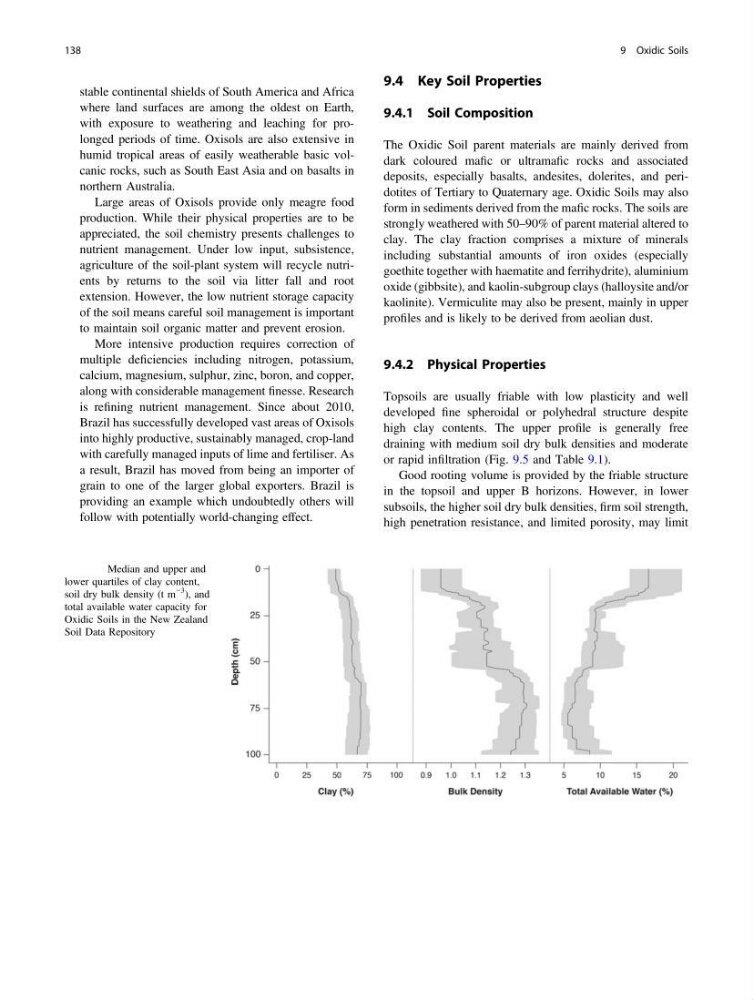
high clay contents. The upper profile is generally free
draining with medium soil dry bulk densities and moderate
or rapid infiltration (Fig. 9.5 and Table 9.1).
Good rooting volume is provided by the friable structure
in the topsoil and upper B horizons. However, in lower
subsoils, the higher soil dry bulk densities, firm soil strength,
high penetration resistance, and limited porosity, may limit
Fig. 9.5 Median and upper and
lower quartiles of clay content,
soil dry bulk density (t m
−3
), and
total available water capacity for
Oxidic Soils in the New Zealand
Soil Data Repository
138
9 Oxidic Soils
where land surfaces are among the oldest on Earth,
with exposure to weathering and leaching for prolonged periods of time. Oxisols are also extensive in
humid tropical areas of easily weatherable basic volcanic rocks, such as South East Asia and on basalts in
northern Australia.
Large areas of Oxisols provide only meagre food
production. While their physical properties are to be
appreciated, the soil chemistry presents challenges to
nutrient management. Under low input, subsistence,
agriculture of the soil-plant system will recycle nutrients by returns to the soil via litter fall and root
extension. However, the low nutrient storage capacity
of the soil means careful soil management is important
to maintain soil organic matter and prevent erosion.
More intensive production requires correction of
multiple deficiencies including nitrogen, potassium,
calcium, magnesium, sulphur, zinc, boron, and copper,
along with considerable management finesse. Research
is refining nutrient management. Since about 2010,
Brazil has successfully developed vast areas of Oxisols
into highly productive, sustainably managed, crop-land
with carefully managed inputs of lime and fertiliser. As
a result, Brazil has moved from being an importer of
grain to one of the larger global exporters. Brazil is
providing an example which undoubtedly others will
follow with potentially world-changing effect.
9.4 Key Soil Properties
9.4.1 Soil Composition
The Oxidic Soil parent materials are mainly derived from
dark coloured mafic or ultramafic rocks and associated
deposits, especially basalts, andesites, dolerites, and peridotites of Tertiary to Quaternary age. Oxidic Soils may also
form in sediments derived from the mafic rocks. The soils are
strongly weathered with 50–90% of parent material altered to
clay. The clay fraction comprises a mixture of minerals
including substantial amounts of iron oxides (especially
goethite together with haematite and ferrihydrite), aluminium
oxide (gibbsite), and kaolin-subgroup clays (halloysite and/or
kaolinite). Vermiculite may also be present, mainly in upper
profiles and is likely to be derived from aeolian dust.
9.4.2 Physical Properties
Topsoils are usually friable with low plasticity and well
developed fine spheroidal or polyhedral structure despite
high clay contents. The upper profile is generally free
draining with medium soil dry bulk densities and moderate
or rapid infiltration (Fig. 9.5 and Table 9.1).
Good rooting volume is provided by the friable structure
in the topsoil and upper B horizons. However, in lower
subsoils, the higher soil dry bulk densities, firm soil strength,
high penetration resistance, and limited porosity, may limit
Fig. 9.5 Median and upper and
lower quartiles of clay content,
soil dry bulk density (t m
−3
), and
total available water capacity for
Oxidic Soils in the New Zealand
Soil Data Repository
138
9 Oxidic Soils