

and Granular Soils in Northland is still in its infancy with
relatively little published on the subject in the last 30 years.
The Oxidic Soils are most concentrated around, and north
and west of, Kerikeri in the Kaikohe-Bay of Islands Volcanic Field, and near Whangarei. The basalt lavas and scoria
materials (Kerekeri Volcanic Group basalts) are Late Miocene to Quaternary in age (ranging from c. 9 million to c.
300,000 years old). Oxidic Soils are also likely to occur on
Early Miocene (c. 20 million years old) basalt lava flows
(Waipoua basalt) in the Waipoua area south of Hokianga
Harbour, and on basaltic volcanic and mafic to ultramafic
igneous deposits in the Karikari Penisula, North Cape, and
Surville Cliffs areas. The soils occur on flattish, stable plateau and interfluve surfaces. The variable topography and
geology of Northland mean that the Oxidic Soils are likely to
occur in small pockets in soil complexes with Granular,
Gley, and Ultic soils as well as Oxidic Brown Soils and
Allophanic Soils. Granular Soils (Chap. 6) or Oxidic Brown
Soils (Chap. 4) tend to prevail on younger basalts and where
weathering has not become so advanced. Local incidences of
Allophanic Soils (Chap. 2) occur on well-drained Late
Quaternary scoria cones. Ultic Soils (Chap. 16) form on the
more silica-rich parent materials including saprolite on
Tertiary sedimentary rocks and dacites and rhyolites.
Work associated with the Smap project in the
Pukekohe-Bombay region has helped to elucidate the topographic relationship between uncommon (probable) Oxidic
Soils, formed on basalt lavas re-exposed (exhumed) at the land
surface, by erosion, in upper slope positions in the South
Auckland Volcanic Field, and other adjacent soils. Oxidic
Granular Soils and Oxidic Brown Soils are formed mainly on
lower slopes and flat terraces where clay-rich, strongly altered,
rhyolitic tephra beds (Hamilton Ash) overlie paleosols formed
on the basalts. The composite soils will be Oxidic Soils where
the buried oxidic horizon on the underlying weathered basalt is
within 60 cm of the modern land surface. The accumulated
understanding of the ‘Red and Brown loams’ (some of which
are Oxidic Soils) originally demarcated by Taylor was published in ‘New Zealand Soil News’ in December 1957, with
the same material largely repeated (often word for word) in the
few publications since then.
Stan Buol and Hari Eswaran described three landscapes
where Oxisols occur in Africa and South America. Firstly,
many Oxisols are associated with stable slopes on igneous
(especially basaltic volcanic) rocks and associated deposits
that are weathered sufficiently to produce low activity clays,
similar to the New Zealand Oxidic Soils. Secondly, Oxisols
are formed on younger landscapes, but only on the most
stable land surfaces in mafic deposits that are readily
weatherable. New Zealand Oxisols and Granular Soils may
have some genetic elements in common with the second kind
of Oxisols. Allophanic soil materials are sometimes found in
upper horizons and may be weathered from the local parent
materials, or are possibly derived from weathering of small
amounts of tephra blown from central North Island volcanoes
and thus fit Buol and Eswaran’s second landscape type. The
third type occurs on late Tertiary high plateaux of mafic
igneous deposits with deep weathering profiles. They are
distinguished by thick resistant caps of plinthite or ferricrete
(a hard, cemented, iron-rich layer) that may have formed
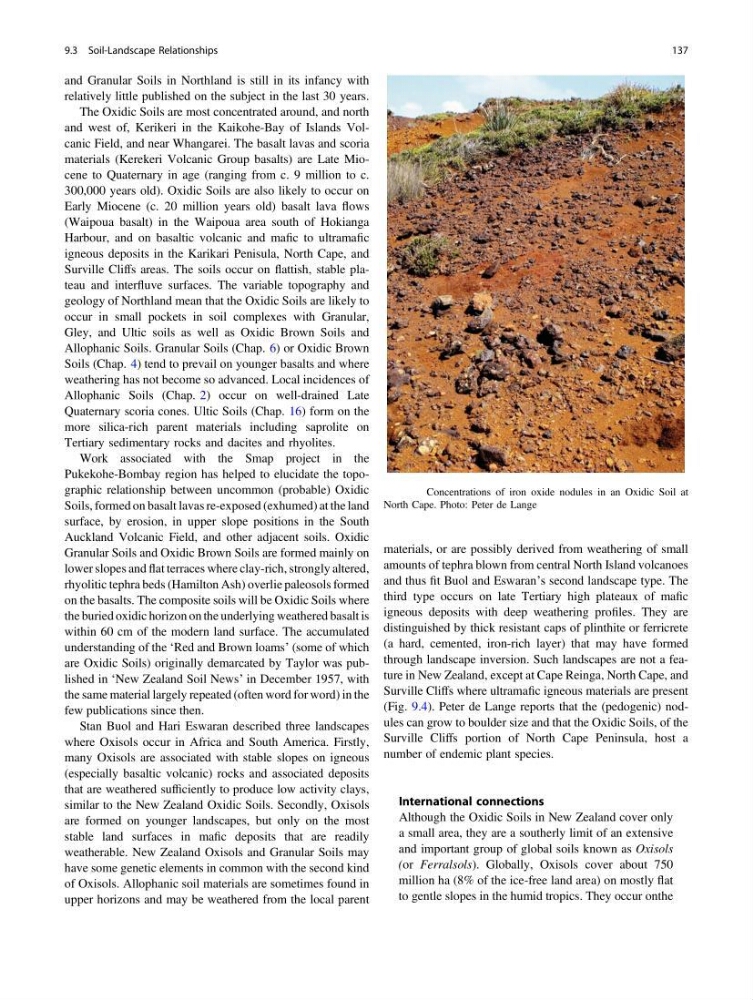
through landscape inversion. Such landscapes are not a feature in New Zealand, except at Cape Reinga, North Cape, and
Surville Cliffs where ultramafic igneous materials are present
(Fig. 9.4). Peter de Lange reports that the (pedogenic) nodules can grow to boulder size and that the Oxidic Soils, of the
Surville Cliffs portion of North Cape Peninsula, host a
number of endemic plant species.
International connections
Although the Oxidic Soils in New Zealand cover only
a small area, they are a southerly limit of an extensive
and important group of global soils known as Oxisols
(or Ferralsols). Globally, Oxisols cover about 750
million ha (8% of the ice-free land area) on mostly flat
to gentle slopes in the humid tropics. They occur onthe
Fig. 9.4 Concentrations of iron oxide nodules in an Oxidic Soil at
North Cape. Photo: Peter de Lange
9.3 Soil-Landscape Relationships
137
relatively little published on the subject in the last 30 years.
The Oxidic Soils are most concentrated around, and north
and west of, Kerikeri in the Kaikohe-Bay of Islands Volcanic Field, and near Whangarei. The basalt lavas and scoria
materials (Kerekeri Volcanic Group basalts) are Late Miocene to Quaternary in age (ranging from c. 9 million to c.
300,000 years old). Oxidic Soils are also likely to occur on
Early Miocene (c. 20 million years old) basalt lava flows
(Waipoua basalt) in the Waipoua area south of Hokianga
Harbour, and on basaltic volcanic and mafic to ultramafic
igneous deposits in the Karikari Penisula, North Cape, and
Surville Cliffs areas. The soils occur on flattish, stable plateau and interfluve surfaces. The variable topography and
geology of Northland mean that the Oxidic Soils are likely to
occur in small pockets in soil complexes with Granular,
Gley, and Ultic soils as well as Oxidic Brown Soils and
Allophanic Soils. Granular Soils (Chap. 6) or Oxidic Brown
Soils (Chap. 4) tend to prevail on younger basalts and where
weathering has not become so advanced. Local incidences of
Allophanic Soils (Chap. 2) occur on well-drained Late
Quaternary scoria cones. Ultic Soils (Chap. 16) form on the
more silica-rich parent materials including saprolite on
Tertiary sedimentary rocks and dacites and rhyolites.
Work associated with the Smap project in the
Pukekohe-Bombay region has helped to elucidate the topographic relationship between uncommon (probable) Oxidic
Soils, formed on basalt lavas re-exposed (exhumed) at the land
surface, by erosion, in upper slope positions in the South
Auckland Volcanic Field, and other adjacent soils. Oxidic
Granular Soils and Oxidic Brown Soils are formed mainly on
lower slopes and flat terraces where clay-rich, strongly altered,
rhyolitic tephra beds (Hamilton Ash) overlie paleosols formed
on the basalts. The composite soils will be Oxidic Soils where
the buried oxidic horizon on the underlying weathered basalt is
within 60 cm of the modern land surface. The accumulated
understanding of the ‘Red and Brown loams’ (some of which
are Oxidic Soils) originally demarcated by Taylor was published in ‘New Zealand Soil News’ in December 1957, with
the same material largely repeated (often word for word) in the
few publications since then.
Stan Buol and Hari Eswaran described three landscapes
where Oxisols occur in Africa and South America. Firstly,
many Oxisols are associated with stable slopes on igneous
(especially basaltic volcanic) rocks and associated deposits
that are weathered sufficiently to produce low activity clays,
similar to the New Zealand Oxidic Soils. Secondly, Oxisols
are formed on younger landscapes, but only on the most
stable land surfaces in mafic deposits that are readily
weatherable. New Zealand Oxisols and Granular Soils may
have some genetic elements in common with the second kind
of Oxisols. Allophanic soil materials are sometimes found in
upper horizons and may be weathered from the local parent
materials, or are possibly derived from weathering of small
amounts of tephra blown from central North Island volcanoes
and thus fit Buol and Eswaran’s second landscape type. The
third type occurs on late Tertiary high plateaux of mafic
igneous deposits with deep weathering profiles. They are
distinguished by thick resistant caps of plinthite or ferricrete
(a hard, cemented, iron-rich layer) that may have formed
through landscape inversion. Such landscapes are not a feature in New Zealand, except at Cape Reinga, North Cape, and
Surville Cliffs where ultramafic igneous materials are present
(Fig. 9.4). Peter de Lange reports that the (pedogenic) nodules can grow to boulder size and that the Oxidic Soils, of the
Surville Cliffs portion of North Cape Peninsula, host a
number of endemic plant species.
International connections
Although the Oxidic Soils in New Zealand cover only
a small area, they are a southerly limit of an extensive
and important group of global soils known as Oxisols
(or Ferralsols). Globally, Oxisols cover about 750
million ha (8% of the ice-free land area) on mostly flat
to gentle slopes in the humid tropics. They occur onthe
Fig. 9.4 Concentrations of iron oxide nodules in an Oxidic Soil at
North Cape. Photo: Peter de Lange
9.3 Soil-Landscape Relationships
137