

8.6 Correlation with Other Classification
Systems
Organic Soils in New Zealand are essentially similar to soils
formed on peat, or in deep and partly decomposed forest
litter, in other parts of the world. Hence, there is a clear
correlation between the New Zealand Soil Classification and
the Histosols in both Soil Taxonomy, and the World Reference Base (Table 8.4).
8.7 Use and Management of Organic Soils
8.7.1 Introduction
About 30% of the Organic Soils in New Zealand are in
reserves where they provide habitat for a unique set of flora
and fauna and are an important component of New Zealand’s biodiversity. The reserves also provide invaluable sites
for studying past environments and climates (see grey box)
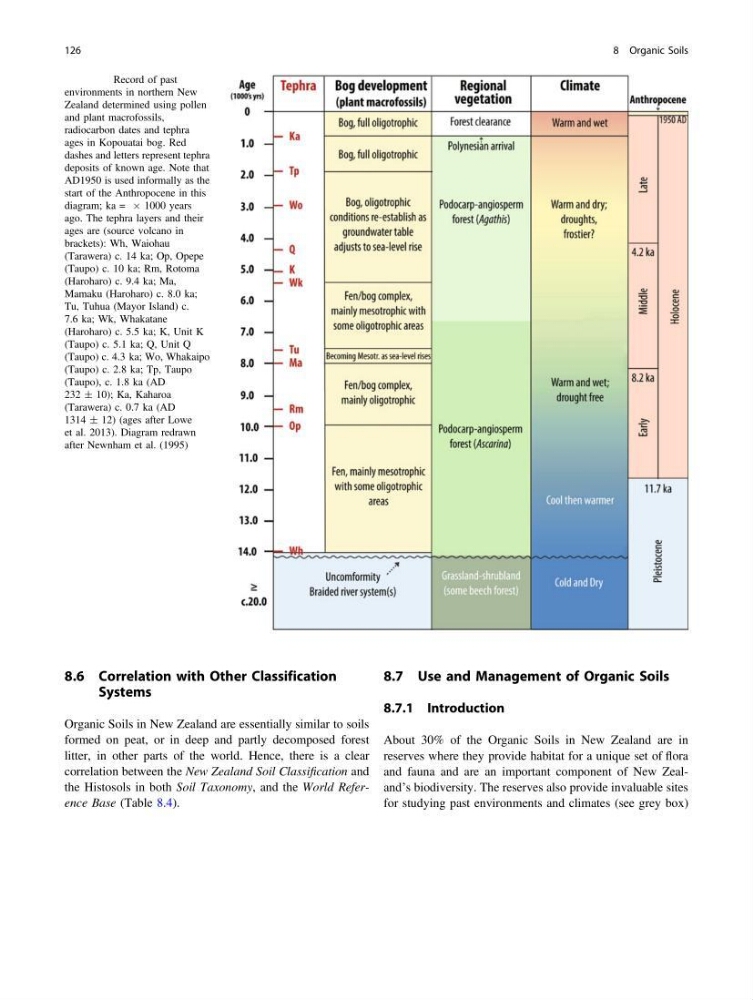
Fig. 8.11 Record of past
environments in northern New
Zealand determined using pollen
and plant macrofossils,
radiocarbon dates and tephra
ages in Kopouatai bog. Red
dashes and letters represent tephra
deposits of known age. Note that
AD1950 is used informally as the
start of the Anthropocene in this
diagram; ka = Â 1000 years
ago. The tephra layers and their
ages are (source volcano in
brackets): Wh, Waiohau
(Tarawera) c. 14 ka; Op, Opepe
(Taupo) c. 10 ka; Rm, Rotoma
(Haroharo) c. 9.4 ka; Ma,
Mamaku (Haroharo) c. 8.0 ka;
Tu, Tuhua (Mayor Island) c.
7.6 ka; Wk, Whakatane
(Haroharo) c. 5.5 ka; K, Unit K
(Taupo) c. 5.1 ka; Q, Unit Q
(Taupo) c. 4.3 ka; Wo, Whakaipo
(Taupo) c. 2.8 ka; Tp, Taupo
(Taupo), c. 1.8 ka (AD
232 ± 10); Ka, Kaharoa
(Tarawera) c. 0.7 ka (AD
1314 ± 12) (ages after Lowe
et al. 2013). Diagram redrawn
after Newnham et al. (1995)
126
8 Organic Soils
Systems
Organic Soils in New Zealand are essentially similar to soils
formed on peat, or in deep and partly decomposed forest
litter, in other parts of the world. Hence, there is a clear
correlation between the New Zealand Soil Classification and
the Histosols in both Soil Taxonomy, and the World Reference Base (Table 8.4).
8.7 Use and Management of Organic Soils
8.7.1 Introduction
About 30% of the Organic Soils in New Zealand are in
reserves where they provide habitat for a unique set of flora
and fauna and are an important component of New Zealand’s biodiversity. The reserves also provide invaluable sites
for studying past environments and climates (see grey box)
Fig. 8.11 Record of past
environments in northern New
Zealand determined using pollen
and plant macrofossils,
radiocarbon dates and tephra
ages in Kopouatai bog. Red
dashes and letters represent tephra
deposits of known age. Note that
AD1950 is used informally as the
start of the Anthropocene in this
diagram; ka = Â 1000 years
ago. The tephra layers and their
ages are (source volcano in
brackets): Wh, Waiohau
(Tarawera) c. 14 ka; Op, Opepe
(Taupo) c. 10 ka; Rm, Rotoma
(Haroharo) c. 9.4 ka; Ma,
Mamaku (Haroharo) c. 8.0 ka;
Tu, Tuhua (Mayor Island) c.
7.6 ka; Wk, Whakatane
(Haroharo) c. 5.5 ka; K, Unit K
(Taupo) c. 5.1 ka; Q, Unit Q
(Taupo) c. 4.3 ka; Wo, Whakaipo
(Taupo) c. 2.8 ka; Tp, Taupo
(Taupo), c. 1.8 ka (AD
232 ± 10); Ka, Kaharoa
(Tarawera) c. 0.7 ka (AD
1314 ± 12) (ages after Lowe
et al. 2013). Diagram redrawn
after Newnham et al. (1995)
126
8 Organic Soils