

as well as useful sites for research into past volcanism (because bogs in North Island preserve distal tephra-fall
deposits, hence a record of volcanic events).
About 70% of New Zealand Organic Soils have been
developed for agriculture, supporting pastoral farming
(predominantly dairy farming), maize, and potato cropping,
and permanent horticultural crops, particularly blueberries
(which are well adapted to the low pH and high moisture
environment of Organic Soils).
Some areas of Organic Soils have been mined for peat
resources, often for use in potting mix and mushroom-growing
compost. Sphagnum moss is also harvested and used for potting mixes. Moss may be dried and used for insulation in
buildings and has also been used in wound dressing.
Organic Soils have a role in the hydrological functioning
of catchments. Because they act as a giant sponge, Organic
Soils can absorb water during periods of high rainfall, slowly
releasing it over time. Thus they help minimise flood peak
flows and maintain water flow in rivers during dry periods.
Organic Soils provide a reservoir of soil carbon. Dave
Campbell, Louis Schipper, Joss Ratcliffe and colleagues and
students have been particularly involved in research on the
rates of losses and gains in soil carbon from the Organic
Soils in the Waikato region. They have found that the
short-term C budget for pasture on peat (used for dairying)
to be approximately in balance, i.e., net gains of C from
photosynthesis are essentially matched by losses as milk
solids and CH 4 and CO 2 emissions.
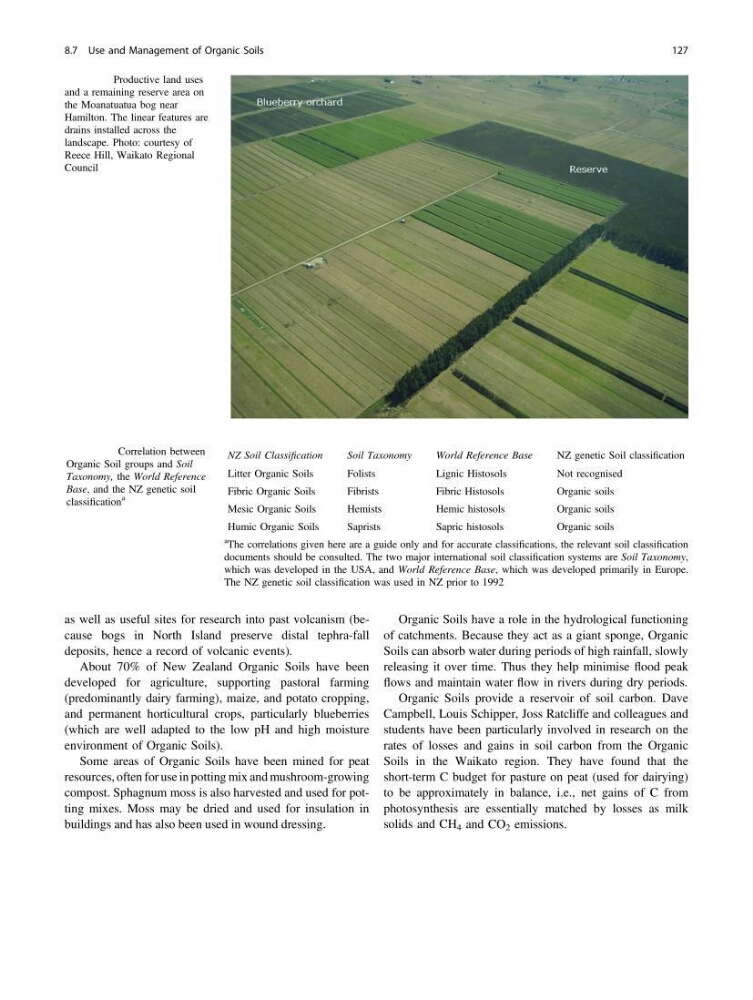
Fig. 8.12 Productive land uses
and a remaining reserve area on
the Moanatuatua bog near
Hamilton. The linear features are
drains installed across the
landscape. Photo: courtesy of
Reece Hill, Waikato Regional
Council
Table 8.4 Correlation between
Organic Soil groups and Soil
Taxonomy, the World Reference
Base, and the NZ genetic soil
classification
a
NZ Soil Classification
Soil Taxonomy
World Reference Base
NZ genetic Soil classification
Litter Organic Soils
Folists
Lignic Histosols
Not recognised
Fibric Organic Soils
Fibrists
Fibric Histosols
Organic soils
Mesic Organic Soils
Hemists
Hemic histosols
Organic soils
Humic Organic Soils
Saprists
Sapric histosols
Organic soils
a The correlations given here are a guide only and for accurate classifications, the relevant soil classification
documents should be consulted. The two major international soil classification systems are Soil Taxonomy,
which was developed in the USA, and World Reference Base, which was developed primarily in Europe.
The NZ genetic soil classification was used in NZ prior to 1992
8.7 Use and Management of Organic Soils
127
deposits, hence a record of volcanic events).
About 70% of New Zealand Organic Soils have been
developed for agriculture, supporting pastoral farming
(predominantly dairy farming), maize, and potato cropping,
and permanent horticultural crops, particularly blueberries
(which are well adapted to the low pH and high moisture
environment of Organic Soils).
Some areas of Organic Soils have been mined for peat
resources, often for use in potting mix and mushroom-growing
compost. Sphagnum moss is also harvested and used for potting mixes. Moss may be dried and used for insulation in
buildings and has also been used in wound dressing.
Organic Soils have a role in the hydrological functioning
of catchments. Because they act as a giant sponge, Organic
Soils can absorb water during periods of high rainfall, slowly
releasing it over time. Thus they help minimise flood peak
flows and maintain water flow in rivers during dry periods.
Organic Soils provide a reservoir of soil carbon. Dave
Campbell, Louis Schipper, Joss Ratcliffe and colleagues and
students have been particularly involved in research on the
rates of losses and gains in soil carbon from the Organic
Soils in the Waikato region. They have found that the
short-term C budget for pasture on peat (used for dairying)
to be approximately in balance, i.e., net gains of C from
photosynthesis are essentially matched by losses as milk
solids and CH 4 and CO 2 emissions.
Fig. 8.12 Productive land uses
and a remaining reserve area on
the Moanatuatua bog near
Hamilton. The linear features are
drains installed across the
landscape. Photo: courtesy of
Reece Hill, Waikato Regional
Council
Table 8.4 Correlation between
Organic Soil groups and Soil
Taxonomy, the World Reference
Base, and the NZ genetic soil
classification
a
NZ Soil Classification
Soil Taxonomy
World Reference Base
NZ genetic Soil classification
Litter Organic Soils
Folists
Lignic Histosols
Not recognised
Fibric Organic Soils
Fibrists
Fibric Histosols
Organic soils
Mesic Organic Soils
Hemists
Hemic histosols
Organic soils
Humic Organic Soils
Saprists
Sapric histosols
Organic soils
a The correlations given here are a guide only and for accurate classifications, the relevant soil classification
documents should be consulted. The two major international soil classification systems are Soil Taxonomy,
which was developed in the USA, and World Reference Base, which was developed primarily in Europe.
The NZ genetic soil classification was used in NZ prior to 1992
8.7 Use and Management of Organic Soils
127