

Cambridge and Te Awamutu. Restiad bogs also occur in the
Chatham Islands and Australia. There are three restiad bog
species: Empodisma robustum the jointed wire rush (northern North Island); Empodisma minus (much of North, South,
and Stewart islands); and Sporadanthus ferrugineus (northern North Island). Further south, sphagnum moss is often the
dominant peat-forming plant. Fens, swamps, and seepages
originally supported water-tolerant native plants including
flax (harakeke, Phormium tenax), cabbage tree (ti kouka,
Cordyline australis), kahikatea (Dacrycarpus dacridioides),
pukeatea (Laurelia novae-zelandiae), raupo (Typha orientalis), and manuka (Leptospermum scoparium). The low pH
and saturated conditions that limit oxygen availability, as
well as the lack of nutrients, such as nitrogen and phosphorus, limit biological activity within Organic Soils.
Peat bogs and lake sediments as paleoenvironmental records
Bogs and lake sediments provide a unique archive for
understanding environmental change over thousands
of years because the anaerobic conditions enable the
remains of plants and animals to be preserved. Analyses of materials such as pollen, plant macrofossils,
and plant cuticles, along with peat humification, carbon content, and dust input, provide a basis for
reconstructing past environments. Vegetation, temperature, wind patterns, and rainfall over thousands of
years can all be determined. For example, a detailed
study on the Kopouatai bog gave a 14,000-year-long
record of environmental change using both pollen
analysis (which gives regional vegetation cover) and
plant macrofossils (which provide a local signal)
(Fig. 8.11).
As well as Kopouatai, the sediments in many lakes
have been cored and analysed including Lake Pupuke
and other Auckland crater lakes, peat lakes in the
Waikato, lakes Tutira and Poukawa in Hawke’s Bay,
Adelaide Tarn near Nelson, and Lake Ohau in
Otago/Canterbury. In addition to pollen and plant
macrofossils, lake sediments may also contain the
remains of midges, microcrustacea, algae, diatoms,
and organic compounds. A climate-event stratigraphy
for New Zealand from 30,000 to 8000 years ago has
been developed using pollen and tephra studies that
linked records from three key sites: Pukaki Lagoon
(Auckland), Galway Tarn (Westland), and Kaipo bog
(Te Urewera National Park) in the INTIMATE
(INTegration of Ice-core, MArine, and TErrestrial
records) project undertaken by the entire New Zealand
paleoclimate community.
8.5 Distinguishing Between Organic Soils
and Related Soil Orders
It is the amount of carbon (or the presence of organic soil
material) that distinguishes Organic Soils from all other soil
orders. Organic Soils formed on peat have more than 30 cm
of organic soil material within a depth of 60 cm. In forests,
the qualifying thickness of (decomposed) litter is ! 40 cm.
The organic material in both cases must contain at least 18%
carbon (or approximately 30% soil organic matter) to qualify
as an Organic Soil. The New Zealand Soil Classification,
where possible, uses soil morphological properties including
colour, deformable failure, weight loss on oven-drying, and
unrubbed fibre content to enable the organic material to be
identified when carbon analyses are not easily available.
Other soil orders (e.g. Gley Soil, and Recent Soils), may
have peaty topsoils identified by a ‘Peaty’ subgroup. The
peaty topsoil is similar to organic soil material but too thin to
meet the thickness and depth requirements for the Organic
Soils order.
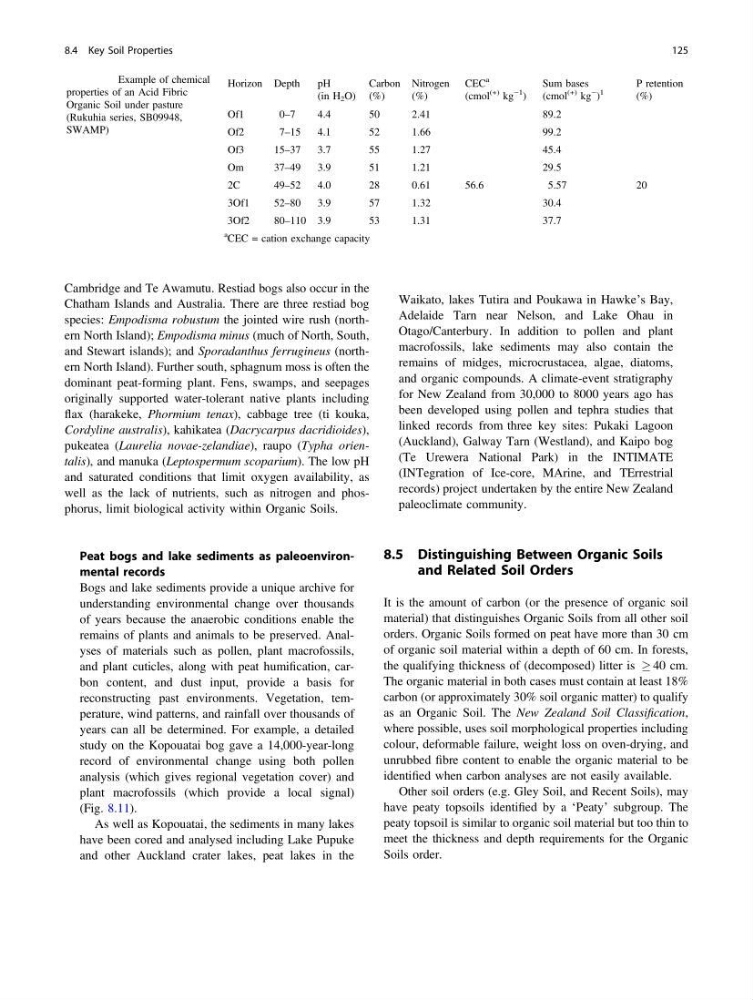
Table 8.3 Example of chemical
properties of an Acid Fibric
Organic Soil under pasture
(Rukuhia series, SB09948,
SWAMP)
Horizon Depth
pH
(in H 2 O)
Carbon
(%)
Nitrogen
(%)
CEC
a
(cmol
(+) kg
−1
)
Sum bases
(cmol
(+) kg
−
)
1
P retention
(%)
Of1
0–7
4.4
50
2.41
89.2
Of2
7–15
4.1
52
1.66
99.2
Of3
15–37
3.7
55
1.27
45.4
Om
37–49
3.9
51
1.21
29.5
2C
49–52
4.0
28
0.61
56.6
5.57
20
3Of1
52–80
3.9
57
1.32
30.4
3Of2
80–110 3.9
53
1.31
37.7
a CEC = cation exchange capacity
8.4 Key Soil Properties
125
Chatham Islands and Australia. There are three restiad bog
species: Empodisma robustum the jointed wire rush (northern North Island); Empodisma minus (much of North, South,
and Stewart islands); and Sporadanthus ferrugineus (northern North Island). Further south, sphagnum moss is often the
dominant peat-forming plant. Fens, swamps, and seepages
originally supported water-tolerant native plants including
flax (harakeke, Phormium tenax), cabbage tree (ti kouka,
Cordyline australis), kahikatea (Dacrycarpus dacridioides),
pukeatea (Laurelia novae-zelandiae), raupo (Typha orientalis), and manuka (Leptospermum scoparium). The low pH
and saturated conditions that limit oxygen availability, as
well as the lack of nutrients, such as nitrogen and phosphorus, limit biological activity within Organic Soils.
Peat bogs and lake sediments as paleoenvironmental records
Bogs and lake sediments provide a unique archive for
understanding environmental change over thousands
of years because the anaerobic conditions enable the
remains of plants and animals to be preserved. Analyses of materials such as pollen, plant macrofossils,
and plant cuticles, along with peat humification, carbon content, and dust input, provide a basis for
reconstructing past environments. Vegetation, temperature, wind patterns, and rainfall over thousands of
years can all be determined. For example, a detailed
study on the Kopouatai bog gave a 14,000-year-long
record of environmental change using both pollen
analysis (which gives regional vegetation cover) and
plant macrofossils (which provide a local signal)
(Fig. 8.11).
As well as Kopouatai, the sediments in many lakes
have been cored and analysed including Lake Pupuke
and other Auckland crater lakes, peat lakes in the
Waikato, lakes Tutira and Poukawa in Hawke’s Bay,
Adelaide Tarn near Nelson, and Lake Ohau in
Otago/Canterbury. In addition to pollen and plant
macrofossils, lake sediments may also contain the
remains of midges, microcrustacea, algae, diatoms,
and organic compounds. A climate-event stratigraphy
for New Zealand from 30,000 to 8000 years ago has
been developed using pollen and tephra studies that
linked records from three key sites: Pukaki Lagoon
(Auckland), Galway Tarn (Westland), and Kaipo bog
(Te Urewera National Park) in the INTIMATE
(INTegration of Ice-core, MArine, and TErrestrial
records) project undertaken by the entire New Zealand
paleoclimate community.
8.5 Distinguishing Between Organic Soils
and Related Soil Orders
It is the amount of carbon (or the presence of organic soil
material) that distinguishes Organic Soils from all other soil
orders. Organic Soils formed on peat have more than 30 cm
of organic soil material within a depth of 60 cm. In forests,
the qualifying thickness of (decomposed) litter is ! 40 cm.
The organic material in both cases must contain at least 18%
carbon (or approximately 30% soil organic matter) to qualify
as an Organic Soil. The New Zealand Soil Classification,
where possible, uses soil morphological properties including
colour, deformable failure, weight loss on oven-drying, and
unrubbed fibre content to enable the organic material to be
identified when carbon analyses are not easily available.
Other soil orders (e.g. Gley Soil, and Recent Soils), may
have peaty topsoils identified by a ‘Peaty’ subgroup. The
peaty topsoil is similar to organic soil material but too thin to
meet the thickness and depth requirements for the Organic
Soils order.
Table 8.3 Example of chemical
properties of an Acid Fibric
Organic Soil under pasture
(Rukuhia series, SB09948,
SWAMP)
Horizon Depth
pH
(in H 2 O)
Carbon
(%)
Nitrogen
(%)
CEC
a
(cmol
(+) kg
−1
)
Sum bases
(cmol
(+) kg
−
)
1
P retention
(%)
Of1
0–7
4.4
50
2.41
89.2
Of2
7–15
4.1
52
1.66
99.2
Of3
15–37
3.7
55
1.27
45.4
Om
37–49
3.9
51
1.21
29.5
2C
49–52
4.0
28
0.61
56.6
5.57
20
3Of1
52–80
3.9
57
1.32
30.4
3Of2
80–110 3.9
53
1.31
37.7
a CEC = cation exchange capacity
8.4 Key Soil Properties
125