

The Whangamarino wetland and the Kopouatai bog are
recognised as wetlands of international importance. The
Whangamarino wetland is a 7000 ha mosaic of swamps,
fens, and bogs. Baumea (rush), manuka, and wire rush are
the most common plant species in the peat bogs, whereas the
swamp areas support a wider range of vegetation with introduced willow over much of the area. Many species of
mosses, including 13 species first described in the
Whangamarino wetland, have been recorded.
The Kopouatai bog is the largest (10,201 ha, 102 km
2 )
unaltered restiad bog in New Zealand and is recognised
internationally (as Ramsar Site 444). The Kopouatai bog
predominantly comprises organic matter but does include
thin mineral layers from the deposition of tephra-fall
deposits and a thin marine-derived layer of mud in northern parts reflecting a period in the mid-Holocene of slightly
higher sea level. The total depth of organic material (including minor thin tephra layers) is about 14 m and the peat
has been accumulating for about 15,000 years. The
Kopouatai bog is the last secure stronghold for the tall (up to
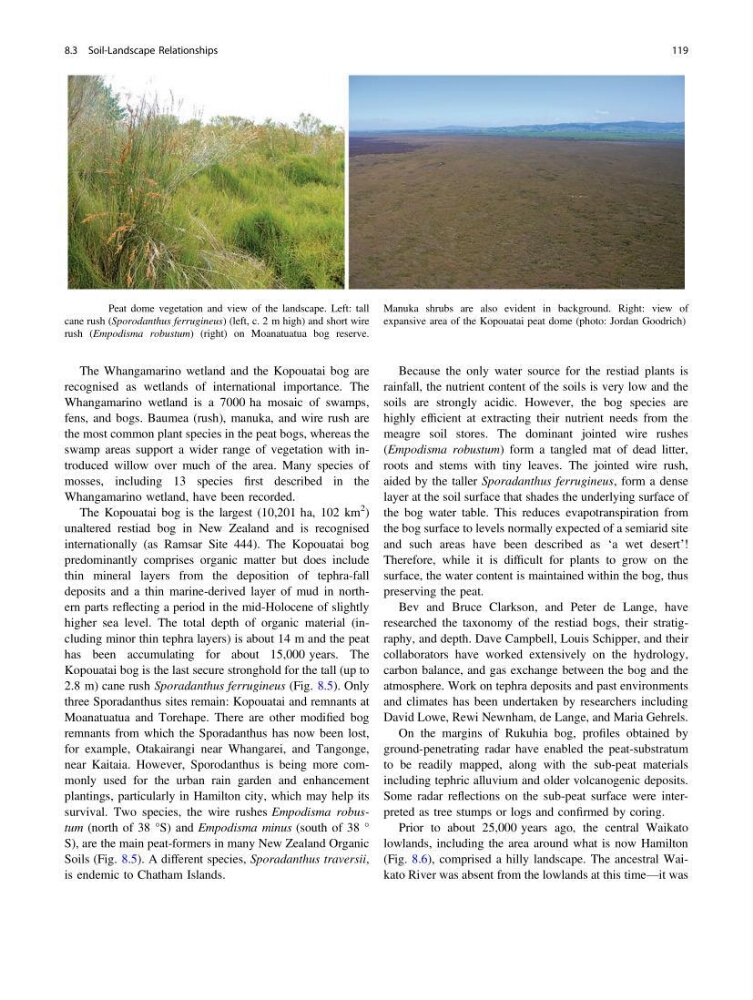
2.8 m) cane rush Sporadanthus ferrugineus (Fig. 8.5). Only
three Sporadanthus sites remain: Kopouatai and remnants at
Moanatuatua and Torehape. There are other modified bog
remnants from which the Sporadanthus has now been lost,
for example, Otakairangi near Whangarei, and Tangonge,
near Kaitaia. However, Sporodanthus is being more commonly used for the urban rain garden and enhancement
plantings, particularly in Hamilton city, which may help its
survival. Two species, the wire rushes Empodisma robustum (north of 38 °S) and Empodisma minus (south of 38 °
S), are the main peat-formers in many New Zealand Organic
Soils (Fig. 8.5). A different species, Sporadanthus traversii,
is endemic to Chatham Islands.
Because the only water source for the restiad plants is
rainfall, the nutrient content of the soils is very low and the
soils are strongly acidic. However, the bog species are
highly efficient at extracting their nutrient needs from the
meagre soil stores. The dominant jointed wire rushes
(Empodisma robustum) form a tangled mat of dead litter,
roots and stems with tiny leaves. The jointed wire rush,
aided by the taller Sporadanthus ferrugineus, form a dense
layer at the soil surface that shades the underlying surface of
the bog water table. This reduces evapotranspiration from
the bog surface to levels normally expected of a semiarid site
and such areas have been described as ‘a wet desert’!
Therefore, while it is difficult for plants to grow on the
surface, the water content is maintained within the bog, thus
preserving the peat.
Bev and Bruce Clarkson, and Peter de Lange, have
researched the taxonomy of the restiad bogs, their stratigraphy, and depth. Dave Campbell, Louis Schipper, and their
collaborators have worked extensively on the hydrology,
carbon balance, and gas exchange between the bog and the
atmosphere. Work on tephra deposits and past environments
and climates has been undertaken by researchers including
David Lowe, Rewi Newnham, de Lange, and Maria Gehrels.
On the margins of Rukuhia bog, profiles obtained by
ground-penetrating radar have enabled the peat-substratum
to be readily mapped, along with the sub-peat materials
including tephric alluvium and older volcanogenic deposits.
Some radar reflections on the sub-peat surface were interpreted as tree stumps or logs and confirmed by coring.
Prior to about 25,000 years ago, the central Waikato
lowlands, including the area around what is now Hamilton
(Fig. 8.6), comprised a hilly landscape. The ancestral Waikato River was absent from the lowlands at this time—it was
Fig. 8.5 Peat dome vegetation and view of the landscape. Left: tall
cane rush (Sporodanthus ferrugineus) (left, c. 2 m high) and short wire
rush (Empodisma robustum) (right) on Moanatuatua bog reserve.
Manuka shrubs are also evident in background. Right: view of
expansive area of the Kopouatai peat dome (photo: Jordan Goodrich)
8.3 Soil-Landscape Relationships
119
recognised as wetlands of international importance. The
Whangamarino wetland is a 7000 ha mosaic of swamps,
fens, and bogs. Baumea (rush), manuka, and wire rush are
the most common plant species in the peat bogs, whereas the
swamp areas support a wider range of vegetation with introduced willow over much of the area. Many species of
mosses, including 13 species first described in the
Whangamarino wetland, have been recorded.
The Kopouatai bog is the largest (10,201 ha, 102 km
2 )
unaltered restiad bog in New Zealand and is recognised
internationally (as Ramsar Site 444). The Kopouatai bog
predominantly comprises organic matter but does include
thin mineral layers from the deposition of tephra-fall
deposits and a thin marine-derived layer of mud in northern parts reflecting a period in the mid-Holocene of slightly
higher sea level. The total depth of organic material (including minor thin tephra layers) is about 14 m and the peat
has been accumulating for about 15,000 years. The
Kopouatai bog is the last secure stronghold for the tall (up to
2.8 m) cane rush Sporadanthus ferrugineus (Fig. 8.5). Only
three Sporadanthus sites remain: Kopouatai and remnants at
Moanatuatua and Torehape. There are other modified bog
remnants from which the Sporadanthus has now been lost,
for example, Otakairangi near Whangarei, and Tangonge,
near Kaitaia. However, Sporodanthus is being more commonly used for the urban rain garden and enhancement
plantings, particularly in Hamilton city, which may help its
survival. Two species, the wire rushes Empodisma robustum (north of 38 °S) and Empodisma minus (south of 38 °
S), are the main peat-formers in many New Zealand Organic
Soils (Fig. 8.5). A different species, Sporadanthus traversii,
is endemic to Chatham Islands.
Because the only water source for the restiad plants is
rainfall, the nutrient content of the soils is very low and the
soils are strongly acidic. However, the bog species are
highly efficient at extracting their nutrient needs from the
meagre soil stores. The dominant jointed wire rushes
(Empodisma robustum) form a tangled mat of dead litter,
roots and stems with tiny leaves. The jointed wire rush,
aided by the taller Sporadanthus ferrugineus, form a dense
layer at the soil surface that shades the underlying surface of
the bog water table. This reduces evapotranspiration from
the bog surface to levels normally expected of a semiarid site
and such areas have been described as ‘a wet desert’!
Therefore, while it is difficult for plants to grow on the
surface, the water content is maintained within the bog, thus
preserving the peat.
Bev and Bruce Clarkson, and Peter de Lange, have
researched the taxonomy of the restiad bogs, their stratigraphy, and depth. Dave Campbell, Louis Schipper, and their
collaborators have worked extensively on the hydrology,
carbon balance, and gas exchange between the bog and the
atmosphere. Work on tephra deposits and past environments
and climates has been undertaken by researchers including
David Lowe, Rewi Newnham, de Lange, and Maria Gehrels.
On the margins of Rukuhia bog, profiles obtained by
ground-penetrating radar have enabled the peat-substratum
to be readily mapped, along with the sub-peat materials
including tephric alluvium and older volcanogenic deposits.
Some radar reflections on the sub-peat surface were interpreted as tree stumps or logs and confirmed by coring.
Prior to about 25,000 years ago, the central Waikato
lowlands, including the area around what is now Hamilton
(Fig. 8.6), comprised a hilly landscape. The ancestral Waikato River was absent from the lowlands at this time—it was
Fig. 8.5 Peat dome vegetation and view of the landscape. Left: tall
cane rush (Sporodanthus ferrugineus) (left, c. 2 m high) and short wire
rush (Empodisma robustum) (right) on Moanatuatua bog reserve.
Manuka shrubs are also evident in background. Right: view of
expansive area of the Kopouatai peat dome (photo: Jordan Goodrich)
8.3 Soil-Landscape Relationships
119