

(including Sphagnum) under high rainfall and frequent
rain-days (>*160 per year). Fens tend to form in valleys or
at the footslopes of hills where runoff and a high water table
keep them moist while swamps form in topographic hollows
where water ponds. Swamps commonly occur in ‘back
swamps’ on river flood plains where drainage to the river is
cut off by a levee along the river bank.
Litter Organic Soils have been little studied and are relatively uncommon. A depth of partly or well-decomposed
litter ! 40 cm (i.e. F or H horizons) is needed to qualify a
soil as a Litter Organic Soil. They occur adjacent to mature
kauri trees (Agathis Australis) which accumulate exceptionally thick litter layers near the tree. The litter helps kauri
to repel competitors, and to conserve nutrients and water and
thus recycle them through the root system back to the tree.
Disturbance of the litter may compromise a kauri tree’s
longevity. Litter Organic Soils may also develop under other
native forest species, and under Pinus radiata plantations
where conditions allow the litter to accumulate (although the
40-cm thickness threshold may not always be met). However, the litter layer under pines will rapidly biodegrade
following tree harvest, and therefore such soils, if they had
been considered Organic Soil, would soon revert to the
underlying mineral soil order following tree removal.
8.3.2 Organic Soils in the Waikato Lowlands
About half of New Zealand’s Organic Soils are in the
Waikato region (which includes the lowlands of the Hauraki
Plains and the Waikato Basin). The Waikato lowlands lie in
geological grabens that have gradually infilled with river
deposits (alluvium) and pyroclastic material (fragmental
volcanic deposits including ignimbrite and tephra-fall
deposits). Widespread low-lying and poorly drained areas on
alluvial surfaces, such as the lower lying parts of the Hinuera
Formation, would have supported a patchwork of gleyed
soils, swamps, and possibly small shallow lakes. Over time,
and with changing climatic conditions that led to rising water
tables, many of the wetlands expanded. Peat accumulation
rates increased, particularly in the early Holocene, and the
wetlands coalesced to form a massive peat bog with a range
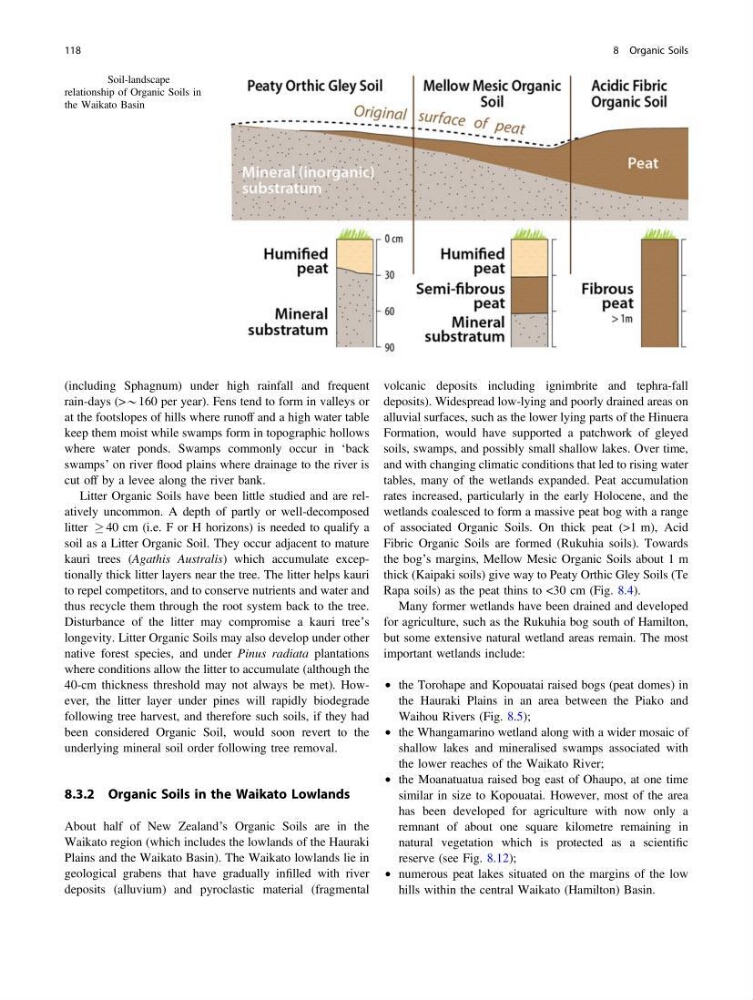
of associated Organic Soils. On thick peat (>1 m), Acid
Fibric Organic Soils are formed (Rukuhia soils). Towards
the bog’s margins, Mellow Mesic Organic Soils about 1 m
thick (Kaipaki soils) give way to Peaty Orthic Gley Soils (Te
Rapa soils) as the peat thins to <30 cm (Fig. 8.4).
Many former wetlands have been drained and developed
for agriculture, such as the Rukuhia bog south of Hamilton,
but some extensive natural wetland areas remain. The most
important wetlands include:
• the Torohape and Kopouatai raised bogs (peat domes) in
the Hauraki Plains in an area between the Piako and
Waihou Rivers (Fig. 8.5);
• the Whangamarino wetland along with a wider mosaic of
shallow lakes and mineralised swamps associated with
the lower reaches of the Waikato River;
• the Moanatuatua raised bog east of Ohaupo, at one time
similar in size to Kopouatai. However, most of the area
has been developed for agriculture with now only a
remnant of about one square kilometre remaining in
natural vegetation which is protected as a scientific
reserve (see Fig. 8.12);
• numerous peat lakes situated on the margins of the low
hills within the central Waikato (Hamilton) Basin.
Fig. 8.4 Soil-landscape
relationship of Organic Soils in
the Waikato Basin
118
8 Organic Soils
rain-days (>*160 per year). Fens tend to form in valleys or
at the footslopes of hills where runoff and a high water table
keep them moist while swamps form in topographic hollows
where water ponds. Swamps commonly occur in ‘back
swamps’ on river flood plains where drainage to the river is
cut off by a levee along the river bank.
Litter Organic Soils have been little studied and are relatively uncommon. A depth of partly or well-decomposed
litter ! 40 cm (i.e. F or H horizons) is needed to qualify a
soil as a Litter Organic Soil. They occur adjacent to mature
kauri trees (Agathis Australis) which accumulate exceptionally thick litter layers near the tree. The litter helps kauri
to repel competitors, and to conserve nutrients and water and
thus recycle them through the root system back to the tree.
Disturbance of the litter may compromise a kauri tree’s
longevity. Litter Organic Soils may also develop under other
native forest species, and under Pinus radiata plantations
where conditions allow the litter to accumulate (although the
40-cm thickness threshold may not always be met). However, the litter layer under pines will rapidly biodegrade
following tree harvest, and therefore such soils, if they had
been considered Organic Soil, would soon revert to the
underlying mineral soil order following tree removal.
8.3.2 Organic Soils in the Waikato Lowlands
About half of New Zealand’s Organic Soils are in the
Waikato region (which includes the lowlands of the Hauraki
Plains and the Waikato Basin). The Waikato lowlands lie in
geological grabens that have gradually infilled with river
deposits (alluvium) and pyroclastic material (fragmental
volcanic deposits including ignimbrite and tephra-fall
deposits). Widespread low-lying and poorly drained areas on
alluvial surfaces, such as the lower lying parts of the Hinuera
Formation, would have supported a patchwork of gleyed
soils, swamps, and possibly small shallow lakes. Over time,
and with changing climatic conditions that led to rising water
tables, many of the wetlands expanded. Peat accumulation
rates increased, particularly in the early Holocene, and the
wetlands coalesced to form a massive peat bog with a range
of associated Organic Soils. On thick peat (>1 m), Acid
Fibric Organic Soils are formed (Rukuhia soils). Towards
the bog’s margins, Mellow Mesic Organic Soils about 1 m
thick (Kaipaki soils) give way to Peaty Orthic Gley Soils (Te
Rapa soils) as the peat thins to <30 cm (Fig. 8.4).
Many former wetlands have been drained and developed
for agriculture, such as the Rukuhia bog south of Hamilton,
but some extensive natural wetland areas remain. The most
important wetlands include:
• the Torohape and Kopouatai raised bogs (peat domes) in
the Hauraki Plains in an area between the Piako and
Waihou Rivers (Fig. 8.5);
• the Whangamarino wetland along with a wider mosaic of
shallow lakes and mineralised swamps associated with
the lower reaches of the Waikato River;
• the Moanatuatua raised bog east of Ohaupo, at one time
similar in size to Kopouatai. However, most of the area
has been developed for agriculture with now only a
remnant of about one square kilometre remaining in
natural vegetation which is protected as a scientific
reserve (see Fig. 8.12);
• numerous peat lakes situated on the margins of the low
hills within the central Waikato (Hamilton) Basin.
Fig. 8.4 Soil-landscape
relationship of Organic Soils in
the Waikato Basin
118
8 Organic Soils