

However, in cropping land, soil cracks that open in dry
weather may also provide a habitat for crop pests.
Soil influences on grapes and truffles
Melanic Soils have been particularly sought after for
the establishment of truffles as it was thought that the
‘rendzina’ or limestone-rich soil was a key to successful truffle establishment, requiring high pH ( 7)
as well as warm dry summers and no competing fungi.
Truffles are the fruiting bodies of a type of fungus
which grows on or around the roots of hazelnut and
oak trees. Hence truffle growing enterprises or truffière
are established on the Melanic Soils in North Canterbury. However, as the management of the soil mycorrhiza that lead to truffle formation has become better
understood, truffles are now grown on a wider range of
soils. The first successful truffière were established in
New Zealand by mycologist, Dr Ian Hall. The first
Périgord black truffles were harvested in July 1993 in
the Gisborne area.
Both truffles and grapes are notable because their
success in the market sits astride the application of
science and the subjectivity of the human pallet.
Finding truffles at harvest time is also dependant on
the olfactory capabilities of pigs or dogs. Our appreciation of the subtle environmental influences of soil
and climate on both wine and truffles is growing. The
Waipara district of North Canterbury enjoys a wide
variety of soils (including Melanic Soils) that provide
many potential outcomes of soil and terroir.
Soil and environmental characteristics are highly
interdependent so there are few simple relationships
we can use to form clear linkages between soils and
wine or food qualities. However, it is understood that
wine qualities respond to soil moisture and
temperature. Heat storage in soil is related to wetness,
stoniness, porosity, and drainage. The drier a soil is the
faster it will warm up, whereas a wet, poorly drained,
soil will be slower to warm up. Soil water storage is
related to porosity, horizon thicknesses, and stoniness.
For example, a high stone content reduces the volume
of soil available to hold water.
7.5 Distinguishing Between Melanic Soils
and Related Soil Orders
Melanic Soils stand out from all other New Zealand soil
orders because of their dark topsoil colour and strongly
developed soil structure. The other diagnostic features relate
to the influence of either calcareous or mafic/ultramafic
rocks in the parent material. Calcareous influence is indicated by a visible (fizzing) reaction to 10% HCl which reacts
with carbonates to give off CO 2 . The presence of the mafic
rock influence is indicated by a pH of 5.9 or more in the
lower B horizon, strong soil structure, and stickiness.
Although Oxidic and Granular Soils are both strongly
weathered with well-developed soil aggregates, they lack the
smectite clays, dark and deep topsoils, and relatively high
pH of Melanic Soils.
7.6 Correlation with Other Classification
Systems
The Melanic Soils are generally similar to soils known
globally as ‘Rendzinas’—a Russian-adopted Polish term for
soils formed in carbonate-rich parent materials. Melanic
Soils mainly correlate with Vertisols and Mollisols in Soil
Taxonomy (Table 7.3). Globally, there is renewed interest in
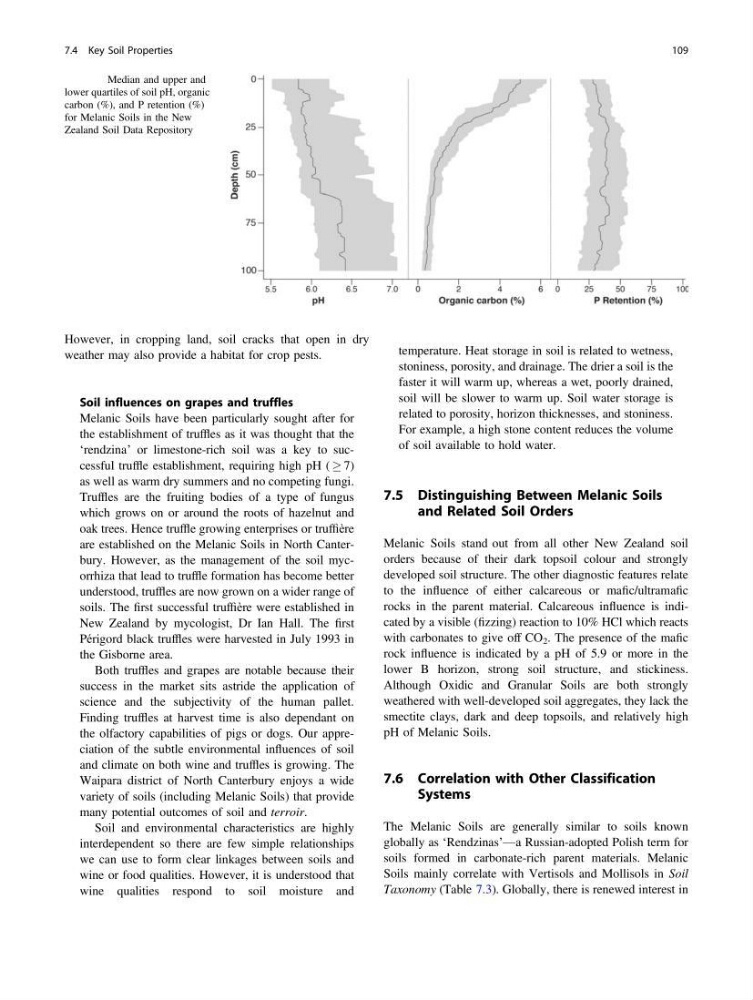
Fig. 7.7 Median and upper and
lower quartiles of soil pH, organic
carbon (%), and P retention (%)
for Melanic Soils in the New
Zealand Soil Data Repository
7.4 Key Soil Properties
109
weather may also provide a habitat for crop pests.
Soil influences on grapes and truffles
Melanic Soils have been particularly sought after for
the establishment of truffles as it was thought that the
‘rendzina’ or limestone-rich soil was a key to successful truffle establishment, requiring high pH ( 7)
as well as warm dry summers and no competing fungi.
Truffles are the fruiting bodies of a type of fungus
which grows on or around the roots of hazelnut and
oak trees. Hence truffle growing enterprises or truffière
are established on the Melanic Soils in North Canterbury. However, as the management of the soil mycorrhiza that lead to truffle formation has become better
understood, truffles are now grown on a wider range of
soils. The first successful truffière were established in
New Zealand by mycologist, Dr Ian Hall. The first
Périgord black truffles were harvested in July 1993 in
the Gisborne area.
Both truffles and grapes are notable because their
success in the market sits astride the application of
science and the subjectivity of the human pallet.
Finding truffles at harvest time is also dependant on
the olfactory capabilities of pigs or dogs. Our appreciation of the subtle environmental influences of soil
and climate on both wine and truffles is growing. The
Waipara district of North Canterbury enjoys a wide
variety of soils (including Melanic Soils) that provide
many potential outcomes of soil and terroir.
Soil and environmental characteristics are highly
interdependent so there are few simple relationships
we can use to form clear linkages between soils and
wine or food qualities. However, it is understood that
wine qualities respond to soil moisture and
temperature. Heat storage in soil is related to wetness,
stoniness, porosity, and drainage. The drier a soil is the
faster it will warm up, whereas a wet, poorly drained,
soil will be slower to warm up. Soil water storage is
related to porosity, horizon thicknesses, and stoniness.
For example, a high stone content reduces the volume
of soil available to hold water.
7.5 Distinguishing Between Melanic Soils
and Related Soil Orders
Melanic Soils stand out from all other New Zealand soil
orders because of their dark topsoil colour and strongly
developed soil structure. The other diagnostic features relate
to the influence of either calcareous or mafic/ultramafic
rocks in the parent material. Calcareous influence is indicated by a visible (fizzing) reaction to 10% HCl which reacts
with carbonates to give off CO 2 . The presence of the mafic
rock influence is indicated by a pH of 5.9 or more in the
lower B horizon, strong soil structure, and stickiness.
Although Oxidic and Granular Soils are both strongly
weathered with well-developed soil aggregates, they lack the
smectite clays, dark and deep topsoils, and relatively high
pH of Melanic Soils.
7.6 Correlation with Other Classification
Systems
The Melanic Soils are generally similar to soils known
globally as ‘Rendzinas’—a Russian-adopted Polish term for
soils formed in carbonate-rich parent materials. Melanic
Soils mainly correlate with Vertisols and Mollisols in Soil
Taxonomy (Table 7.3). Globally, there is renewed interest in
Fig. 7.7 Median and upper and
lower quartiles of soil pH, organic
carbon (%), and P retention (%)
for Melanic Soils in the New
Zealand Soil Data Repository
7.4 Key Soil Properties
109