

An important feature of Melanic Soils is their
well-formed soil structure resulting from the presence of
swelling clays. During winter or spring, the clays become
wet and swell. In summer, the soils dry and shrink, and the
soil mass cracks with fissures extending from the surface
downward. The cracks extend throughout the soil profile,
opening up the planar pores between soil aggregates. If
heavy rainfall occurs during summer, when the soils are dry
and cracked, much water may be lost to the soil as by-pass
flow down the cracks.
As the soils rewet in winter, the soil mass swells and the
cracks close. Pressure comes on the peds as the soil heaves
upward and sideways. The compression forms the characteristic strong polyhedral, blocky, and prismatic structure. The
structure has good stability, which is aided by high soil organic
matter, and the stabilising effect of calcium or magnesium
bivalent cations in the exchange complex. Structural stability
usually also means stability of the soil pores, which is important for aeration, drainage, water storage, and root penetration.
An indicator of shrink/swell is the presence of slickensides. As noted earlier, these are polished surfaces or striations on ped faces caused by lateral ped-on-ped smearing
action (Fig. 7.4). The orientation of slickensides shows the
relative direction of the internal soil movement in response
to the swelling pressure. Significant shrink/swell potential is
measured by a coefficient of linear expandability, strong soil
structure, and slickensides.
Soil dry bulk density is about 0.75–1.0 t m
−3 in topsoils
and lower in subsoils. The values are lower than expected for
the amount of clay because of the porosity associated with
the well-formed soil structure.
Although most Melanic Soils are well drained, Perch-gley
Melanic Soils are found where gleying (shown by reddish
brown mottles and pale, low chroma, matrix colours) occurs
above a slowly permeable horizon, usually in the deeper
subsoil.
7.4.3 Chemical Properties
Melanic Soils are derived from rocks with significant components of either calcareous or mafic minerals that, by
weathering, supply high levels of calcium or magnesium
cations (or both) to the developing soil. The calcium and
magnesium cations are bivalent cations meaning they have
two positive charges per atom.
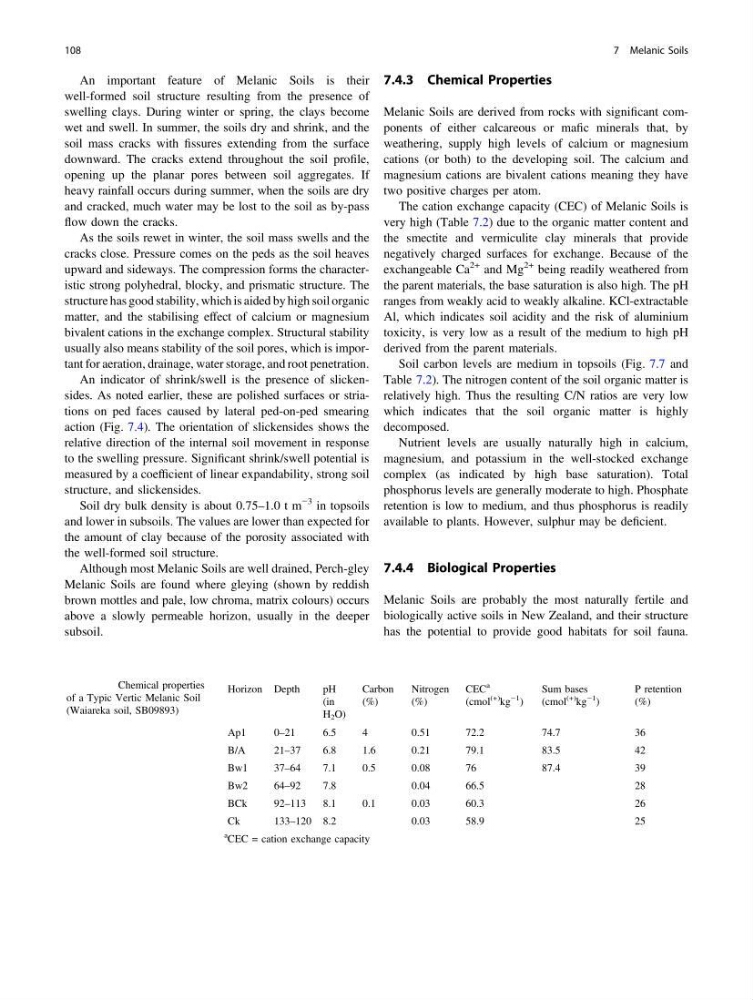
The cation exchange capacity (CEC) of Melanic Soils is
very high (Table 7.2) due to the organic matter content and
the smectite and vermiculite clay minerals that provide
negatively charged surfaces for exchange. Because of the
exchangeable Ca
2+ and Mg
2+ being readily weathered from
the parent materials, the base saturation is also high. The pH
ranges from weakly acid to weakly alkaline. KCl-extractable
Al, which indicates soil acidity and the risk of aluminium
toxicity, is very low as a result of the medium to high pH
derived from the parent materials.
Soil carbon levels are medium in topsoils (Fig. 7.7 and
Table 7.2). The nitrogen content of the soil organic matter is
relatively high. Thus the resulting C/N ratios are very low
which indicates that the soil organic matter is highly
decomposed.
Nutrient levels are usually naturally high in calcium,
magnesium, and potassium in the well-stocked exchange
complex (as indicated by high base saturation). Total
phosphorus levels are generally moderate to high. Phosphate
retention is low to medium, and thus phosphorus is readily
available to plants. However, sulphur may be deficient.
7.4.4 Biological Properties
Melanic Soils are probably the most naturally fertile and
biologically active soils in New Zealand, and their structure
has the potential to provide good habitats for soil fauna.
Table 7.2 Chemical properties
of a Typic Vertic Melanic Soil
(Waiareka soil, SB09893)
Horizon Depth
pH
(in
H 2 O)
Carbon
(%)
Nitrogen
(%)
CEC
a
(cmol
(+)
kg
−1 )
Sum bases
(cmol
(+)
kg
−1
)
P retention
(%)
Ap1
0–21
6.5
4
0.51
72.2
74.7
36
B/A
21–37
6.8
1.6
0.21
79.1
83.5
42
Bw1
37–64
7.1
0.5
0.08
76
87.4
39
Bw2
64–92
7.8
0.04
66.5
28
BCk
92–113
8.1
0.1
0.03
60.3
26
Ck
133–120 8.2
0.03
58.9
25
a CEC = cation exchange capacity
108
7 Melanic Soils
well-formed soil structure resulting from the presence of
swelling clays. During winter or spring, the clays become
wet and swell. In summer, the soils dry and shrink, and the
soil mass cracks with fissures extending from the surface
downward. The cracks extend throughout the soil profile,
opening up the planar pores between soil aggregates. If
heavy rainfall occurs during summer, when the soils are dry
and cracked, much water may be lost to the soil as by-pass
flow down the cracks.
As the soils rewet in winter, the soil mass swells and the
cracks close. Pressure comes on the peds as the soil heaves
upward and sideways. The compression forms the characteristic strong polyhedral, blocky, and prismatic structure. The
structure has good stability, which is aided by high soil organic
matter, and the stabilising effect of calcium or magnesium
bivalent cations in the exchange complex. Structural stability
usually also means stability of the soil pores, which is important for aeration, drainage, water storage, and root penetration.
An indicator of shrink/swell is the presence of slickensides. As noted earlier, these are polished surfaces or striations on ped faces caused by lateral ped-on-ped smearing
action (Fig. 7.4). The orientation of slickensides shows the
relative direction of the internal soil movement in response
to the swelling pressure. Significant shrink/swell potential is
measured by a coefficient of linear expandability, strong soil
structure, and slickensides.
Soil dry bulk density is about 0.75–1.0 t m
−3 in topsoils
and lower in subsoils. The values are lower than expected for
the amount of clay because of the porosity associated with
the well-formed soil structure.
Although most Melanic Soils are well drained, Perch-gley
Melanic Soils are found where gleying (shown by reddish
brown mottles and pale, low chroma, matrix colours) occurs
above a slowly permeable horizon, usually in the deeper
subsoil.
7.4.3 Chemical Properties
Melanic Soils are derived from rocks with significant components of either calcareous or mafic minerals that, by
weathering, supply high levels of calcium or magnesium
cations (or both) to the developing soil. The calcium and
magnesium cations are bivalent cations meaning they have
two positive charges per atom.
The cation exchange capacity (CEC) of Melanic Soils is
very high (Table 7.2) due to the organic matter content and
the smectite and vermiculite clay minerals that provide
negatively charged surfaces for exchange. Because of the
exchangeable Ca
2+ and Mg
2+ being readily weathered from
the parent materials, the base saturation is also high. The pH
ranges from weakly acid to weakly alkaline. KCl-extractable
Al, which indicates soil acidity and the risk of aluminium
toxicity, is very low as a result of the medium to high pH
derived from the parent materials.
Soil carbon levels are medium in topsoils (Fig. 7.7 and
Table 7.2). The nitrogen content of the soil organic matter is
relatively high. Thus the resulting C/N ratios are very low
which indicates that the soil organic matter is highly
decomposed.
Nutrient levels are usually naturally high in calcium,
magnesium, and potassium in the well-stocked exchange
complex (as indicated by high base saturation). Total
phosphorus levels are generally moderate to high. Phosphate
retention is low to medium, and thus phosphorus is readily
available to plants. However, sulphur may be deficient.
7.4.4 Biological Properties
Melanic Soils are probably the most naturally fertile and
biologically active soils in New Zealand, and their structure
has the potential to provide good habitats for soil fauna.
Table 7.2 Chemical properties
of a Typic Vertic Melanic Soil
(Waiareka soil, SB09893)
Horizon Depth
pH
(in
H 2 O)
Carbon
(%)
Nitrogen
(%)
CEC
a
(cmol
(+)
kg
−1 )
Sum bases
(cmol
(+)
kg
−1
)
P retention
(%)
Ap1
0–21
6.5
4
0.51
72.2
74.7
36
B/A
21–37
6.8
1.6
0.21
79.1
83.5
42
Bw1
37–64
7.1
0.5
0.08
76
87.4
39
Bw2
64–92
7.8
0.04
66.5
28
BCk
92–113
8.1
0.1
0.03
60.3
26
Ck
133–120 8.2
0.03
58.9
25
a CEC = cation exchange capacity
108
7 Melanic Soils