

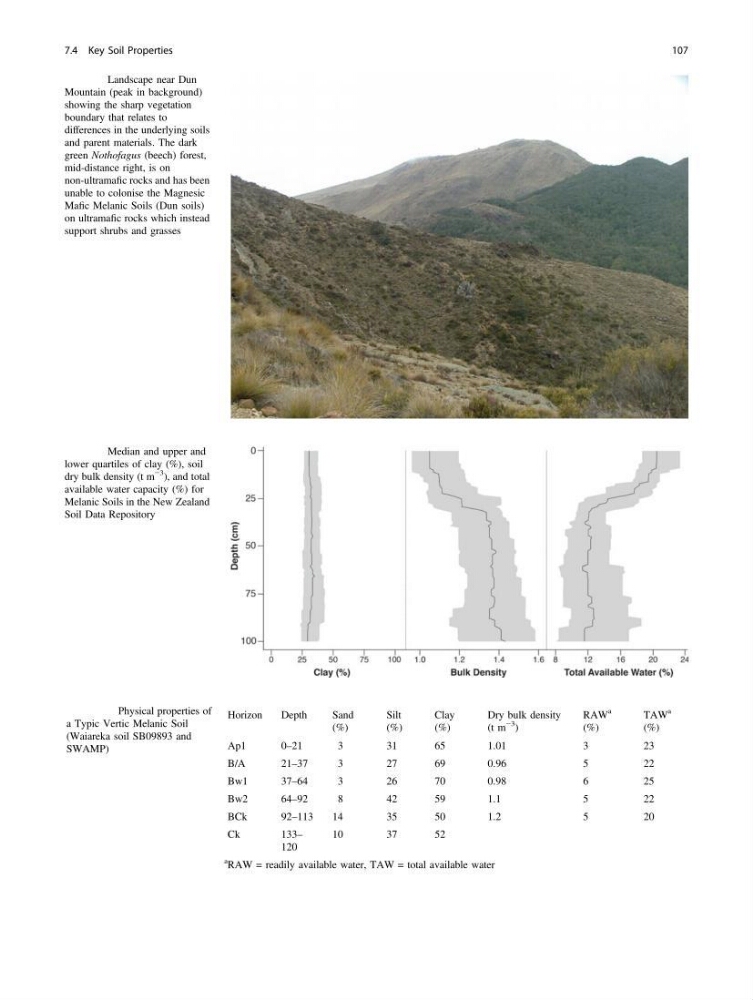
Fig. 7.5 Landscape near Dun
Mountain (peak in background)
showing the sharp vegetation
boundary that relates to
differences in the underlying soils
and parent materials. The dark
green Nothofagus (beech) forest,
mid-distance right, is on
non-ultramafic rocks and has been
unable to colonise the Magnesic
Mafic Melanic Soils (Dun soils)
on ultramafic rocks which instead
support shrubs and grasses
Fig. 7.6 Median and upper and
lower quartiles of clay (%), soil
dry bulk density (t m
−3
), and total
available water capacity (%) for
Melanic Soils in the New Zealand
Soil Data Repository
Table 7.1 Physical properties of
a Typic Vertic Melanic Soil
(Waiareka soil SB09893 and
SWAMP)
Horizon
Depth
Sand
(%)
Silt
(%)
Clay
(%)
Dry bulk density
(t m
−3
)
RAW
a
(%)
TAW
a
(%)
Ap1
0–21
3
31
65
1.01
3
23
B/A
21–37
3
27
69
0.96
5
22
Bw1
37–64
3
26
70
0.98
6
25
Bw2
64–92
8
42
59
1.1
5
22
BCk
92–113
14
35
50
1.2
5
20
Ck
133–
120
10
37
52
a RAW = readily available water, TAW = total available water
7.4 Key Soil Properties
107
Mountain (peak in background)
showing the sharp vegetation
boundary that relates to
differences in the underlying soils
and parent materials. The dark
green Nothofagus (beech) forest,
mid-distance right, is on
non-ultramafic rocks and has been
unable to colonise the Magnesic
Mafic Melanic Soils (Dun soils)
on ultramafic rocks which instead
support shrubs and grasses
Fig. 7.6 Median and upper and
lower quartiles of clay (%), soil
dry bulk density (t m
−3
), and total
available water capacity (%) for
Melanic Soils in the New Zealand
Soil Data Repository
Table 7.1 Physical properties of
a Typic Vertic Melanic Soil
(Waiareka soil SB09893 and
SWAMP)
Horizon
Depth
Sand
(%)
Silt
(%)
Clay
(%)
Dry bulk density
(t m
−3
)
RAW
a
(%)
TAW
a
(%)
Ap1
0–21
3
31
65
1.01
3
23
B/A
21–37
3
27
69
0.96
5
22
Bw1
37–64
3
26
70
0.98
6
25
Bw2
64–92
8
42
59
1.1
5
22
BCk
92–113
14
35
50
1.2
5
20
Ck
133–
120
10
37
52
a RAW = readily available water, TAW = total available water
7.4 Key Soil Properties
107