

so-called ‘Black soils’ (which include some New Zealand
Melanic Soils) as a consequence of their high carbon contents and high soil fertility. Black soils are important as they
are globally extensive and productive soil orders. In contrast,
in New Zealand the Melanic Soils, which incorporate
important features of both Vertisols and Mollisols, are relatively uncommon. The Vertisols are extensive and diverse
in Australia where they are informally known as black
cracking clay soils, and formally designated as Vertosols
which Ray Isbell defined as ‘clay soils with shrink-swell
properties that exhibit strong cracking when dry and at depth
have slickensides and/or lenticular structural aggregates’.
Vertisols are dominated by smectite group clays (particularly
the mineral montmorillonite). The Mollisols are extensive in
natural grasslands regions such as the Great Plains of the
USA and the Russian Steppe, where they are known as
Chernozems (a term also used in the World Reference Base
classification), and characteristically have thick, black, A
horizons and are well structured, highly fertile soils.
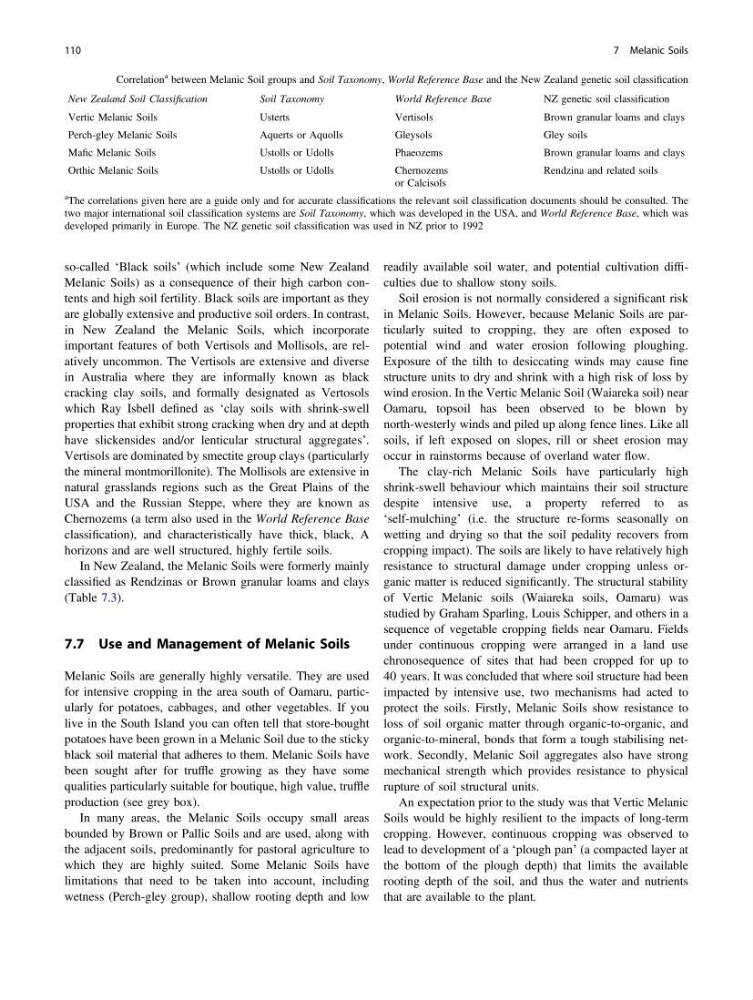
In New Zealand, the Melanic Soils were formerly mainly
classified as Rendzinas or Brown granular loams and clays
(Table 7.3).
7.7 Use and Management of Melanic Soils
Melanic Soils are generally highly versatile. They are used
for intensive cropping in the area south of Oamaru, particularly for potatoes, cabbages, and other vegetables. If you
live in the South Island you can often tell that store-bought
potatoes have been grown in a Melanic Soil due to the sticky
black soil material that adheres to them. Melanic Soils have
been sought after for truffle growing as they have some
qualities particularly suitable for boutique, high value, truffle
production (see grey box).
In many areas, the Melanic Soils occupy small areas
bounded by Brown or Pallic Soils and are used, along with
the adjacent soils, predominantly for pastoral agriculture to
which they are highly suited. Some Melanic Soils have
limitations that need to be taken into account, including
wetness (Perch-gley group), shallow rooting depth and low
readily available soil water, and potential cultivation difficulties due to shallow stony soils.
Soil erosion is not normally considered a significant risk
in Melanic Soils. However, because Melanic Soils are particularly suited to cropping, they are often exposed to
potential wind and water erosion following ploughing.
Exposure of the tilth to desiccating winds may cause fine
structure units to dry and shrink with a high risk of loss by
wind erosion. In the Vertic Melanic Soil (Waiareka soil) near
Oamaru, topsoil has been observed to be blown by
north-westerly winds and piled up along fence lines. Like all
soils, if left exposed on slopes, rill or sheet erosion may
occur in rainstorms because of overland water flow.
The clay-rich Melanic Soils have particularly high
shrink-swell behaviour which maintains their soil structure
despite intensive use, a property referred to as
‘self-mulching’ (i.e. the structure re-forms seasonally on
wetting and drying so that the soil pedality recovers from
cropping impact). The soils are likely to have relatively high
resistance to structural damage under cropping unless organic matter is reduced significantly. The structural stability
of Vertic Melanic soils (Waiareka soils, Oamaru) was
studied by Graham Sparling, Louis Schipper, and others in a
sequence of vegetable cropping fields near Oamaru. Fields
under continuous cropping were arranged in a land use
chronosequence of sites that had been cropped for up to
40 years. It was concluded that where soil structure had been
impacted by intensive use, two mechanisms had acted to
protect the soils. Firstly, Melanic Soils show resistance to
loss of soil organic matter through organic-to-organic, and
organic-to-mineral, bonds that form a tough stabilising network. Secondly, Melanic Soil aggregates also have strong
mechanical strength which provides resistance to physical
rupture of soil structural units.
An expectation prior to the study was that Vertic Melanic
Soils would be highly resilient to the impacts of long-term
cropping. However, continuous cropping was observed to
lead to development of a ‘plough pan’ (a compacted layer at
the bottom of the plough depth) that limits the available
rooting depth of the soil, and thus the water and nutrients
that are available to the plant.
Table 7.3 Correlation
a between Melanic Soil groups and Soil Taxonomy, World Reference Base and the New Zealand genetic soil classification
New Zealand Soil Classification
Soil Taxonomy
World Reference Base
NZ genetic soil classification
Vertic Melanic Soils
Usterts
Vertisols
Brown granular loams and clays
Perch-gley Melanic Soils
Aquerts or Aquolls
Gleysols
Gley soils
Mafic Melanic Soils
Ustolls or Udolls
Phaeozems
Brown granular loams and clays
Orthic Melanic Soils
Ustolls or Udolls
Chernozems
or Calcisols
Rendzina and related soils
a The correlations given here are a guide only and for accurate classifications the relevant soil classification documents should be consulted. The
two major international soil classification systems are Soil Taxonomy, which was developed in the USA, and World Reference Base, which was
developed primarily in Europe. The NZ genetic soil classification was used in NZ prior to 1992
110
7 Melanic Soils
Melanic Soils) as a consequence of their high carbon contents and high soil fertility. Black soils are important as they
are globally extensive and productive soil orders. In contrast,
in New Zealand the Melanic Soils, which incorporate
important features of both Vertisols and Mollisols, are relatively uncommon. The Vertisols are extensive and diverse
in Australia where they are informally known as black
cracking clay soils, and formally designated as Vertosols
which Ray Isbell defined as ‘clay soils with shrink-swell
properties that exhibit strong cracking when dry and at depth
have slickensides and/or lenticular structural aggregates’.
Vertisols are dominated by smectite group clays (particularly
the mineral montmorillonite). The Mollisols are extensive in
natural grasslands regions such as the Great Plains of the
USA and the Russian Steppe, where they are known as
Chernozems (a term also used in the World Reference Base
classification), and characteristically have thick, black, A
horizons and are well structured, highly fertile soils.
In New Zealand, the Melanic Soils were formerly mainly
classified as Rendzinas or Brown granular loams and clays
(Table 7.3).
7.7 Use and Management of Melanic Soils
Melanic Soils are generally highly versatile. They are used
for intensive cropping in the area south of Oamaru, particularly for potatoes, cabbages, and other vegetables. If you
live in the South Island you can often tell that store-bought
potatoes have been grown in a Melanic Soil due to the sticky
black soil material that adheres to them. Melanic Soils have
been sought after for truffle growing as they have some
qualities particularly suitable for boutique, high value, truffle
production (see grey box).
In many areas, the Melanic Soils occupy small areas
bounded by Brown or Pallic Soils and are used, along with
the adjacent soils, predominantly for pastoral agriculture to
which they are highly suited. Some Melanic Soils have
limitations that need to be taken into account, including
wetness (Perch-gley group), shallow rooting depth and low
readily available soil water, and potential cultivation difficulties due to shallow stony soils.
Soil erosion is not normally considered a significant risk
in Melanic Soils. However, because Melanic Soils are particularly suited to cropping, they are often exposed to
potential wind and water erosion following ploughing.
Exposure of the tilth to desiccating winds may cause fine
structure units to dry and shrink with a high risk of loss by
wind erosion. In the Vertic Melanic Soil (Waiareka soil) near
Oamaru, topsoil has been observed to be blown by
north-westerly winds and piled up along fence lines. Like all
soils, if left exposed on slopes, rill or sheet erosion may
occur in rainstorms because of overland water flow.
The clay-rich Melanic Soils have particularly high
shrink-swell behaviour which maintains their soil structure
despite intensive use, a property referred to as
‘self-mulching’ (i.e. the structure re-forms seasonally on
wetting and drying so that the soil pedality recovers from
cropping impact). The soils are likely to have relatively high
resistance to structural damage under cropping unless organic matter is reduced significantly. The structural stability
of Vertic Melanic soils (Waiareka soils, Oamaru) was
studied by Graham Sparling, Louis Schipper, and others in a
sequence of vegetable cropping fields near Oamaru. Fields
under continuous cropping were arranged in a land use
chronosequence of sites that had been cropped for up to
40 years. It was concluded that where soil structure had been
impacted by intensive use, two mechanisms had acted to
protect the soils. Firstly, Melanic Soils show resistance to
loss of soil organic matter through organic-to-organic, and
organic-to-mineral, bonds that form a tough stabilising network. Secondly, Melanic Soil aggregates also have strong
mechanical strength which provides resistance to physical
rupture of soil structural units.
An expectation prior to the study was that Vertic Melanic
Soils would be highly resilient to the impacts of long-term
cropping. However, continuous cropping was observed to
lead to development of a ‘plough pan’ (a compacted layer at
the bottom of the plough depth) that limits the available
rooting depth of the soil, and thus the water and nutrients
that are available to the plant.
Table 7.3 Correlation
a between Melanic Soil groups and Soil Taxonomy, World Reference Base and the New Zealand genetic soil classification
New Zealand Soil Classification
Soil Taxonomy
World Reference Base
NZ genetic soil classification
Vertic Melanic Soils
Usterts
Vertisols
Brown granular loams and clays
Perch-gley Melanic Soils
Aquerts or Aquolls
Gleysols
Gley soils
Mafic Melanic Soils
Ustolls or Udolls
Phaeozems
Brown granular loams and clays
Orthic Melanic Soils
Ustolls or Udolls
Chernozems
or Calcisols
Rendzina and related soils
a The correlations given here are a guide only and for accurate classifications the relevant soil classification documents should be consulted. The
two major international soil classification systems are Soil Taxonomy, which was developed in the USA, and World Reference Base, which was
developed primarily in Europe. The NZ genetic soil classification was used in NZ prior to 1992
110
7 Melanic Soils