

organic matter is strongly accumulated along with some less
soluble weathering products of the rocks. Due to the alkaline
nature of the parent materials, the resulting soils tend to have
higher pHs than most other New Zealand soils.
The clays that form are dominantly smectites (notably
montmorillonite) that may shrink and swell by up to 50%
during wetting and drying. Thus the soils form strongly
aggregated structures, typically very stable, with large cracks
forming when the soils dry (Fig. 7.4). In contrast, when wet,
Melanic Soils are very sticky and they become massive as
the soil materials swell to fill any voids. In Vertic Melanic
Soils, distinctive slickensides (smoothly polished surfaces
where clayey soil masses have sheared through swelling
pressure) are formed in subsoils because of the dominant
shrink-swell clays (Fig. 7.4). The strong aggregation in
topsoils is also supported by the predominance of dissolved
calcium and magnesium ions in the soil solution. The cation
exchange sites are thus also dominated by calcium and
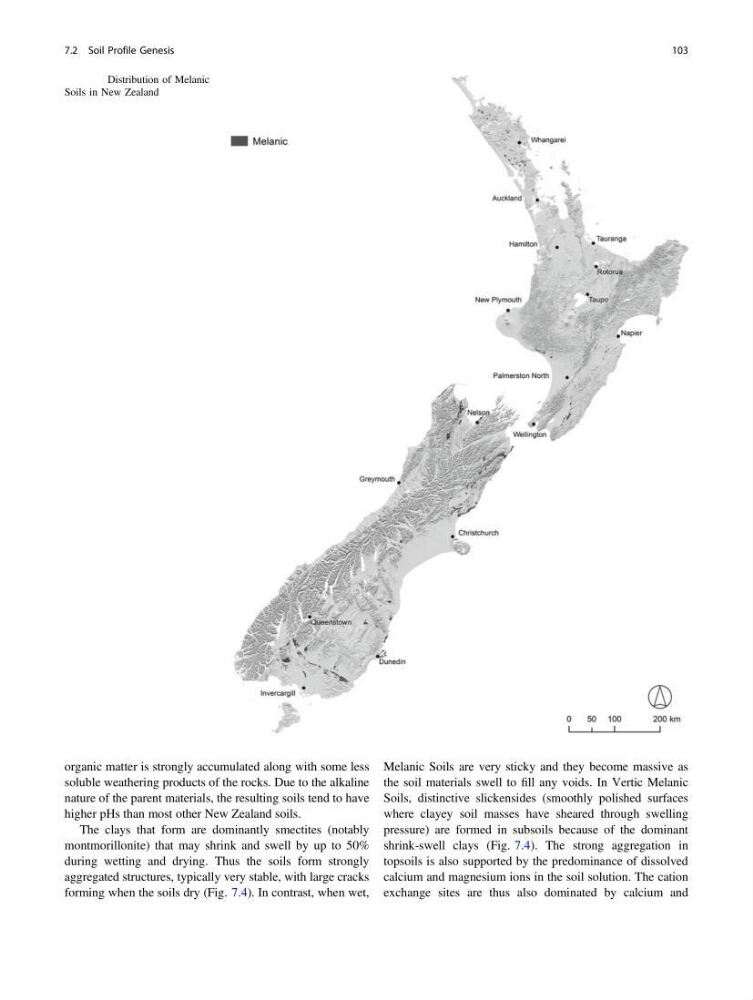
Fig. 7.2 Distribution of Melanic
Soils in New Zealand
7.2 Soil Profile Genesis
103
soluble weathering products of the rocks. Due to the alkaline
nature of the parent materials, the resulting soils tend to have
higher pHs than most other New Zealand soils.
The clays that form are dominantly smectites (notably
montmorillonite) that may shrink and swell by up to 50%
during wetting and drying. Thus the soils form strongly
aggregated structures, typically very stable, with large cracks
forming when the soils dry (Fig. 7.4). In contrast, when wet,
Melanic Soils are very sticky and they become massive as
the soil materials swell to fill any voids. In Vertic Melanic
Soils, distinctive slickensides (smoothly polished surfaces
where clayey soil masses have sheared through swelling
pressure) are formed in subsoils because of the dominant
shrink-swell clays (Fig. 7.4). The strong aggregation in
topsoils is also supported by the predominance of dissolved
calcium and magnesium ions in the soil solution. The cation
exchange sites are thus also dominated by calcium and
Fig. 7.2 Distribution of Melanic
Soils in New Zealand
7.2 Soil Profile Genesis
103