

magnesium (rather than the monovalent cations sodium,
potassium, and hydrogen), giving a relatively thinner cation
exchange layer on the surface of negatively charged particles. The thinner exchange layer allows the clay particles
and organic materials to approach each other closely,
forming strongly bonded, hence stable, aggregates.
The polyhedral peds are self-mulching, meaning they
re-form seasonally on wetting and drying, recovering from
the impacts of cropping, for example. The strong attraction
to the cation exchange layer allows large quantities of organic matter to be adsorbed and stabilised which contributes
to the high organic matter content and dark colour of the
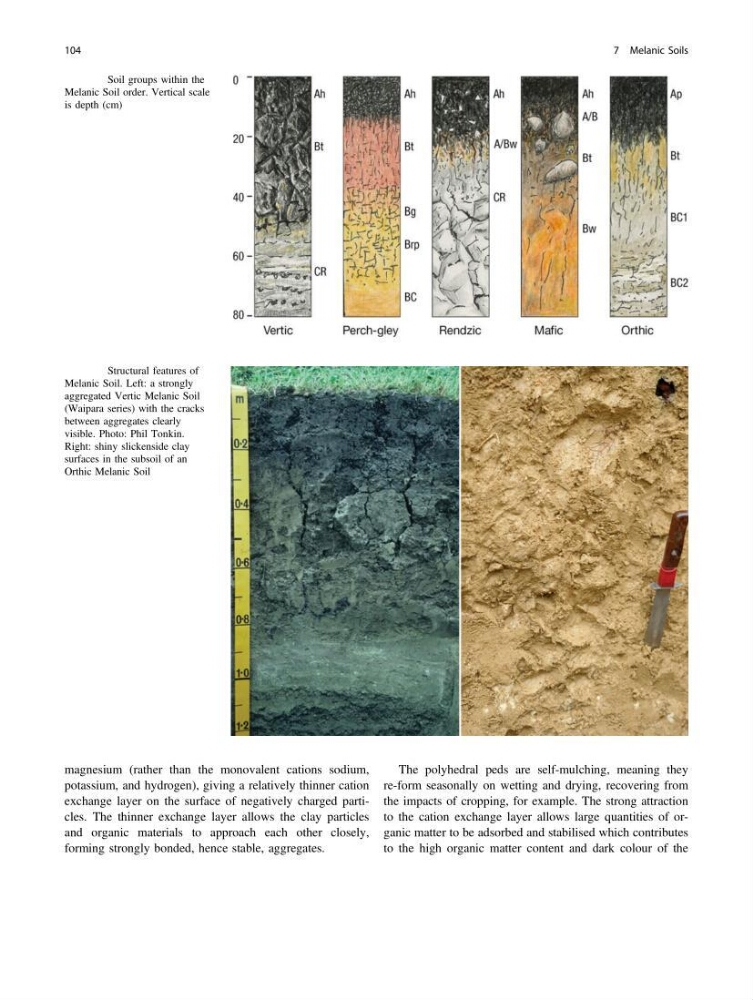
Fig. 7.3 Soil groups within the
Melanic Soil order. Vertical scale
is depth (cm)
Fig. 7.4 Structural features of
Melanic Soil. Left: a strongly
aggregated Vertic Melanic Soil
(Waipara series) with the cracks
between aggregates clearly
visible. Photo: Phil Tonkin.
Right: shiny slickenside clay
surfaces in the subsoil of an
Orthic Melanic Soil
104
7 Melanic Soils
potassium, and hydrogen), giving a relatively thinner cation
exchange layer on the surface of negatively charged particles. The thinner exchange layer allows the clay particles
and organic materials to approach each other closely,
forming strongly bonded, hence stable, aggregates.
The polyhedral peds are self-mulching, meaning they
re-form seasonally on wetting and drying, recovering from
the impacts of cropping, for example. The strong attraction
to the cation exchange layer allows large quantities of organic matter to be adsorbed and stabilised which contributes
to the high organic matter content and dark colour of the
Fig. 7.3 Soil groups within the
Melanic Soil order. Vertical scale
is depth (cm)
Fig. 7.4 Structural features of
Melanic Soil. Left: a strongly
aggregated Vertic Melanic Soil
(Waipara series) with the cracks
between aggregates clearly
visible. Photo: Phil Tonkin.
Right: shiny slickenside clay
surfaces in the subsoil of an
Orthic Melanic Soil
104
7 Melanic Soils