

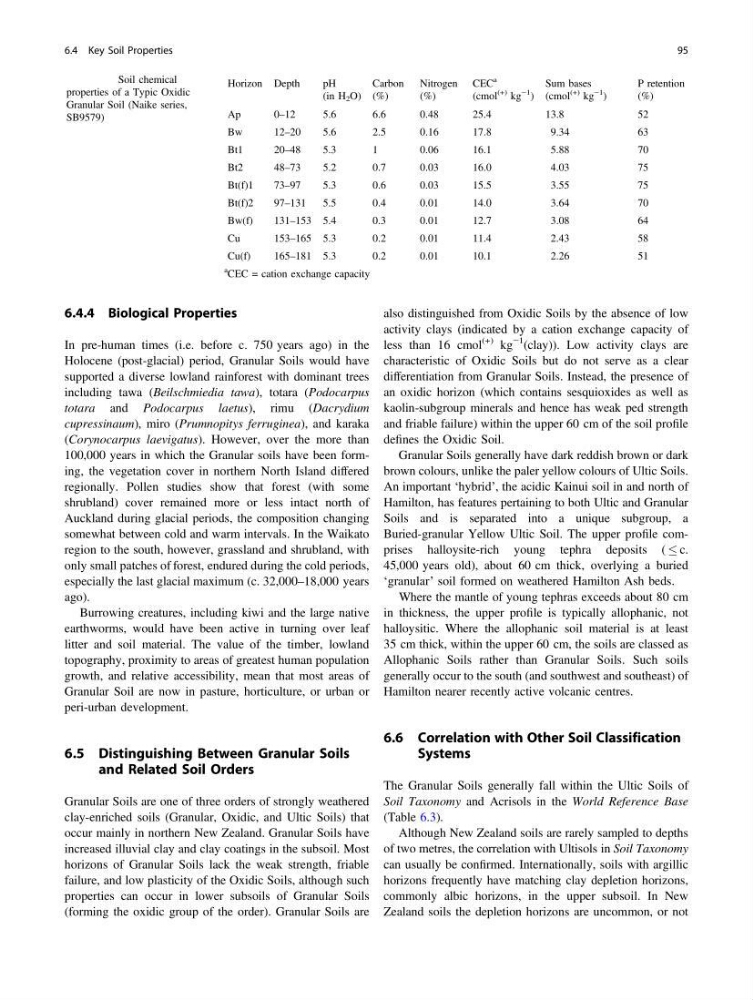
Table 6.2 Soil chemical
properties of a Typic Oxidic
Granular Soil (Naike series,
SB9579)
Horizon Depth
pH
(in H 2 O)
Carbon
(%)
Nitrogen
(%)
CEC
a
(cmol
(+) kg
−1
)
Sum bases
(cmol
(+) kg
−1
)
P retention
(%)
Ap
0–12
5.6
6.6
0.48
25.4
13.8
52
Bw
12–20
5.6
2.5
0.16
17.8
9.34
63
Bt1
20–48
5.3
1
0.06
16.1
5.88
70
Bt2
48–73
5.2
0.7
0.03
16.0
4.03
75
Bt(f)1
73–97
5.3
0.6
0.03
15.5
3.55
75
Bt(f)2
97–131
5.5
0.4
0.01
14.0
3.64
70
Bw(f)
131–153 5.4
0.3
0.01
12.7
3.08
64
Cu
153–165 5.3
0.2
0.01
11.4
2.43
58
Cu(f)
165–181 5.3
0.2
0.01
10.1
2.26
51
a CEC = cation exchange capacity
6.4.4 Biological Properties
In pre-human times (i.e. before c. 750 years ago) in the
Holocene (post-glacial) period, Granular Soils would have
supported a diverse lowland rainforest with dominant trees
including tawa (Beilschmiedia tawa), totara (Podocarpus
totara and Podocarpus laetus), rimu (Dacrydium
cupressinaum), miro (Prumnopitys ferruginea), and karaka
(Corynocarpus laevigatus). However, over the more than
100,000 years in which the Granular soils have been forming, the vegetation cover in northern North Island differed
regionally. Pollen studies show that forest (with some
shrubland) cover remained more or less intact north of
Auckland during glacial periods, the composition changing
somewhat between cold and warm intervals. In the Waikato
region to the south, however, grassland and shrubland, with
only small patches of forest, endured during the cold periods,
especially the last glacial maximum (c. 32,000–18,000 years
ago).
Burrowing creatures, including kiwi and the large native
earthworms, would have been active in turning over leaf
litter and soil material. The value of the timber, lowland
topography, proximity to areas of greatest human population
growth, and relative accessibility, mean that most areas of
Granular Soil are now in pasture, horticulture, or urban or
peri-urban development.
6.5 Distinguishing Between Granular Soils
and Related Soil Orders
Granular Soils are one of three orders of strongly weathered
clay-enriched soils (Granular, Oxidic, and Ultic Soils) that
occur mainly in northern New Zealand. Granular Soils have
increased illuvial clay and clay coatings in the subsoil. Most
horizons of Granular Soils lack the weak strength, friable
failure, and low plasticity of the Oxidic Soils, although such
properties can occur in lower subsoils of Granular Soils
(forming the oxidic group of the order). Granular Soils are
also distinguished from Oxidic Soils by the absence of low
activity clays (indicated by a cation exchange capacity of
less than 16 cmol
(+) kg
−1 (clay)). Low activity clays are
characteristic of Oxidic Soils but do not serve as a clear
differentiation from Granular Soils. Instead, the presence of
an oxidic horizon (which contains sesquioxides as well as
kaolin-subgroup minerals and hence has weak ped strength
and friable failure) within the upper 60 cm of the soil profile
defines the Oxidic Soil.
Granular Soils generally have dark reddish brown or dark
brown colours, unlike the paler yellow colours of Ultic Soils.
An important ‘hybrid’, the acidic Kainui soil in and north of
Hamilton, has features pertaining to both Ultic and Granular
Soils and is separated into a unique subgroup, a
Buried-granular Yellow Ultic Soil. The upper profile comprises halloysite-rich young tephra deposits ( c.
45,000 years old), about 60 cm thick, overlying a buried
‘granular’ soil formed on weathered Hamilton Ash beds.
Where the mantle of young tephras exceeds about 80 cm
in thickness, the upper profile is typically allophanic, not
halloysitic. Where the allophanic soil material is at least
35 cm thick, within the upper 60 cm, the soils are classed as
Allophanic Soils rather than Granular Soils. Such soils
generally occur to the south (and southwest and southeast) of
Hamilton nearer recently active volcanic centres.
6.6 Correlation with Other Soil Classification
Systems
The Granular Soils generally fall within the Ultic Soils of
Soil Taxonomy and Acrisols in the World Reference Base
(Table 6.3).
Although New Zealand soils are rarely sampled to depths
of two metres, the correlation with Ultisols in Soil Taxonomy
can usually be confirmed. Internationally, soils with argillic
horizons frequently have matching clay depletion horizons,
commonly albic horizons, in the upper subsoil. In New
Zealand soils the depletion horizons are uncommon, or not
6.4 Key Soil Properties
95
properties of a Typic Oxidic
Granular Soil (Naike series,
SB9579)
Horizon Depth
pH
(in H 2 O)
Carbon
(%)
Nitrogen
(%)
CEC
a
(cmol
(+) kg
−1
)
Sum bases
(cmol
(+) kg
−1
)
P retention
(%)
Ap
0–12
5.6
6.6
0.48
25.4
13.8
52
Bw
12–20
5.6
2.5
0.16
17.8
9.34
63
Bt1
20–48
5.3
1
0.06
16.1
5.88
70
Bt2
48–73
5.2
0.7
0.03
16.0
4.03
75
Bt(f)1
73–97
5.3
0.6
0.03
15.5
3.55
75
Bt(f)2
97–131
5.5
0.4
0.01
14.0
3.64
70
Bw(f)
131–153 5.4
0.3
0.01
12.7
3.08
64
Cu
153–165 5.3
0.2
0.01
11.4
2.43
58
Cu(f)
165–181 5.3
0.2
0.01
10.1
2.26
51
a CEC = cation exchange capacity
6.4.4 Biological Properties
In pre-human times (i.e. before c. 750 years ago) in the
Holocene (post-glacial) period, Granular Soils would have
supported a diverse lowland rainforest with dominant trees
including tawa (Beilschmiedia tawa), totara (Podocarpus
totara and Podocarpus laetus), rimu (Dacrydium
cupressinaum), miro (Prumnopitys ferruginea), and karaka
(Corynocarpus laevigatus). However, over the more than
100,000 years in which the Granular soils have been forming, the vegetation cover in northern North Island differed
regionally. Pollen studies show that forest (with some
shrubland) cover remained more or less intact north of
Auckland during glacial periods, the composition changing
somewhat between cold and warm intervals. In the Waikato
region to the south, however, grassland and shrubland, with
only small patches of forest, endured during the cold periods,
especially the last glacial maximum (c. 32,000–18,000 years
ago).
Burrowing creatures, including kiwi and the large native
earthworms, would have been active in turning over leaf
litter and soil material. The value of the timber, lowland
topography, proximity to areas of greatest human population
growth, and relative accessibility, mean that most areas of
Granular Soil are now in pasture, horticulture, or urban or
peri-urban development.
6.5 Distinguishing Between Granular Soils
and Related Soil Orders
Granular Soils are one of three orders of strongly weathered
clay-enriched soils (Granular, Oxidic, and Ultic Soils) that
occur mainly in northern New Zealand. Granular Soils have
increased illuvial clay and clay coatings in the subsoil. Most
horizons of Granular Soils lack the weak strength, friable
failure, and low plasticity of the Oxidic Soils, although such
properties can occur in lower subsoils of Granular Soils
(forming the oxidic group of the order). Granular Soils are
also distinguished from Oxidic Soils by the absence of low
activity clays (indicated by a cation exchange capacity of
less than 16 cmol
(+) kg
−1 (clay)). Low activity clays are
characteristic of Oxidic Soils but do not serve as a clear
differentiation from Granular Soils. Instead, the presence of
an oxidic horizon (which contains sesquioxides as well as
kaolin-subgroup minerals and hence has weak ped strength
and friable failure) within the upper 60 cm of the soil profile
defines the Oxidic Soil.
Granular Soils generally have dark reddish brown or dark
brown colours, unlike the paler yellow colours of Ultic Soils.
An important ‘hybrid’, the acidic Kainui soil in and north of
Hamilton, has features pertaining to both Ultic and Granular
Soils and is separated into a unique subgroup, a
Buried-granular Yellow Ultic Soil. The upper profile comprises halloysite-rich young tephra deposits ( c.
45,000 years old), about 60 cm thick, overlying a buried
‘granular’ soil formed on weathered Hamilton Ash beds.
Where the mantle of young tephras exceeds about 80 cm
in thickness, the upper profile is typically allophanic, not
halloysitic. Where the allophanic soil material is at least
35 cm thick, within the upper 60 cm, the soils are classed as
Allophanic Soils rather than Granular Soils. Such soils
generally occur to the south (and southwest and southeast) of
Hamilton nearer recently active volcanic centres.
6.6 Correlation with Other Soil Classification
Systems
The Granular Soils generally fall within the Ultic Soils of
Soil Taxonomy and Acrisols in the World Reference Base
(Table 6.3).
Although New Zealand soils are rarely sampled to depths
of two metres, the correlation with Ultisols in Soil Taxonomy
can usually be confirmed. Internationally, soils with argillic
horizons frequently have matching clay depletion horizons,
commonly albic horizons, in the upper subsoil. In New
Zealand soils the depletion horizons are uncommon, or not
6.4 Key Soil Properties
95