

leached from the soil, over a long time (hundreds of thousands of years). When soil formation began the parent
material would have been rich in minerals and volcanic glass
shards that were readily weathered and easily broken down
by hydrolysis with release of nutrients for storage and uptake
by plants. The advanced weathering of Granular Soils does
not significantly limit crop production provided normal
fertiliser management is applied.
Granular Soils—an endangered species?
Granular Soils are of particular importance for horticulture in the area around Pukekohe. A favourable
climate, resilient soil, and proximity to half of New
Zealand’s population make the area important for food
growing. It is the only area that produces quantities of
fresh green vegetables in the late winter season.
However, greater Auckland city is rapidly encroaching. Much of the flatter or gently sloping land that
comprises the roads, industrial development, and
housing, in South Auckland is on Granular Soils.
During major earthworks, that are undertaken during
road construction and modern urban subdivision,
topsoils are removed and the land surface is recontoured. The changes are such that many areas that were
Granular Soils could now be classified as Anthropic
Soils in much of the newer urban environment.
Gone are the days of the ‘quarter acre section’ and a
large productive home garden. Under current intense
urban development much of the land is covered by
buildings and sealed surfaces with minimal soil left
exposed to support any form of plant production. In
2017 it was reported that 16% of the Granular Soils
around Pukekohe had been taken over for housing in
just the previous 10 years with a further 5000 houses
in the pipeline and a further 9000 planned in the next
ten years.
While food prices remain relatively low the market
for horticultural land cannot compete with that for
housing, thus without some strong intervention we are
in danger of losing some of our most productive soils
to intense urban development as well as ‘rural fragmentation’ for lifestyle blocks and rural industry such
as extensive glasshouses.
At the time of writing the New Zealand government
was working on a proposal for a National Policy
Statement (NPS) to help protect our most highly productive land. In 2019 the New Zealand Society of Soil
Science stated, in their submission to the proposed
NPS, that ‘highly productive land and soil are a
strategic national non-renewable resource that is
finite in supply and needs to be sustained for this
generation, and for generations to come. Sustaining
food supply, enabling versatility in crops that can be
grown, and minimizing impact on wider environmental values are core to NZ community wellbeing’. It will
likely be some years before any NPS will be implemented and take effect.
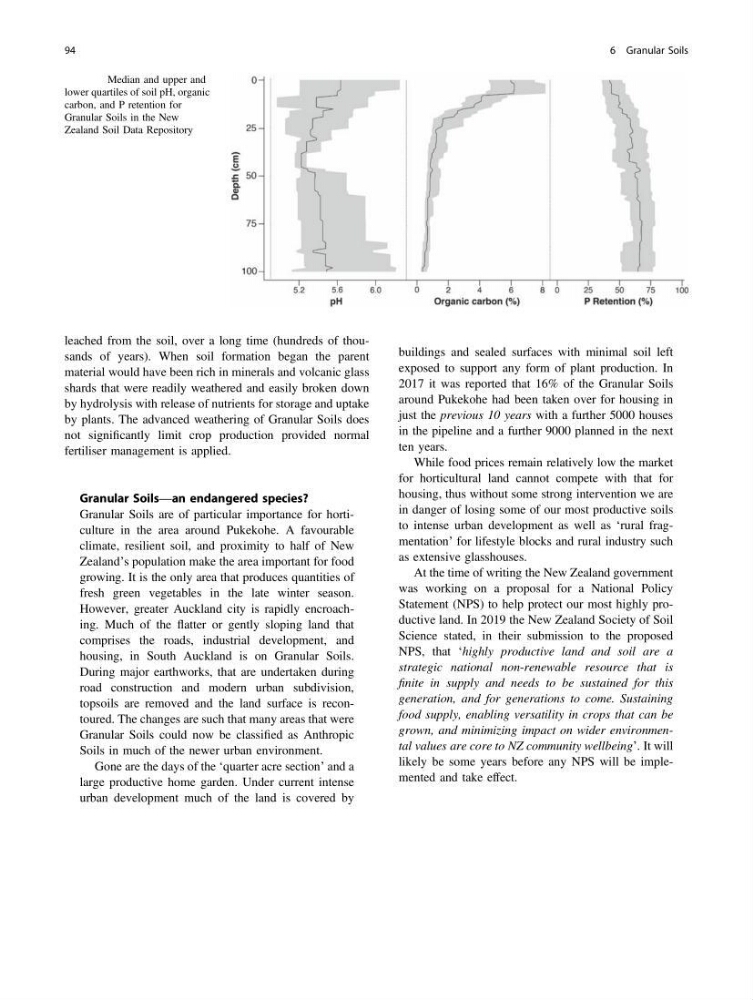
Fig. 6.7 Median and upper and
lower quartiles of soil pH, organic
carbon, and P retention for
Granular Soils in the New
Zealand Soil Data Repository
94
6 Granular Soils
material would have been rich in minerals and volcanic glass
shards that were readily weathered and easily broken down
by hydrolysis with release of nutrients for storage and uptake
by plants. The advanced weathering of Granular Soils does
not significantly limit crop production provided normal
fertiliser management is applied.
Granular Soils—an endangered species?
Granular Soils are of particular importance for horticulture in the area around Pukekohe. A favourable
climate, resilient soil, and proximity to half of New
Zealand’s population make the area important for food
growing. It is the only area that produces quantities of
fresh green vegetables in the late winter season.
However, greater Auckland city is rapidly encroaching. Much of the flatter or gently sloping land that
comprises the roads, industrial development, and
housing, in South Auckland is on Granular Soils.
During major earthworks, that are undertaken during
road construction and modern urban subdivision,
topsoils are removed and the land surface is recontoured. The changes are such that many areas that were
Granular Soils could now be classified as Anthropic
Soils in much of the newer urban environment.
Gone are the days of the ‘quarter acre section’ and a
large productive home garden. Under current intense
urban development much of the land is covered by
buildings and sealed surfaces with minimal soil left
exposed to support any form of plant production. In
2017 it was reported that 16% of the Granular Soils
around Pukekohe had been taken over for housing in
just the previous 10 years with a further 5000 houses
in the pipeline and a further 9000 planned in the next
ten years.
While food prices remain relatively low the market
for horticultural land cannot compete with that for
housing, thus without some strong intervention we are
in danger of losing some of our most productive soils
to intense urban development as well as ‘rural fragmentation’ for lifestyle blocks and rural industry such
as extensive glasshouses.
At the time of writing the New Zealand government
was working on a proposal for a National Policy
Statement (NPS) to help protect our most highly productive land. In 2019 the New Zealand Society of Soil
Science stated, in their submission to the proposed
NPS, that ‘highly productive land and soil are a
strategic national non-renewable resource that is
finite in supply and needs to be sustained for this
generation, and for generations to come. Sustaining
food supply, enabling versatility in crops that can be
grown, and minimizing impact on wider environmental values are core to NZ community wellbeing’. It will
likely be some years before any NPS will be implemented and take effect.
Fig. 6.7 Median and upper and
lower quartiles of soil pH, organic
carbon, and P retention for
Granular Soils in the New
Zealand Soil Data Repository
94
6 Granular Soils