

Despite the high clay contents (up to 90% in subsoils) the
soil remains friable with low plasticity and fine soil structure.
However, when wet, topsoils have limited workability and
trafficability, especially in the Waikato area. The soil dry
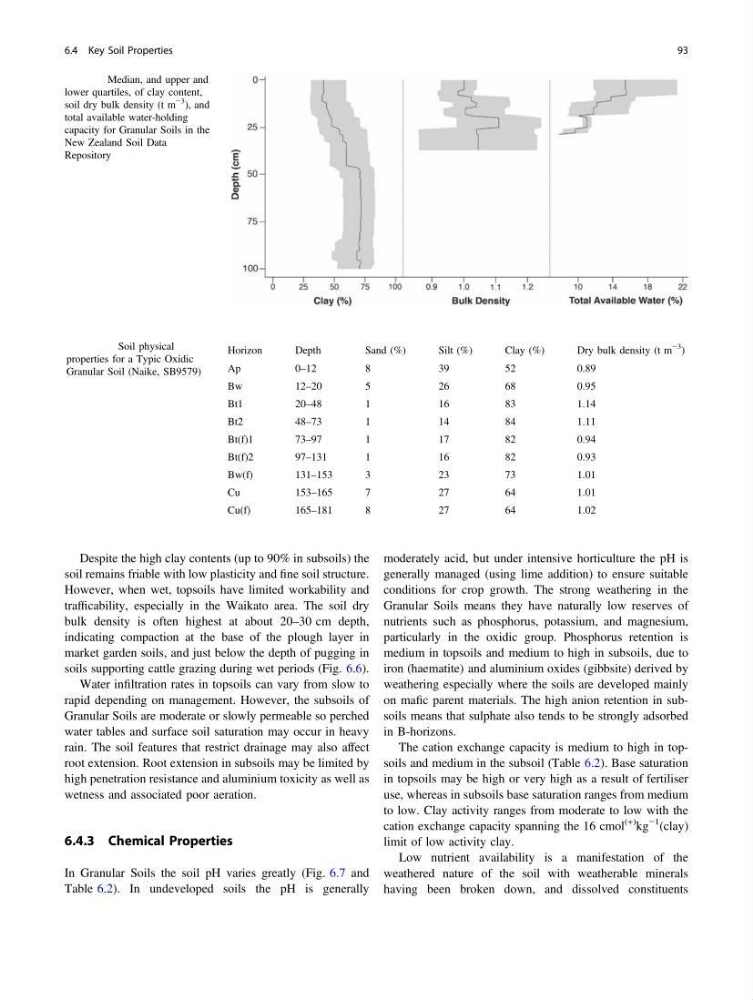
bulk density is often highest at about 20–30 cm depth,
indicating compaction at the base of the plough layer in
market garden soils, and just below the depth of pugging in
soils supporting cattle grazing during wet periods (Fig. 6.6).
Water infiltration rates in topsoils can vary from slow to
rapid depending on management. However, the subsoils of
Granular Soils are moderate or slowly permeable so perched
water tables and surface soil saturation may occur in heavy
rain. The soil features that restrict drainage may also affect
root extension. Root extension in subsoils may be limited by
high penetration resistance and aluminium toxicity as well as
wetness and associated poor aeration.
6.4.3 Chemical Properties
In Granular Soils the soil pH varies greatly (Fig. 6.7 and
Table 6.2). In undeveloped soils the pH is generally
moderately acid, but under intensive horticulture the pH is
generally managed (using lime addition) to ensure suitable
conditions for crop growth. The strong weathering in the
Granular Soils means they have naturally low reserves of
nutrients such as phosphorus, potassium, and magnesium,
particularly in the oxidic group. Phosphorus retention is
medium in topsoils and medium to high in subsoils, due to
iron (haematite) and aluminium oxides (gibbsite) derived by
weathering especially where the soils are developed mainly
on mafic parent materials. The high anion retention in subsoils means that sulphate also tends to be strongly adsorbed
in B-horizons.
The cation exchange capacity is medium to high in topsoils and medium in the subsoil (Table 6.2). Base saturation
in topsoils may be high or very high as a result of fertiliser
use, whereas in subsoils base saturation ranges from medium
to low. Clay activity ranges from moderate to low with the
cation exchange capacity spanning the 16 cmol
(+) kg
−1 (clay)
limit of low activity clay.
Low nutrient availability is a manifestation of the
weathered nature of the soil with weatherable minerals
having been broken down, and dissolved constituents
Fig. 6.6 Median, and upper and
lower quartiles, of clay content,
soil dry bulk density (t m
−3
), and
total available water-holding
capacity for Granular Soils in the
New Zealand Soil Data
Repository
Table 6.1 Soil physical
properties for a Typic Oxidic
Granular Soil (Naike, SB9579)
Horizon
Depth
Sand (%)
Silt (%)
Clay (%)
Dry bulk density (t m
−3
)
Ap
0–12
8
39
52
0.89
Bw
12–20
5
26
68
0.95
Bt1
20–48
1
16
83
1.14
Bt2
48–73
1
14
84
1.11
Bt(f)1
73–97
1
17
82
0.94
Bt(f)2
97–131
1
16
82
0.93
Bw(f)
131–153
3
23
73
1.01
Cu
153–165
7
27
64
1.01
Cu(f)
165–181
8
27
64
1.02
6.4 Key Soil Properties
93
soil remains friable with low plasticity and fine soil structure.
However, when wet, topsoils have limited workability and
trafficability, especially in the Waikato area. The soil dry
bulk density is often highest at about 20–30 cm depth,
indicating compaction at the base of the plough layer in
market garden soils, and just below the depth of pugging in
soils supporting cattle grazing during wet periods (Fig. 6.6).
Water infiltration rates in topsoils can vary from slow to
rapid depending on management. However, the subsoils of
Granular Soils are moderate or slowly permeable so perched
water tables and surface soil saturation may occur in heavy
rain. The soil features that restrict drainage may also affect
root extension. Root extension in subsoils may be limited by
high penetration resistance and aluminium toxicity as well as
wetness and associated poor aeration.
6.4.3 Chemical Properties
In Granular Soils the soil pH varies greatly (Fig. 6.7 and
Table 6.2). In undeveloped soils the pH is generally
moderately acid, but under intensive horticulture the pH is
generally managed (using lime addition) to ensure suitable
conditions for crop growth. The strong weathering in the
Granular Soils means they have naturally low reserves of
nutrients such as phosphorus, potassium, and magnesium,
particularly in the oxidic group. Phosphorus retention is
medium in topsoils and medium to high in subsoils, due to
iron (haematite) and aluminium oxides (gibbsite) derived by
weathering especially where the soils are developed mainly
on mafic parent materials. The high anion retention in subsoils means that sulphate also tends to be strongly adsorbed
in B-horizons.
The cation exchange capacity is medium to high in topsoils and medium in the subsoil (Table 6.2). Base saturation
in topsoils may be high or very high as a result of fertiliser
use, whereas in subsoils base saturation ranges from medium
to low. Clay activity ranges from moderate to low with the
cation exchange capacity spanning the 16 cmol
(+) kg
−1 (clay)
limit of low activity clay.
Low nutrient availability is a manifestation of the
weathered nature of the soil with weatherable minerals
having been broken down, and dissolved constituents
Fig. 6.6 Median, and upper and
lower quartiles, of clay content,
soil dry bulk density (t m
−3
), and
total available water-holding
capacity for Granular Soils in the
New Zealand Soil Data
Repository
Table 6.1 Soil physical
properties for a Typic Oxidic
Granular Soil (Naike, SB9579)
Horizon
Depth
Sand (%)
Silt (%)
Clay (%)
Dry bulk density (t m
−3
)
Ap
0–12
8
39
52
0.89
Bw
12–20
5
26
68
0.95
Bt1
20–48
1
16
83
1.14
Bt2
48–73
1
14
84
1.11
Bt(f)1
73–97
1
17
82
0.94
Bt(f)2
97–131
1
16
82
0.93
Bw(f)
131–153
3
23
73
1.01
Cu
153–165
7
27
64
1.01
Cu(f)
165–181
8
27
64
1.02
6.4 Key Soil Properties
93