

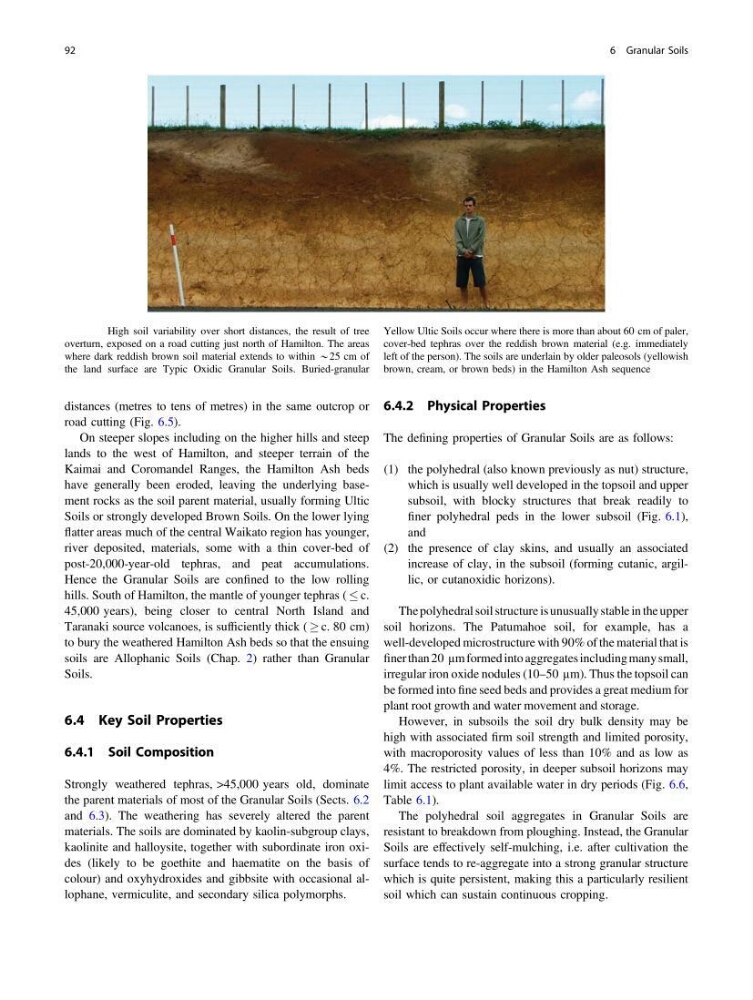
distances (metres to tens of metres) in the same outcrop or
road cutting (Fig. 6.5).
On steeper slopes including on the higher hills and steep
lands to the west of Hamilton, and steeper terrain of the
Kaimai and Coromandel Ranges, the Hamilton Ash beds
have generally been eroded, leaving the underlying basement rocks as the soil parent material, usually forming Ultic
Soils or strongly developed Brown Soils. On the lower lying
flatter areas much of the central Waikato region has younger,
river deposited, materials, some with a thin cover-bed of
post-20,000-year-old tephras, and peat accumulations.
Hence the Granular Soils are confined to the low rolling
hills. South of Hamilton, the mantle of younger tephras ( c.
45,000 years), being closer to central North Island and
Taranaki source volcanoes, is sufficiently thick ( c. 80 cm)
to bury the weathered Hamilton Ash beds so that the ensuing
soils are Allophanic Soils (Chap. 2) rather than Granular
Soils.
6.4 Key Soil Properties
6.4.1 Soil Composition
Strongly weathered tephras, >45,000 years old, dominate
the parent materials of most of the Granular Soils (Sects. 6.2
and 6.3). The weathering has severely altered the parent
materials. The soils are dominated by kaolin-subgroup clays,
kaolinite and halloysite, together with subordinate iron oxides (likely to be goethite and haematite on the basis of
colour) and oxyhydroxides and gibbsite with occasional allophane, vermiculite, and secondary silica polymorphs.
6.4.2 Physical Properties
The defining properties of Granular Soils are as follows:
(1) the polyhedral (also known previously as nut) structure,
which is usually well developed in the topsoil and upper
subsoil, with blocky structures that break readily to
finer polyhedral peds in the lower subsoil (Fig. 6.1),
and
(2) the presence of clay skins, and usually an associated
increase of clay, in the subsoil (forming cutanic, argillic, or cutanoxidic horizons).
The polyhedral soil structure is unusually stable in the upper
soil horizons. The Patumahoe soil, for example, has a
well-developed microstructure with 90% of the material that is
finer than 20 µm formed into aggregates including many small,
irregular iron oxide nodules (10–50 µm). Thus the topsoil can
be formed into fine seed beds and provides a great medium for
plant root growth and water movement and storage.
However, in subsoils the soil dry bulk density may be
high with associated firm soil strength and limited porosity,
with macroporosity values of less than 10% and as low as
4%. The restricted porosity, in deeper subsoil horizons may
limit access to plant available water in dry periods (Fig. 6.6,
Table 6.1).
The polyhedral soil aggregates in Granular Soils are
resistant to breakdown from ploughing. Instead, the Granular
Soils are effectively self-mulching, i.e. after cultivation the
surface tends to re-aggregate into a strong granular structure
which is quite persistent, making this a particularly resilient
soil which can sustain continuous cropping.
Fig. 6.5 High soil variability over short distances, the result of tree
overturn, exposed on a road cutting just north of Hamilton. The areas
where dark reddish brown soil material extends to within *25 cm of
the land surface are Typic Oxidic Granular Soils. Buried-granular
Yellow Ultic Soils occur where there is more than about 60 cm of paler,
cover-bed tephras over the reddish brown material (e.g. immediately
left of the person). The soils are underlain by older paleosols (yellowish
brown, cream, or brown beds) in the Hamilton Ash sequence
92
6 Granular Soils
road cutting (Fig. 6.5).
On steeper slopes including on the higher hills and steep
lands to the west of Hamilton, and steeper terrain of the
Kaimai and Coromandel Ranges, the Hamilton Ash beds
have generally been eroded, leaving the underlying basement rocks as the soil parent material, usually forming Ultic
Soils or strongly developed Brown Soils. On the lower lying
flatter areas much of the central Waikato region has younger,
river deposited, materials, some with a thin cover-bed of
post-20,000-year-old tephras, and peat accumulations.
Hence the Granular Soils are confined to the low rolling
hills. South of Hamilton, the mantle of younger tephras ( c.
45,000 years), being closer to central North Island and
Taranaki source volcanoes, is sufficiently thick ( c. 80 cm)
to bury the weathered Hamilton Ash beds so that the ensuing
soils are Allophanic Soils (Chap. 2) rather than Granular
Soils.
6.4 Key Soil Properties
6.4.1 Soil Composition
Strongly weathered tephras, >45,000 years old, dominate
the parent materials of most of the Granular Soils (Sects. 6.2
and 6.3). The weathering has severely altered the parent
materials. The soils are dominated by kaolin-subgroup clays,
kaolinite and halloysite, together with subordinate iron oxides (likely to be goethite and haematite on the basis of
colour) and oxyhydroxides and gibbsite with occasional allophane, vermiculite, and secondary silica polymorphs.
6.4.2 Physical Properties
The defining properties of Granular Soils are as follows:
(1) the polyhedral (also known previously as nut) structure,
which is usually well developed in the topsoil and upper
subsoil, with blocky structures that break readily to
finer polyhedral peds in the lower subsoil (Fig. 6.1),
and
(2) the presence of clay skins, and usually an associated
increase of clay, in the subsoil (forming cutanic, argillic, or cutanoxidic horizons).
The polyhedral soil structure is unusually stable in the upper
soil horizons. The Patumahoe soil, for example, has a
well-developed microstructure with 90% of the material that is
finer than 20 µm formed into aggregates including many small,
irregular iron oxide nodules (10–50 µm). Thus the topsoil can
be formed into fine seed beds and provides a great medium for
plant root growth and water movement and storage.
However, in subsoils the soil dry bulk density may be
high with associated firm soil strength and limited porosity,
with macroporosity values of less than 10% and as low as
4%. The restricted porosity, in deeper subsoil horizons may
limit access to plant available water in dry periods (Fig. 6.6,
Table 6.1).
The polyhedral soil aggregates in Granular Soils are
resistant to breakdown from ploughing. Instead, the Granular
Soils are effectively self-mulching, i.e. after cultivation the
surface tends to re-aggregate into a strong granular structure
which is quite persistent, making this a particularly resilient
soil which can sustain continuous cropping.
Fig. 6.5 High soil variability over short distances, the result of tree
overturn, exposed on a road cutting just north of Hamilton. The areas
where dark reddish brown soil material extends to within *25 cm of
the land surface are Typic Oxidic Granular Soils. Buried-granular
Yellow Ultic Soils occur where there is more than about 60 cm of paler,
cover-bed tephras over the reddish brown material (e.g. immediately
left of the person). The soils are underlain by older paleosols (yellowish
brown, cream, or brown beds) in the Hamilton Ash sequence
92
6 Granular Soils