

as pale as their counterparts in other countries (EB- or pale
Bw-horizons rather than E-horizons), and this can cause
difficulties in arriving at clear correlations with international
soil classes. One reason for the difference is that in the New
Zealand environment there has been continuing accumulation of material (mainly tephra and loess) on much of the
land surface over a considerable time. Another is that,
broadly, the high average rainfall and mainly non-deciduous
vegetation (conservative nutrient cycling) tend to favour a
podzolization rather than argilluviation pathway.
Granular Soils, with moderate clay activity and low base
saturation, should correlate with World Reference Base Acrisols but they will fail to meet the strong clay contrast between
an upper albic horizon and underlying clayey argic horizon.
Granular Soils more closely correlate with Nitisols, though
they do not develop the shiny ped faces common in Nitisols.
This might be explained by the weathered tephric component
in many New Zealand soils. Tephra may be responsible for the
flocculated surface appearance of ped faces.
6.7 Use and Management of Granular Soils
6.7.1 Uses for Granular Soils
Granular Soils are important for New Zealand vegetable
production. Extensive areas under horticulture at Pukekohe
and Bombay demonstrate the productivity of these soils
when they are well managed despite high clay contents,
stickiness when wet, and low natural fertility. The soils are,
however, subject to erosion under long-term cultivation. The
area around the Pukekohe Hill was cleared of forest between
about 1876 and 1900. The dense timber from puriri trees
(Vitex lucens), which were common in the area, was in
demand for railway sleepers. Specialised growing of onions
and potatoes began in the 1890s. Many Granular Soils,
around Pukekohe, have been used for horticulture continuously or semi-continuously for >40 years, some for >70
years, and some for >110 years, often with more than one
crop each year.
Vegetables grown around Pukekohe help to feed Auckland and other regions of New Zealand and are also exported. The ‘Pukekohe long-keeper onions’ are a particularly
well known product of Granular Soils with an annual production around Pukekohe of about 120,000 tonnes, 90% of
which are exported, particularly to the Northern Hemisphere
off season. Also widely grown are potatoes, salad greens,
and brassicas. Production yields are among the highest in
New Zealand: onions 55 t/ha; potatoes 60 t/ha; cabbage 30
t/ha. The vegetables grown in the Pukekohe area provide
about one-third of New Zealand’s fresh vegetable production. A report in 2018 by Deloitte showed that vegetable
production generated about $330 million per year on the
4,359 ha growing vegetables around Pukekohe on predominantly Granular Soils.
The Granular Soils of Pukekohe benefit from a unique
climate, especially the frost-free status and thermic soil
temperature regime, allowing vegetable production in late
winter when the area is the main supplier of green vegetables
to New Zealand. In the Waikato, most Granular Soils are in
pastoral, predominantly dairy, farming with some associated
maize cropping.
6.7.2 Urban and Peri-urban Development
Granular Soils have no major limitations for urban development. They provide adequate substrate for road and
building construction. However, there is concern that the
productive Granular Soils of South Auckland are being lost
to urban development and the fragmentation of the soil
resource to lifestyle blocks (see grey box). Growers are also
concerned about increasing ‘reverse sensibility’ as urban
neighbours object to necessary horticultural activities that
generate noise or odour. Rising land values mean that
growers have to keep increasing intensification to maintain
economic operations. This need can lead to some sustainable
practices such as crop rotation being utilised less, and higher
fertiliser and pesticide inputs, to maintain production of only
the most lucrative crops. With growing urban populations
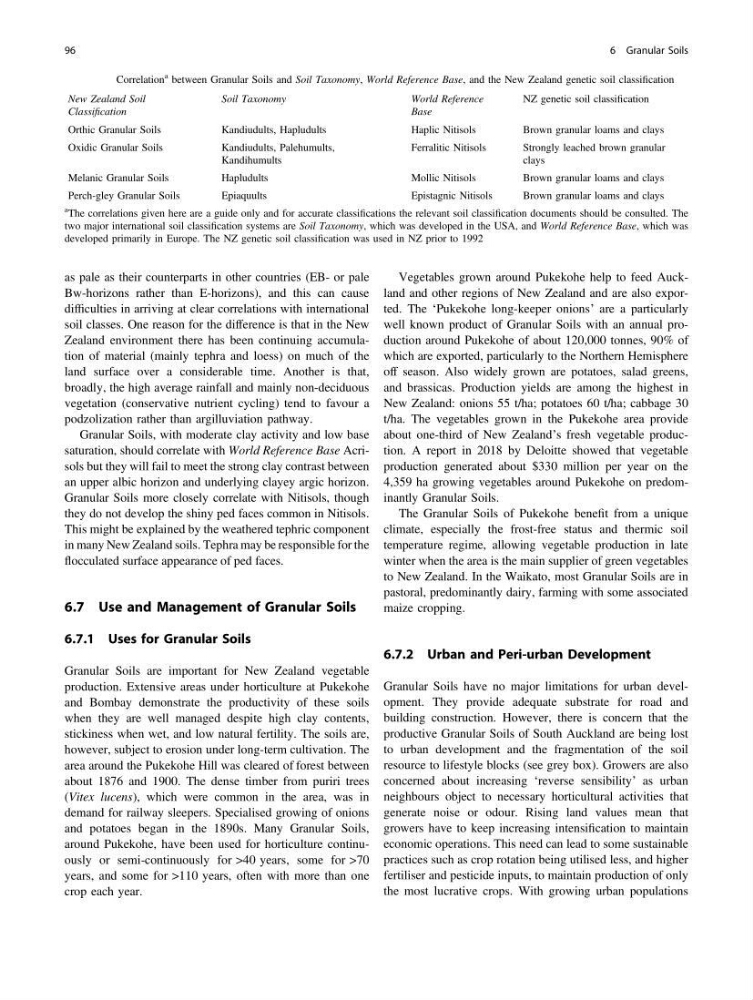
Table 6.3 Correlation
a between Granular Soils and Soil Taxonomy, World Reference Base, and the New Zealand genetic soil classification
New Zealand Soil
Classification
Soil Taxonomy
World Reference
Base
NZ genetic soil classification
Orthic Granular Soils
Kandiudults, Hapludults
Haplic Nitisols
Brown granular loams and clays
Oxidic Granular Soils
Kandiudults, Palehumults,
Kandihumults
Ferralitic Nitisols
Strongly leached brown granular
clays
Melanic Granular Soils
Hapludults
Mollic Nitisols
Brown granular loams and clays
Perch-gley Granular Soils
Epiaquults
Epistagnic Nitisols
Brown granular loams and clays
a The correlations given here are a guide only and for accurate classifications the relevant soil classification documents should be consulted. The
two major international soil classification systems are Soil Taxonomy, which was developed in the USA, and World Reference Base, which was
developed primarily in Europe. The NZ genetic soil classification was used in NZ prior to 1992
96
6 Granular Soils
Bw-horizons rather than E-horizons), and this can cause
difficulties in arriving at clear correlations with international
soil classes. One reason for the difference is that in the New
Zealand environment there has been continuing accumulation of material (mainly tephra and loess) on much of the
land surface over a considerable time. Another is that,
broadly, the high average rainfall and mainly non-deciduous
vegetation (conservative nutrient cycling) tend to favour a
podzolization rather than argilluviation pathway.
Granular Soils, with moderate clay activity and low base
saturation, should correlate with World Reference Base Acrisols but they will fail to meet the strong clay contrast between
an upper albic horizon and underlying clayey argic horizon.
Granular Soils more closely correlate with Nitisols, though
they do not develop the shiny ped faces common in Nitisols.
This might be explained by the weathered tephric component
in many New Zealand soils. Tephra may be responsible for the
flocculated surface appearance of ped faces.
6.7 Use and Management of Granular Soils
6.7.1 Uses for Granular Soils
Granular Soils are important for New Zealand vegetable
production. Extensive areas under horticulture at Pukekohe
and Bombay demonstrate the productivity of these soils
when they are well managed despite high clay contents,
stickiness when wet, and low natural fertility. The soils are,
however, subject to erosion under long-term cultivation. The
area around the Pukekohe Hill was cleared of forest between
about 1876 and 1900. The dense timber from puriri trees
(Vitex lucens), which were common in the area, was in
demand for railway sleepers. Specialised growing of onions
and potatoes began in the 1890s. Many Granular Soils,
around Pukekohe, have been used for horticulture continuously or semi-continuously for >40 years, some for >70
years, and some for >110 years, often with more than one
crop each year.
Vegetables grown around Pukekohe help to feed Auckland and other regions of New Zealand and are also exported. The ‘Pukekohe long-keeper onions’ are a particularly
well known product of Granular Soils with an annual production around Pukekohe of about 120,000 tonnes, 90% of
which are exported, particularly to the Northern Hemisphere
off season. Also widely grown are potatoes, salad greens,
and brassicas. Production yields are among the highest in
New Zealand: onions 55 t/ha; potatoes 60 t/ha; cabbage 30
t/ha. The vegetables grown in the Pukekohe area provide
about one-third of New Zealand’s fresh vegetable production. A report in 2018 by Deloitte showed that vegetable
production generated about $330 million per year on the
4,359 ha growing vegetables around Pukekohe on predominantly Granular Soils.
The Granular Soils of Pukekohe benefit from a unique
climate, especially the frost-free status and thermic soil
temperature regime, allowing vegetable production in late
winter when the area is the main supplier of green vegetables
to New Zealand. In the Waikato, most Granular Soils are in
pastoral, predominantly dairy, farming with some associated
maize cropping.
6.7.2 Urban and Peri-urban Development
Granular Soils have no major limitations for urban development. They provide adequate substrate for road and
building construction. However, there is concern that the
productive Granular Soils of South Auckland are being lost
to urban development and the fragmentation of the soil
resource to lifestyle blocks (see grey box). Growers are also
concerned about increasing ‘reverse sensibility’ as urban
neighbours object to necessary horticultural activities that
generate noise or odour. Rising land values mean that
growers have to keep increasing intensification to maintain
economic operations. This need can lead to some sustainable
practices such as crop rotation being utilised less, and higher
fertiliser and pesticide inputs, to maintain production of only
the most lucrative crops. With growing urban populations
Table 6.3 Correlation
a between Granular Soils and Soil Taxonomy, World Reference Base, and the New Zealand genetic soil classification
New Zealand Soil
Classification
Soil Taxonomy
World Reference
Base
NZ genetic soil classification
Orthic Granular Soils
Kandiudults, Hapludults
Haplic Nitisols
Brown granular loams and clays
Oxidic Granular Soils
Kandiudults, Palehumults,
Kandihumults
Ferralitic Nitisols
Strongly leached brown granular
clays
Melanic Granular Soils
Hapludults
Mollic Nitisols
Brown granular loams and clays
Perch-gley Granular Soils
Epiaquults
Epistagnic Nitisols
Brown granular loams and clays
a The correlations given here are a guide only and for accurate classifications the relevant soil classification documents should be consulted. The
two major international soil classification systems are Soil Taxonomy, which was developed in the USA, and World Reference Base, which was
developed primarily in Europe. The NZ genetic soil classification was used in NZ prior to 1992
96
6 Granular Soils