

weathered tephras of the Hamilton Ash Formation (derived
predominantly from eruptions in central North Island),
which have no, or less than a few decimetres of, later tephra
deposits.
The Hamilton Ash Formation comprises a series of
now-altered tephras deposited in the northern North Island
from about 340,000 to c. 75,000 years ago. The upper beds
in the sequence are inferred to be between c. 125,000 and
75,000 years old, but have not been dated directly. Based on
tephrochronology, however, they are considerably older than
c. 45,000 years, the age of Rotoehu Ash that overlies them
unconformably. Apart from the sandy basal unit (bed H1 or
Rangitawa Tephra, c. 340,000 years old), the entire Hamilton Ash sequence, up to c. 6 m thick, is dominated by clay
(c. 60–90%) and beds often contain relict clay coatings that
represent (paleo) argillic horizons, and also often coatings of
MnO 2 (mangans).
In the subsoil, clay coatings (clay skins or cutans) can be
seen on some aggregate surfaces, indicating that downward
movement of clay through the soil has occurred. Such
movement is also evident from increasing ratios of fine-clay
to total-clay with increasing depth. The soils also become
more weathered with depth suggesting that ‘developmental
upbuilding pedogenesis’ (Chap. 2) dominated in forming the
soils. In developmental upbuilding, the incremental accumulation of thin tephra materials has allowed weathering and
soil formation to commence on each tephra at the soil surface before it is gradually buried by new material.
In some places in the Pukekohe area the Hamilton
Ash-derived soil may be covered by a thin mantle of
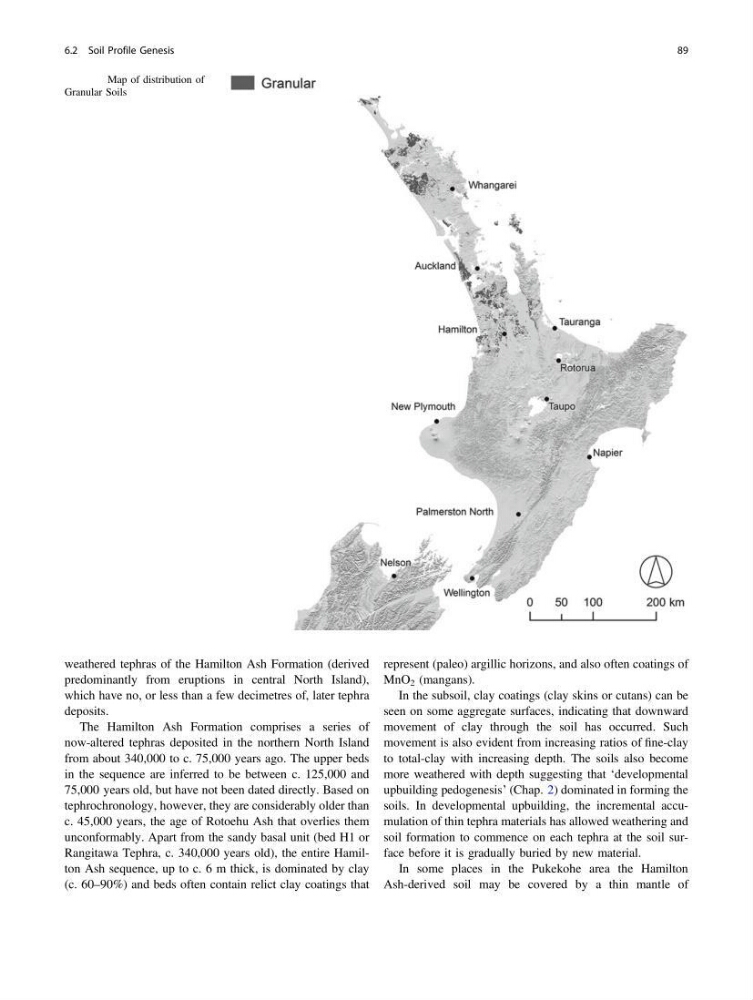
Fig. 6.2 Map of distribution of
Granular Soils
6.2 Soil Profile Genesis
89
predominantly from eruptions in central North Island),
which have no, or less than a few decimetres of, later tephra
deposits.
The Hamilton Ash Formation comprises a series of
now-altered tephras deposited in the northern North Island
from about 340,000 to c. 75,000 years ago. The upper beds
in the sequence are inferred to be between c. 125,000 and
75,000 years old, but have not been dated directly. Based on
tephrochronology, however, they are considerably older than
c. 45,000 years, the age of Rotoehu Ash that overlies them
unconformably. Apart from the sandy basal unit (bed H1 or
Rangitawa Tephra, c. 340,000 years old), the entire Hamilton Ash sequence, up to c. 6 m thick, is dominated by clay
(c. 60–90%) and beds often contain relict clay coatings that
represent (paleo) argillic horizons, and also often coatings of
MnO 2 (mangans).
In the subsoil, clay coatings (clay skins or cutans) can be
seen on some aggregate surfaces, indicating that downward
movement of clay through the soil has occurred. Such
movement is also evident from increasing ratios of fine-clay
to total-clay with increasing depth. The soils also become
more weathered with depth suggesting that ‘developmental
upbuilding pedogenesis’ (Chap. 2) dominated in forming the
soils. In developmental upbuilding, the incremental accumulation of thin tephra materials has allowed weathering and
soil formation to commence on each tephra at the soil surface before it is gradually buried by new material.
In some places in the Pukekohe area the Hamilton
Ash-derived soil may be covered by a thin mantle of
Fig. 6.2 Map of distribution of
Granular Soils
6.2 Soil Profile Genesis
89