

indistinct, younger tephra deposits c. 45,000 years old.
Where the thickness of younger tephra is 25 cm the soils
remain as Granular Soils because the bulk of the profile is
dominated by the clayey and well-structured Hamilton Ash
beds.
Underlying the Hamilton Ash Formation are older,
strongly weathered tephra beds termed the Kauroa Ash Formation that range in age from about 2.3 to c. 0.8 Ma
(million years). The oldest Kauroa Ash beds (which were first
described by Bill Ward in 1967) were possibly derived from
volcanic centres of the Coromandel Volcanic Zone but the
remainder (erupted since c. 2 Ma) were likely derived from
centres in the Taupo Volcanic Zone. The strongly altered
Kauroa Ash beds are extremely clay rich and are marked by
strongly developed paleosols that are among the oldest known
in New Zealand, forming remnants of a remarkably ancient
paleo-landscape dating to about 1 million years in the northern
Waikato and South Auckland regions. Thus the Kauroa Ash
beds form an extended, composite ‘giant’ welded paleosol that
represents up to about 1.5 million years of developmental
upbuilding pedogenesis. In a few places, Granular Soils
encompass both Hamilton and Kauroa ash beds in the profile
within the upper 2 m of the land surface. In some places older
tephra beds, and/or underlying weathered geological materials, have been exposed by the erosion of younger cover tephra
beds, a process that can lead to ‘exhumed paleosols’ being
exposed at the modern soil surface (Fig. 6.4).
In situations where the Hamilton Ash beds were not
deposited, such as in Northland, the parent materials of
Granular Soils may include basaltic and andesitic rocks
(aged from about 2–20 million years). In the
Pukekohe-Bombay area magnesium- and iron-rich basaltic
lavas (c. 1.6–0.5 million years old) underlie the soil-forming
Hamilton Ash beds and occasionally, on steep slopes, are
exhumed (exposed at the surface due to erosion), forming
contemporary Granular Soils.
The soils on lava flows will likely have more oxidic
properties than those formed entirely on altered Hamilton
Ash beds so may form Oxidic Soils (Chap. 9), or Oxidic
Granular Soils, alongside the more common Orthic Granular
Soils. At some sites the soil profiles include both tephra and
rock materials with reddish brown to brown, 1–3.5 m thick,
Hamilton Ash beds, over buried soils. The buried soils,
developed on the underlying weathered basaltic deposits, are
usually a distinct dusky reddish brown colour. Additions of
aeolian or reworked materials may be locally important.
Although similar in most respects, the Granular Soils of
the Pukekohe-Bombay area have more allophane, gibbsite,
and crystalline iron oxides (haematite and goethite) than
those in the Waikato. As a consequence, the soils in the
Pukekohe area tend to be less sticky and have better tilth,
than the equivalent mainly halloysitic and heavy Granular
Soils in the Waikato region. Why the differences in clay
mineralogy occur is uncertain but the variation, which
impacts the soil properties, may be a result of different climatic and vegetational histories associated with the development of the soils (through upbuilding pedogenesis) over at
least 125,000 years.
The Pukekohe soils have probably always been under
mainly forest cover (Sect. 6.4.4), whereas the soils in the
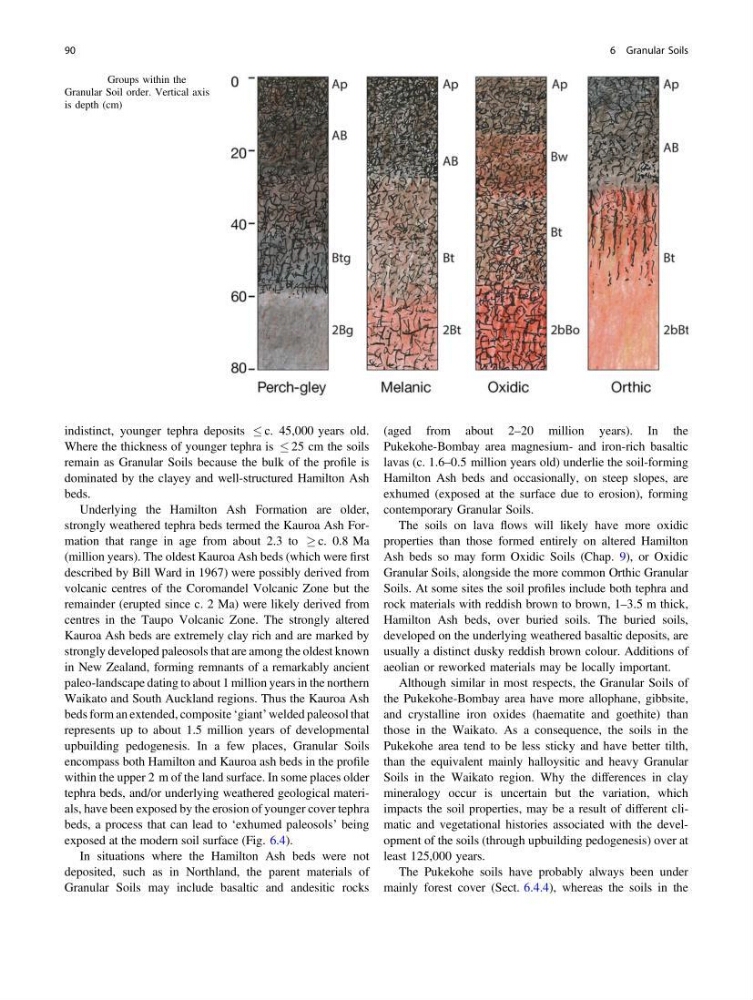
Fig. 6.3 Groups within the
Granular Soil order. Vertical axis
is depth (cm)
90
6 Granular Soils
Where the thickness of younger tephra is 25 cm the soils
remain as Granular Soils because the bulk of the profile is
dominated by the clayey and well-structured Hamilton Ash
beds.
Underlying the Hamilton Ash Formation are older,
strongly weathered tephra beds termed the Kauroa Ash Formation that range in age from about 2.3 to c. 0.8 Ma
(million years). The oldest Kauroa Ash beds (which were first
described by Bill Ward in 1967) were possibly derived from
volcanic centres of the Coromandel Volcanic Zone but the
remainder (erupted since c. 2 Ma) were likely derived from
centres in the Taupo Volcanic Zone. The strongly altered
Kauroa Ash beds are extremely clay rich and are marked by
strongly developed paleosols that are among the oldest known
in New Zealand, forming remnants of a remarkably ancient
paleo-landscape dating to about 1 million years in the northern
Waikato and South Auckland regions. Thus the Kauroa Ash
beds form an extended, composite ‘giant’ welded paleosol that
represents up to about 1.5 million years of developmental
upbuilding pedogenesis. In a few places, Granular Soils
encompass both Hamilton and Kauroa ash beds in the profile
within the upper 2 m of the land surface. In some places older
tephra beds, and/or underlying weathered geological materials, have been exposed by the erosion of younger cover tephra
beds, a process that can lead to ‘exhumed paleosols’ being
exposed at the modern soil surface (Fig. 6.4).
In situations where the Hamilton Ash beds were not
deposited, such as in Northland, the parent materials of
Granular Soils may include basaltic and andesitic rocks
(aged from about 2–20 million years). In the
Pukekohe-Bombay area magnesium- and iron-rich basaltic
lavas (c. 1.6–0.5 million years old) underlie the soil-forming
Hamilton Ash beds and occasionally, on steep slopes, are
exhumed (exposed at the surface due to erosion), forming
contemporary Granular Soils.
The soils on lava flows will likely have more oxidic
properties than those formed entirely on altered Hamilton
Ash beds so may form Oxidic Soils (Chap. 9), or Oxidic
Granular Soils, alongside the more common Orthic Granular
Soils. At some sites the soil profiles include both tephra and
rock materials with reddish brown to brown, 1–3.5 m thick,
Hamilton Ash beds, over buried soils. The buried soils,
developed on the underlying weathered basaltic deposits, are
usually a distinct dusky reddish brown colour. Additions of
aeolian or reworked materials may be locally important.
Although similar in most respects, the Granular Soils of
the Pukekohe-Bombay area have more allophane, gibbsite,
and crystalline iron oxides (haematite and goethite) than
those in the Waikato. As a consequence, the soils in the
Pukekohe area tend to be less sticky and have better tilth,
than the equivalent mainly halloysitic and heavy Granular
Soils in the Waikato region. Why the differences in clay
mineralogy occur is uncertain but the variation, which
impacts the soil properties, may be a result of different climatic and vegetational histories associated with the development of the soils (through upbuilding pedogenesis) over at
least 125,000 years.
The Pukekohe soils have probably always been under
mainly forest cover (Sect. 6.4.4), whereas the soils in the
Fig. 6.3 Groups within the
Granular Soil order. Vertical axis
is depth (cm)
90
6 Granular Soils